Partial Amendment to Enforcement Decree of Fundraising Act Passed at Cabinet Meeting
Expansion of Fundraising Scope and Promotion of Donation Purpose Changes
Donations Possible for 'Low Birthrate and Aging' Purposes Beyond Disasters
Acceptance via Account Deposit, ARS, and Courier Also Allowed
From now on, donations can be made using stocks, cards, points, and gift certificates. This is due to the revision of related laws to promote a culture of donation, allowing donations not only for charity or disaster relief purposes but also for addressing low birth rates and aging population issues.
On the 16th, the Ministry of the Interior and Safety announced that the partial amendment of the "Enforcement Decree of the Act on the Collection and Use of Donations (Donation Act Enforcement Decree)" containing these details passed the Cabinet meeting and will be enforced from the 31st.
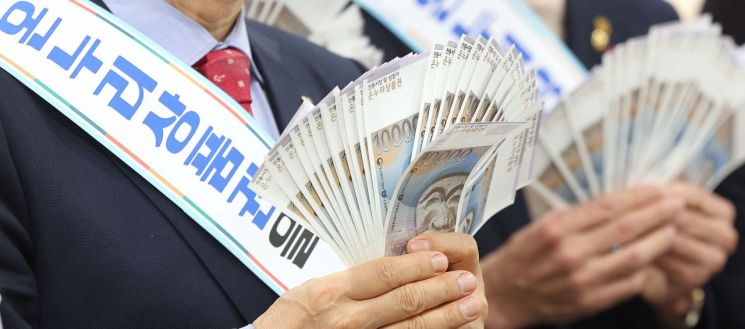
This amendment to the enforcement decree reflects the provisions delegated by the revised "Donation Act" in January, including ▲expansion of the scope of donation items ▲addition of donation purposes beyond those specified in the law ▲additional information to be posted and provided when collecting donations ▲establishment and operation of an integrated donation management system.
First, to promote a culture of donation, securities with monetary value that can be transferred, in addition to cash and goods, have been added to the scope of donation items. Representative examples include listed stocks, prepaid electronic payment methods, electronic money, prepaid cards, and various gift certificates. Donations can now be made in the form of ○○Pay, ○○Points, ○○Money, gift cards, T-money cards, book and cultural gift certificates, and department store gift certificates.
In such cases, donation collecting organizations can negotiate with card companies and other issuers to add the name of the collecting organization to the list of donation destinations where the points can be donated. Donors can also access the issuer’s website or application (app) and donate card company points, etc., to the collecting organizations through the donation menu.
The scope of donation activities has also been expanded. In addition to the purposes specified in the law such as charity, disaster relief, and international aid, the range of donation purposes now includes promoting employment for workers, addressing low birth rates, aging population, population decline, and regional extinction, allowing donation activities to be conducted for solving and supporting core national tasks. Furthermore, a basis has been established to hold events such as commemorative ceremonies, research presentations, encouragement of meritorious persons and organizations, and education and promotion to activate the donation culture during Donation Day and Donation Week.
Transparency in donation fund management will also be improved. In addition to the matters stipulated by law, the information to be posted and provided by collectors at collection sites now includes the target amount, collection period, and usage period, enabling donors to know relevant information before donating. Additionally, the donation methods have changed. While the principle is to accept donations in public places, to diversify acceptance channels, methods such as automatic response telephone (ARS) and mail or logistics services (courier) have been added alongside account deposits and information and communication network reception stipulated by law. This will enable collectors and registration offices to handle related tasks efficiently and is expected to enhance the transparency of donation fund management.
Minister of the Interior and Safety Lee Sang-min said, "With this amendment to the enforcement decree, donation funds will be managed more transparently, and diverse and easier donations will be possible, strengthening the institutional foundation for making a culture of donation a daily practice." He added, "We will strive to ensure that donations not only become a warm gesture thinking of neighbors but also act as a driving force for solving national challenges such as low birth rates, aging population, population decline, and regional extinction."
© The Asia Business Daily(www.asiae.co.kr). All rights reserved.

















