National Forensic Service Emphasizes Driver Fault
Controversy Continues Over EDR Analysis Results
Despite the National Forensic Service's (NFS) conclusion placing weight on driver fault in the 'Sicheong Station reverse driving accident,' voices questioning the analysis results continue unabated. Given that there has never been a case where sudden unintended acceleration was recognized through Event Data Recorder (EDR) analysis, there are calls for urgent alternatives to clarify the cause of the accident.
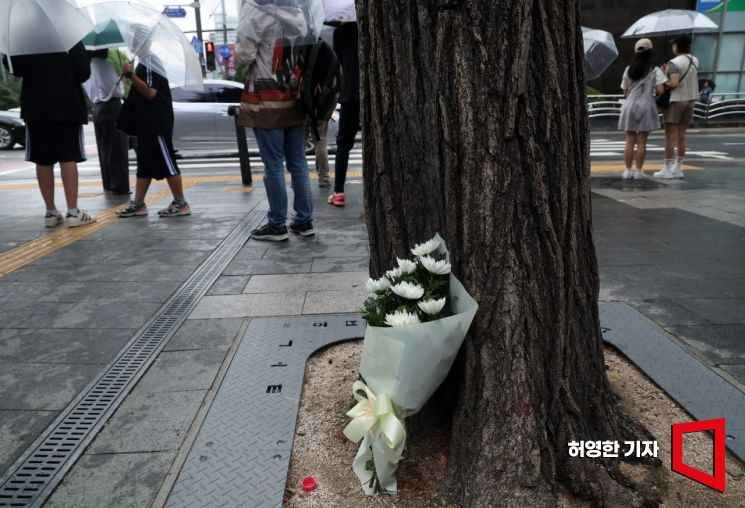 On the night of the 1st, near Seoul City Hall, a passenger car drove in the wrong direction at an intersection and struck pedestrians, resulting in 9 deaths. On the morning of the 2nd, someone placed chrysanthemums near the accident site. Photo by Heo Younghan younghan@
"EDR Analysis Lacks Credibility"
On the 15th, Cho Ji-ho, Commissioner of the Seoul Metropolitan Police Agency, stated at a regular press briefing held at the Jongno District Office in Seoul, "On the 11th, the NFS released an investigation result emphasizing driver fault," adding, "I believe it is very close to the substantive testimony. Although it is difficult to disclose specific details, based on this result, once we receive the driver's statement, we expect to conclude the investigation into the accident." He continued, "We plan to verify whether the driver's statement aligns with the NFS investigation results once the driver recovers his health."
On the 2nd, the NFS received the Genesis G80 vehicle driven by driver Mr. Cha (68) and the EDR from the police and began a detailed inspection and appraisal. On the 11th, the NFS notified the police that Mr. Cha had pressed the accelerator pedal (gas pedal) more than 90% at the time of the accident and suggested a high possibility of pedal malfunction.
Commissioner Cho said, "The rear lights that were on at the time of the accident are presumed not to be due to braking but caused by 'diffuse reflection,' where external light is projected onto the rear lights, or by an electronic defect causing a momentary flicker on the vehicle body," adding, "Moreover, decisive evidence was found in unexpected places."
However, among netizens and experts, opinions that "the appraisal results cannot be trusted" still persist. This is because, despite numerous claims of sudden unintended acceleration, there has never been a precedent recognizing vehicle defects by manufacturers. Each time, courts have accepted the NFS's EDR analysis results at the time of the accident as decisive evidence.
Voices questioning the credibility of EDR results have continued. For example, in December 2022, when a vehicle driven by a grandmother carrying her grandson in Gangneung, Gangwon Province, suddenly surged forward, resulting in the death of the grandson Lee Do-hyun, the possibility of 'sudden unintended acceleration' gained momentum. However, the NFS concluded 'pedal misoperation' through EDR analysis. Later, during accident reenactment experiments, results differed entirely from the EDR data, sparking controversy over the NFS analysis.
In response, netizens on major domestic automotive communities and online platforms expressed disbelief in the NFS judgment, saying things like, "Isn't it already known that EDR can't detect sudden unintended acceleration?" and "When have you ever seen sudden unintended acceleration recorded on EDR?"
Experts also pointed out that EDR lacks credibility as evidence in actual sudden unintended acceleration cases. Professor Kim Pil-su of Daelim University’s Department of Automotive Engineering said, "Simply put, it's like accepting testimony from a dementia patient or someone with a mental illness as evidence. When sudden unintended acceleration occurs, the vehicle's software, algorithms, and everything else are all damaged. How can we trust the EDR results recorded under such conditions?"
Researcher Lee Hang-gu of the Korea Automotive Technology Institute also said, "There is almost no way to prove software defects," adding, "It was somewhat expected that the NFS would announce driver fault."
Reluctance Toward Mandatory Installation of 'Pedal Black Boxes'
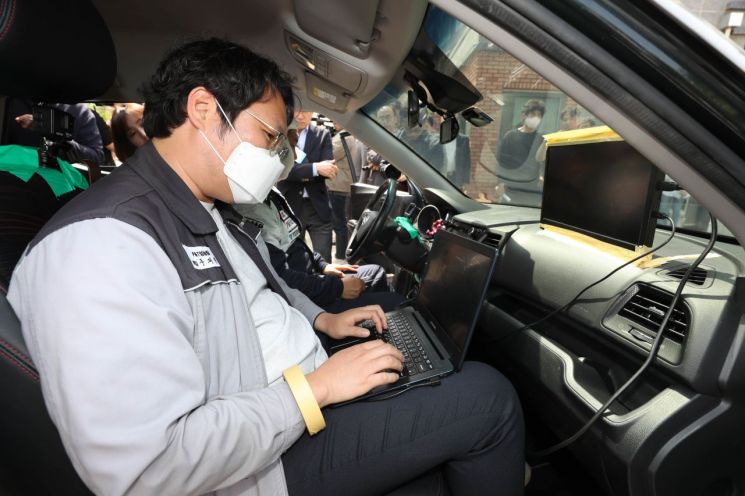 A sudden unintended acceleration reenactment test is being conducted to determine whether sudden acceleration occurred in the suspected sudden acceleration incident that took place in Gangneung, Gangwon Province.
 [Photo by Yonhap News]
As sudden unintended acceleration controversies repeat, calls for more accurate methods to verify the truth, such as 'pedal black boxes,' are gaining traction. A pedal black box is a device that records the driver's foot movements in real time, indicating whether the accelerator or brake pedals are being used.
Discussions on this issue are also emerging in the political arena. On the 8th, Lee Heon-seung, a member of the People Power Party, introduced a bill to amend the Automobile Management Act, mandating the installation of pedal black boxes. The bill requires new or imported vehicles to be equipped with black boxes, with violations punishable by up to three years in prison or fines up to 30 million won.
However, despite such discussions, the government and related parties generally expressed skepticism about mandating pedal black box installation. On the 10th, at a plenary session of the National Assembly Land, Infrastructure and Transport Committee, Minister of Land, Infrastructure and Transport Park Sang-woo said, "Personally, I am considering installing a pedal black box in my own car," but drew a line by stating, "Legally mandating it could cause various regulatory issues."
Experts also pointed out that mandatory pedal black box installation is unrealistic. Professor Kim said, "In Europe, vehicle black boxes are outright banned due to privacy concerns. Forcing domestic manufacturers to install pedal black boxes would obviously cause problems with vehicle exports and imports," advising, "The government should filter high-quality products among pedal black boxes produced by small and medium enterprises through quality certification and encourage voluntary installation by offering incentives in collaboration with insurance companies for vehicles equipped with pedal black boxes."
© The Asia Business Daily(www.asiae.co.kr). All rights reserved.
![Clutching a Stolen Dior Bag, Saying "I Hate Being Poor but Real"... The Grotesque Con of a "Human Knockoff" [Slate]](https://cwcontent.asiae.co.kr/asiaresize/183/2026021902243444107_1771435474.jpg)


















