The guided rocket "Bigung," developed by LIG Nex1, achieved a 100% hit rate in a live-fire test in the United States, successfully passing the final evaluation.
On the 15th, LIG Nex1 announced that its 2.75-inch guided rocket "Bigung (Poniard)" hit all six targets during the final launch of the FCT (Foreign Comparative Testing) conducted in the waters off Hawaii, USA, on the 12th local time. The FCT is a program run by the U.S. Department of Defense to evaluate technologies from allied defense companies worldwide and connect them to U.S. development and acquisition projects.
This live-fire test, conducted during the Rim of the Pacific Exercise (RIMPAC), was based on a scenario established by the South Korean and U.S. navies for future unmanned operations. It marks the first case in both Korea and the United States where the entire process, including "unmanned target detection by aerial drone, satellite communication, and launch of guided rockets from unmanned surface vessels," applied unmanned concepts throughout.
"Bigung," which was deployed by the Korean Marine Corps in 2016, was developed as a vehicle-mounted weapon system to strike North Korean hovercraft and similar threats. LIG Nex1 independently developed a 2.75-inch guided rocket launcher compatible with small unmanned surface vessels for export purposes.
LIG Nex1 plans to use the know-how gained from this test to pursue standardization and modularization, aiming to enhance the agility of domestic unmanned surface vessels during operational missions. Through these efforts, they expect to move closer to the Navy Sea Ghost concept, the future strategy of the Korean Navy.
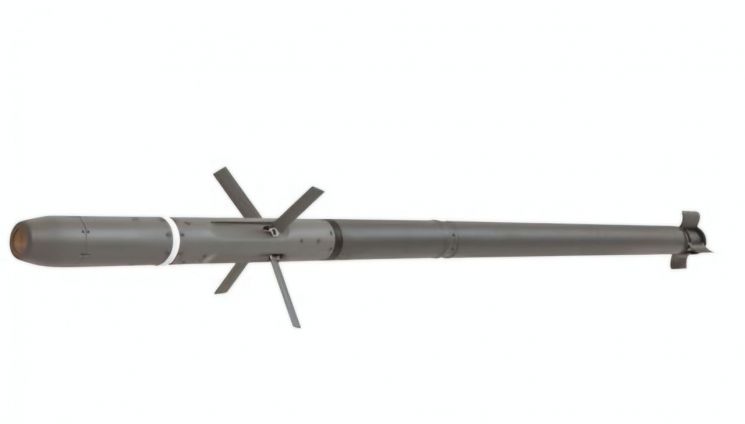
Since being designated as a target system for the U.S. FCT program in 2019, Bigung has maintained a perfect hit rate with zero errors up to this final test.
The first FCT test in 2019 focused on verifying the missile's performance, and from 2020, development of a launch system for small vessels tailored to U.S. military requirements continued. The subsequent second phase of FCT was divided into four stages, conducted in Korea and the U.S. locations of Key West, San Diego, and Hawaii.
During the final FCT firing test, U.S. Chief of Naval Operations Lisa Franchetti visited the Korean amphibious ship Cheonjabong, which was conducting the Bigung FCT near Hawaii by helicopter. She emphasized, "It is of great significance for both countries that Korea and the U.S. are jointly preparing and training with next-generation weapon systems," expressing the U.S. Navy's interest and expectations for Bigung.
LIG Nex1 explained that integrating Bigung, operated as a ground-launched system by the Korean military, into a launch system mounted on Textron's unmanned surface vessel and verifying its maritime operability required significant time and effort.
The military and related agencies played a crucial role in developing and evaluating the maritime platform launch system using unmanned surface vessels. In addition to LIG Nex1's in-house development, the Defense Acquisition Program Administration planned the weapon system modification project, and related projects were promoted through the Agency for Defense Development, enabling development in the form desired by the U.S. The Agency for Defense Development not only oversaw the initial development of Bigung but also handled firing test planning and provided various technical supports for the guided rocket.
Furthermore, without the support of the Navy, smooth progress of the Bigung FCT in the U.S. would have been impossible. The 4,900-ton amphibious ship Cheonjabong transported the Bigung launcher and the U.S. unmanned surface vessel to U.S. waters in the Pacific and supported the evaluation in close cooperation with the U.S. Navy.
During the FCT program, LIG Nex1 met the demanding requirements of the world’s most powerful navy, the U.S. Navy. Developed to counter threats such as North Korean hovercraft landings and high-speed boats, Bigung has drawn attention since its deployment in 2016 for its excellent performance, including seeker and guidance control systems, and outstanding cost-effectiveness.
An LIG Nex1 official who participated in the local evaluation stated, "The FCT is a process for the U.S. to test weapon systems it does not possess, so the requirements from the U.S. Navy were extremely demanding. We take great pride in successfully completing the test with a 100% hit rate." He added, "The fact that our military actually operates Bigung on the front lines was a decisive factor in building trust."
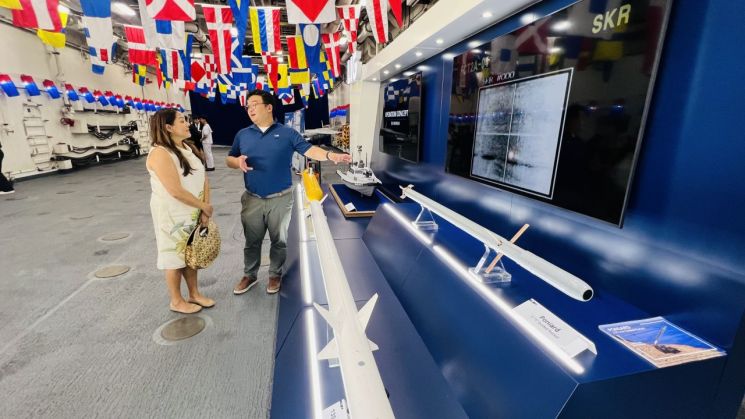
Based on the successful completion of this test launch, LIG Nex1 plans to focus on signing export contracts with the U.S. and actively expanding into global markets. Since October last year, LIG Nex1 has initiated requirement activities with the U.S. Navy and is pursuing commercialization in line with the unmanned operational concepts under review by the U.S. Navy. Although steps such as requirement establishment, budget allocation, and contract verification remain before an actual contract, the company is committed to achieving the milestone of the first-ever export of a Korean guided weapon to the United States.
If the U.S. export is successful, demand for LIG Nex1’s proven weapon systems is expected to increase significantly not only among U.S. allies but also worldwide, and the company plans to focus on developing various platforms tailored to the security environments of each country.
Based on the medium-sized reconnaissance unmanned surface vessel (Haegum) platform developed by LIG Nex1, various mission equipment including Bigung can be mounted. Currently, after proposing an export model to the Middle East, detailed negotiations are underway, raising expectations that another star export item for K-defense will emerge.
Shin Ikhyun, CEO of LIG Nex1, who led the final evaluation in the U.S., commented, "In just half a century, we have laid the foundation to export guided weapons to the United States, a country that was once barren for the defense industry."
CEO Shin also remarked, "This success is the result of the combined efforts and aspirations of our government, military, institutions, and industry for achieving self-reliant national defense and the growth of K-defense," highlighting the significance of the FCT evaluation's success.
© The Asia Business Daily(www.asiae.co.kr). All rights reserved.
![Clutching a Stolen Dior Bag, Saying "I Hate Being Poor but Real"... The Grotesque Con of a "Human Knockoff" [Slate]](https://cwcontent.asiae.co.kr/asiaresize/183/2026021902243444107_1771435474.jpg)

















