A possibility to reduce the occurrence of PTSD by suppressing excessive memory formation, which causes post-traumatic stress disorder (PTSD), has been suggested in South Korea.
The human brain forms and extinguishes new memories daily through various experiences. The memory formation process takes place in a brain region called the hippocampus, where positive and negative signals balance each other to maintain optimal memory formation.
However, if positive regulatory factors are insufficient, problems arise in memory formation, and if negative regulatory factors are impaired, excessive memories are formed. The latter (excessive memory formation) is known to cause mental disorders such as PTSD.
On the 15th, KAIST announced that Professor Huh Won-do’s research team from the Department of Biological Sciences identified a new mechanism regulating memory formation in the brain and revealed a new molecular mechanism of mental disorders caused by excessive memory formation such as PTSD.
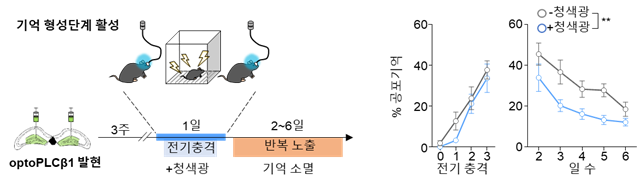 Data showing the numerical increase and decrease of spatial fear memory responses observed when activating the protein (PLCβ1) during the memory formation stage. Provided by KAIST
First, the research team was the first in the world to demonstrate that the protein PLCβ1 acts as a memory suppressor in the hippocampus, playing a role in suppressing excessive memory formation.
The protein is a representative intracellular signaling molecule enzyme activated by various brain neurotransmitters. The research team elucidated the function of this protein, which plays an important role in regulating memory formation and extinction, and contributed to revealing a new molecular mechanism of mental disorders caused by excessive memory formation such as PTSD.
In experiments, mice deficient in the protein showed increased excessive memory formation and fear responses, whereas mice with overexpression or optogenetic activation of the protein exhibited suppressed excessive fear responses. This indicates that the protein plays an important role in the early stages of memory formation and induces appropriate memory formation.
In particular, the research team developed optogenetic technology controlled by light and succeeded in precisely regulating the function of the protein. This technology can activate or deactivate specific proteins using light, allowing precise control of neural activity occurring in specific brain regions.
Through this, the research team opened the possibility that optogenetic technology can not only advance neuroscience research but also serve as an innovative therapeutic tool while elucidating the causes of mental disorders such as PTSD.
Professor Huh Won-do said, "This study is meaningful in that it revealed that the protein plays an important role in the early stages of memory formation in the hippocampus and suggested new therapeutic possibilities for mental disorders such as PTSD," adding, "Above all, the research team laid the foundation to develop a method to suppress excessive fear memory formation by precisely regulating the function of the protein."
However, he added, "Further clinical research is needed to determine whether the research results can be applied to actual treatment, how protein signal suppression affects other brain functions, and whether it is applicable to humans."
Meanwhile, this research was conducted with support from the Ministry of Science and ICT’s Mid-career Research Program and the KAIST Global Singularity Program.
© The Asia Business Daily(www.asiae.co.kr). All rights reserved.
![Clutching a Stolen Dior Bag, Saying "I Hate Being Poor but Real"... The Grotesque Con of a "Human Knockoff" [Slate]](https://cwcontent.asiae.co.kr/asiaresize/183/2026021902243444107_1771435474.jpg)















