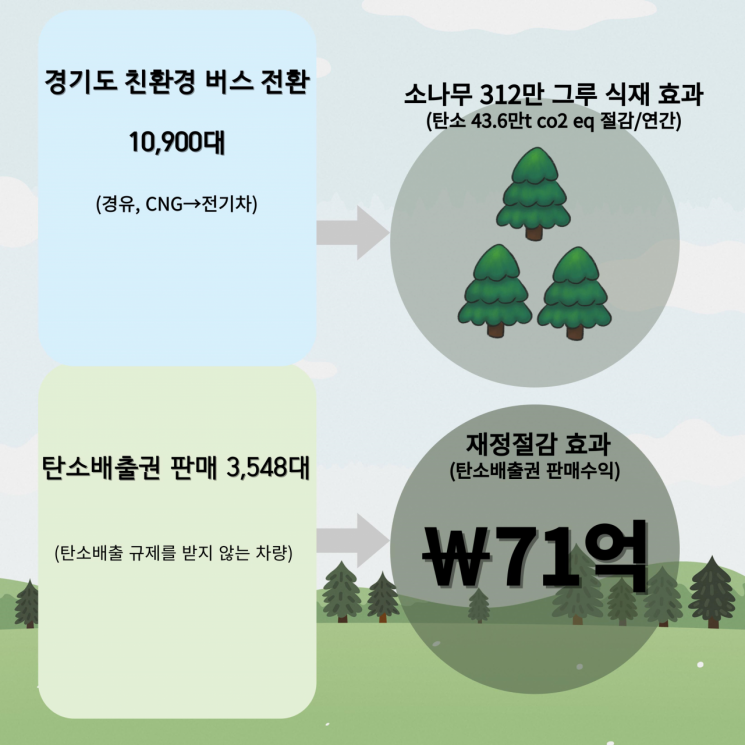
 Poster on 'Carbon Reduction Effect of Eco-friendly Bus Conversion' and 'Fiscal Savings Effect of Carbon Emission Trading Activation' in Gyeonggi-do
Gyeonggi Province will convert all 8,000 city buses within the province to eco-friendly vehicles such as electric buses by 2033. Additionally, it will promote a carbon emissions trading activation project.
On the 15th, Gyeonggi Province announced the "Carbon Neutrality Implementation Plan through Eco-friendly Bus Conversion," which aims to replace all city buses in the province with eco-friendly vehicles by 2033 as part of the "Gyeonggi RE100" transportation sector policy.
According to the announced plan, out of 10,900 city buses, 8,131 diesel and CNG (Compressed Natural Gas) buses (76%), which emit relatively high greenhouse gases, will be sequentially replaced with eco-friendly buses over the next nine years.
According to the Korea Environment Corporation's "Guidelines for Applying Reduction Factors by Local Government Greenhouse Gas Reduction Projects," if 10,900 CNG buses are converted to electric buses, the carbon dioxide equivalent per vehicle will reach 40 tons, resulting in an annual reduction of 436,000 tons of carbon emissions. The Korea Environment Corporation explained that this is equivalent to planting 3.12 million pine trees every year.
Along with replacing vehicles with eco-friendly ones, Gyeonggi Province plans to actively utilize the carbon emissions trading system in its public bus electric bus conversion policy.
The carbon emissions trading system is a scheme where the government allocates carbon emission quotas to companies in advance, and if the emissions are lower than the allocated amount, the excess quotas can be sold on the exchange. However, until now, bus companies and public institutions have shown very little interest in carbon emissions trading.
Therefore, Gyeonggi Province will provide administrative support to ensure active trading by streamlining the application, certification, and sales procedures for carbon emission rights that bus companies can obtain through electric bus conversion.
Gyeonggi Province plans to first expand carbon emissions trading for 3,548 companies within the province that are not subject to the Ministry of Environment's carbon emission regulations. The province estimates that the trading profits for these companies could reach 7.1 billion KRW. This improvement in profitability for bus companies will reduce the need for Gyeonggi Province's "public bus financial support fund." Currently, the province compensates for deficits excluding transportation revenue through financial support.
Kim Sang-su, Director of the Gyeonggi Province Transportation Bureau, stated, "In addition to this eco-friendly bus conversion plan and the carbon emissions trading system, Gyeonggi Province will implement various carbon neutrality policies such as expanding hydrogen buses and economically operating public buses. We will actively explore multiple ways to save public finances, not just relying on fare revenue, by leveraging profits from carbon emissions rights sales."
© The Asia Business Daily(www.asiae.co.kr). All rights reserved.
![Clutching a Stolen Dior Bag, Saying "I Hate Being Poor but Real"... The Grotesque Con of a "Human Knockoff" [Slate]](https://cwcontent.asiae.co.kr/asiaresize/183/2026021902243444107_1771435474.jpg)















