Briefing by Park Heonsu, Head of Samsung Electronics Digital Health Team, on the 11th
Considering E2E for Sleep Apnea and Irregular Heartbeat
Plans to Expand Health Features to Home Appliances like TVs
Samsung Electronics, which unveiled new wearable devices such as the Ring and Watch, announced plans to add nutrition and cardiovascular-related features in future models. The company is also focusing on expanding its wearable portfolio by considering end-to-end (E2E) services that link values monitored by wearable devices with medical institutions.
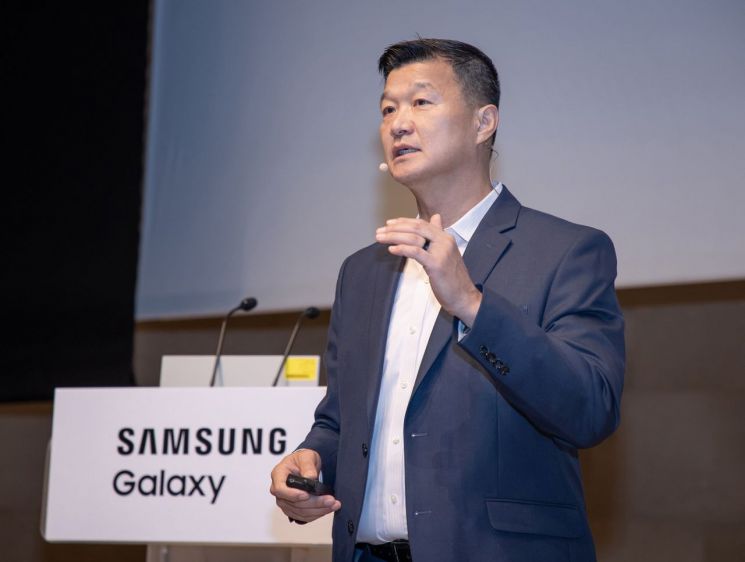 On the afternoon of the 11th (local time), Park Heon-su, head of the Digital Health Team at Samsung Electronics MX Division, introduced Samsung Health's vision for wearable devices such as the Galaxy Watch7, Galaxy Watch Ultra, and Galaxy Ring in Paris, France. Photo by Samsung Electronics
On the afternoon of the 11th (local time) in Paris, France, Park Heon-su, head of the Digital Health team at Samsung Electronics' MX Division, told reporters that when asked if there were any functions he wanted to add to the Galaxy Ring and Watch, "We are thinking about new forms related to nutrition and cardiovascular health," but added, "However, it is difficult to disclose detailed information."
Samsung Electronics held 'Galaxy Unpacked 2024' in Paris, France, on the 10th, unveiling the wearable devices 'Galaxy Ring,' 'Galaxy Watch7,' and 'Galaxy Watch Ultra.' Park’s vision suggests that Samsung plans to further expand its wearable portfolio by increasing the functions that wearable devices can measure.
The Galaxy Watch7 and Galaxy Watch Ultra are the first in the Watch series to offer a measurement function for Advanced Glycation End-products (AGEs). AGEs are one of the health indicators reflecting the user's biological aging process and are significantly influenced by regular diet and lifestyle habits. The watch’s sensor measures AGEs accumulated in the skin to assess the user's health status. According to existing academic research, the correlation coefficient between AGEs and glycated hemoglobin (a glucose-bound hemoglobin whose level increases with high blood sugar) is approximately 0.7.
Park said, "When comparing the measurement accuracy of wearable devices with existing devices, it shows a similar or even higher level." Samsung Electronics is conducting clinical trials focused on the accuracy of these indicators in collaboration with Massachusetts General Hospital.
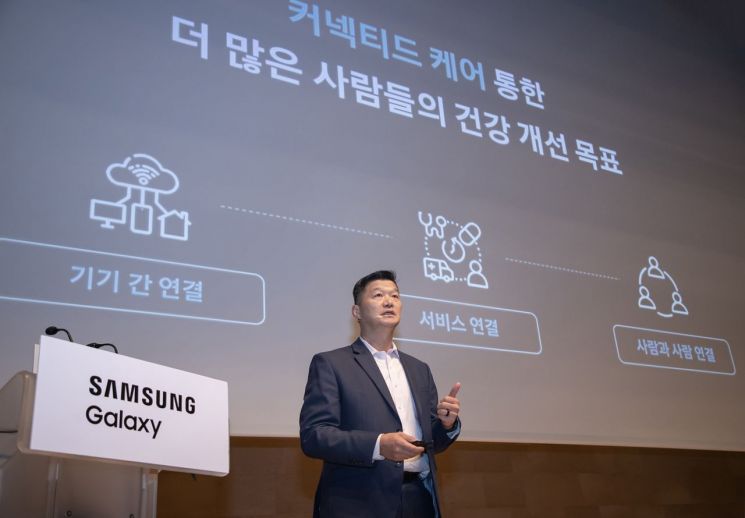 Park Heon-su, head of the Digital Health team at Samsung Electronics MX Division, is explaining the 'Samsung Health Vision' on the afternoon of the 11th (local time) in Paris, France. Photo by Samsung Electronics
The newly provided 'sleep apnea function' in the Watch series is considering linkage with medical institutions beyond simple health diagnosis. Park stated, "Wearable devices do not provide treatment plans for sleep apnea but indicate the possibility of risk," adding, "Final results and alternatives should be confirmed by a doctor." He further added, "In the future, we are also considering follow-up measures such as connecting with other medical institutions and doctors to conduct tests." Treatment plans or diagnostic information related to irregular heartbeat or increased AGEs index may also be linked with medical institutions.
The new Watch series also supports heart health monitoring, measurement of over 100 types of exercises, and female health indicators such as ovulation and menstrual cycle tracking. Although blood glucose measurement was expected to be included, it was not incorporated in this Watch series due to regulatory issues.
The Galaxy Ring focuses on sleep analysis to provide information, considering comfortable wearability. It also offers features such as heart rate alerts, automatic exercise detection, inactivity alerts, and female health indicator measurements. Together with the Watch, it provides the Galaxy AI-based solution support service 'Energy Score,' which comprehensively measures these factors to help users manage their condition.
Wearing the Galaxy Ring and Watch together increases measurement accuracy. Park said, "Using both devices together allows for uninterrupted 24-hour monitoring," adding, "The Watch requires charging and sometimes the sensor is not tightly attached to the wrist, which the Ring can compensate for." According to Samsung Electronics, in this case, battery life can be extended by up to 30%.
Samsung Electronics plans to expand health management support not only through wearable devices but also through home appliances and other products. Park said, "Samsung emphasizes the connection of various home devices," adding, "We have already formed a task force (TF) and are conducting extensive research related to the Internet of Things (IoT) world that connects devices such as TVs and refrigerators, and providing insights based on these connections."
© The Asia Business Daily(www.asiae.co.kr). All rights reserved.
![Clutching a Stolen Dior Bag, Saying "I Hate Being Poor but Real"... The Grotesque Con of a "Human Knockoff" [Slate]](https://cwcontent.asiae.co.kr/asiaresize/183/2026021902243444107_1771435474.jpg)

















