Set at 10,030 won... 1.7% Increase
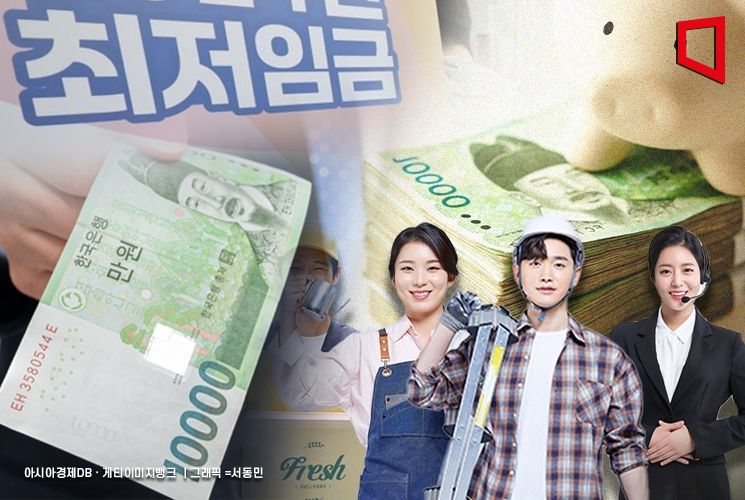
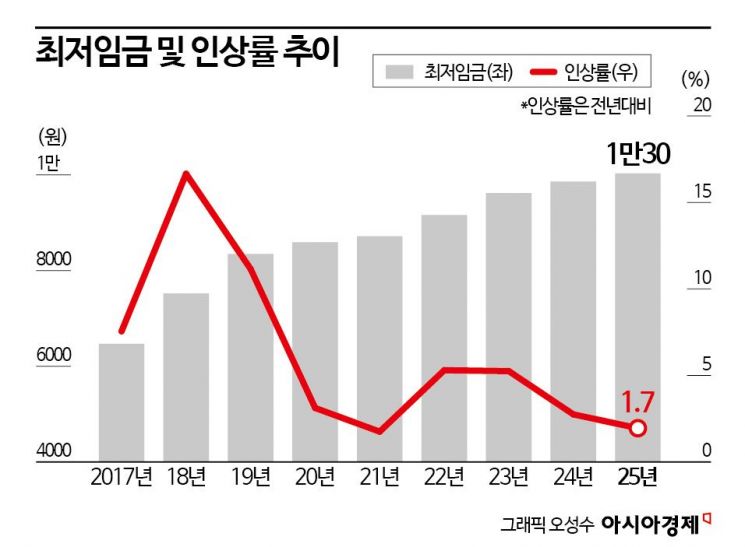
The Minimum Wage Commission has decided the minimum wage for next year to be 10,030 KRW per hour. This is 170 KRW higher than this year's 9,860 KRW, representing a 1.7% increase. Although the minimum wage has surpassed 10,000 KRW for the first time in history, the rate of increase was the second smallest ever, following 2021's 1.5%. This year as well, the minimum wage was determined by voting on the final proposals from labor and management within the standard proposal prepared by the public interest members, without labor-management agreement. Amid severe labor-management conflicts, disrupted deliberations, and physical confrontations recurring again this year, there are calls for a major overhaul of the minimum wage decision-making system.
53 Days of Deliberation... Voting After 12 Hours of Overnight Talks 'Behind the Scenes'
On the 12th, the Minimum Wage Commission held its 11th plenary meeting at the Government Complex Sejong and resolved the minimum wage for next year as stated. After overnight meetings continuing from the previous day, at around 2 a.m., the labor and management sides each presented their final proposals of 10,120 KRW and 10,030 KRW respectively, which were put to a vote. The management proposal received 14 votes, and the labor proposal 9 votes, resulting in the approval of the management's 10,030 KRW. On a monthly basis, this amounts to 2,096,270 KRW (based on 40 hours per week and 209 hours per month).
The Minimum Wage Commission consists of 27 members: 9 worker representatives from labor, 9 employer representatives from management, and 9 public interest members from the government side. However, just before the vote, 4 worker representatives from the Korean Confederation of Trade Unions (KCTU) boycotted the vote in protest against the deliberation facilitation range proposed by the public interest members, resulting in only 23 members participating. Among the 9 public interest members, 4 appeared to have voted for the labor proposal and 5 for the management proposal. Once again this year, the public interest members' votes decided the outcome.
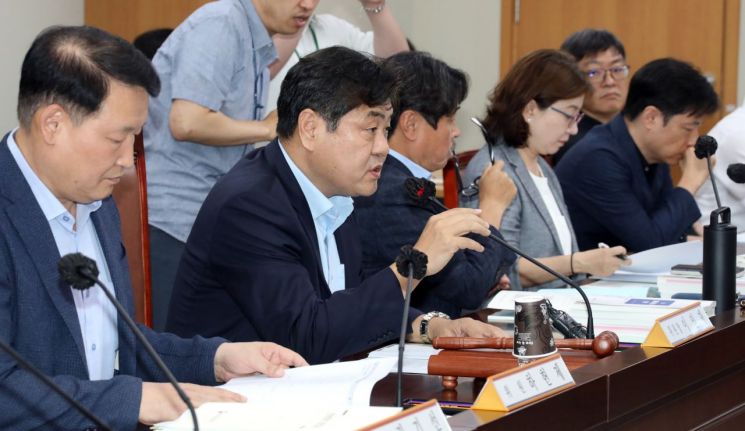
When the meeting began at 3 p.m. the previous day, it was not expected that the minimum wage for this week would be finalized. Discussions had been prolonged due to contentious issues such as sectoral differential application and the introduction of subcontracted minimum wage, with the main debate on the minimum wage amount only starting on the 9th, a week before the deadline. Considering the legal announcement date of the 5th of next month, it was widely expected that one or two more meetings could be held next week, with the final decision likely by the end of next week. However, after the meeting started, four revised proposals were presented, and Chairperson Lee In-jae requested final proposals from labor and management. This was 103 days after the Ministry of Employment and Labor's deliberation request on March 31 and 53 days after the first plenary meeting on May 21.
This Year Also Uses the 'Growth Rate + Inflation Rate - Employment Growth Rate' Formula
The final proposal was based on the 'deliberation facilitation range' suggested by the public interest members. In the minimum wage deliberations that intensified on the 9th, the labor side initially demanded a 27.8% increase to 12,600 KRW per hour, while the management side requested a freeze at 9,620 KRW, showing a large gap. Despite repeated meetings, the gap in the fourth revised proposal reached 900 KRW, prompting labor and management members to request the public interest members to set a deliberation facilitation range. This range is a method where public interest members set upper and lower limits for the minimum wage to help labor and management reach an agreement.
The public interest members proposed a deliberation facilitation range of 10,000 to 10,290 KRW (a 1.4% to 4.4% increase). The lower limit of 10,000 KRW represents a 1.4% increase over this year's 9,860 KRW minimum wage, based on 60% of the median wage of workers and the labor side's final proposal from last year's deliberations. The upper limit of 10,290 KRW is a 4.4% increase over this year, calculated by adding this year's economic growth rate (2.6%) and consumer price inflation rate (2.6%) and subtracting the employment growth rate (0.8%). The average of forecasts from major institutions such as the Ministry of Strategy and Finance, Bank of Korea, and Korea Development Institute (KDI) was used.
Labor-Management-Government 'Consultation Without Consensus' Stigma... Urgent Need for System Reform
Although the minimum wage was decided after much difficulty, the process left numerous records including unprecedented conflicts between labor and management, fueling discussions on system reform. At the meeting held on the 2nd, some labor representatives attempted to block the vote on whether to apply sectoral differentials as requested by management, resulting in incidents where the gavel was snatched and ballots were torn.
Since the Minimum Wage Commission began seriously addressing sectoral differential application in 2016, this year was the first time that physical confrontations occurred during the voting process. The Minimum Wage Commission is a tripartite consultative body of labor, management, and government, but actual consensus-based decisions on the minimum wage have been made only seven times since the system's introduction in 1988. The most recent cases were in 2008 and 2009 during the global financial crisis. Since 2010, there has been no such consensus.
This has led to calls for a fundamental change in the minimum wage system. Currently, labor and management, whose interests sharply conflict, decide key issues such as the minimum wage amount and sectoral differential application within a short period of about two months each year. As a result, labor and management repeatedly engage in intense confrontations and exhausting conflicts based on their interests, while public interest members, influenced by government intentions and pressed for time, resort to hasty votes every year.
Another problem pointed out is the lack of impact analysis or objective formulas in this process. In the past two years (2021?2022), the rate of increase was proposed using a formula adding economic growth rate and inflation rate, then subtracting employment growth rate. This year, the formula was used to set the deliberation facilitation range.
Experts argue that the minimum wage decision formula should be objectified and advanced. Article 4 of the Minimum Wage Act states only that "the minimum wage shall be determined considering workers' living costs, wages of similar workers, labor productivity, and income distribution ratio." Professor Seok Byung-hoon of Ewha Womans University’s Department of Economics pointed out, "In addition to the currently used labor productivity and consumer price indices, a formula reflecting various mechanisms by which minimum wage increases affect macroeconomic variables such as employment and investment should be utilized."
Calls for reform have also been raised within the commission. After the minimum wage decision, Chairperson Lee said, "With the current decision system, there are limits to advancing rational and productive discussions," and added, "I hope the Ministry of Employment and Labor will conduct in-depth discussions and follow-up measures on system reform."
According to the Minimum Wage Act, the commission will submit the approved minimum wage proposal for next year to the Ministry of Employment and Labor. The ministry will finalize and announce the minimum wage by the 5th of next month, with effect from January 1 of next year. Before the announcement, both labor and management can raise objections, and if the ministry deems the objections valid, it can request a re-deliberation by the commission. However, no re-deliberation has ever taken place so far.
© The Asia Business Daily(www.asiae.co.kr). All rights reserved.
![Clutching a Stolen Dior Bag, Saying "I Hate Being Poor but Real"... The Grotesque Con of a "Human Knockoff" [Slate]](https://cwcontent.asiae.co.kr/asiaresize/183/2026021902243444107_1771435474.jpg)













