Warning Signs Presumed by Shamans in Apartment Elevators
Harsh Warnings About Smoking Near Outdoor Units... Actually Very Dangerous
Precautions Needed in Summer When Air Conditioner Usage Surges
A resident suffering from a neighbor's smoking problem posted a fierce warning note in the elevator, which has been made public.
On the 12th, a post titled "The Mudang (shaman) uncle who even advanced to the elevator" along with photos was uploaded to an online community. This resident, presumed to be a shaman, attached a note inside the building's elevator that read, "I am a practicing Mudang. To those smoking near the outdoor unit, please stop before I put a curse on you." It appears to reveal the reality of suffering caused by cigarette smoke.
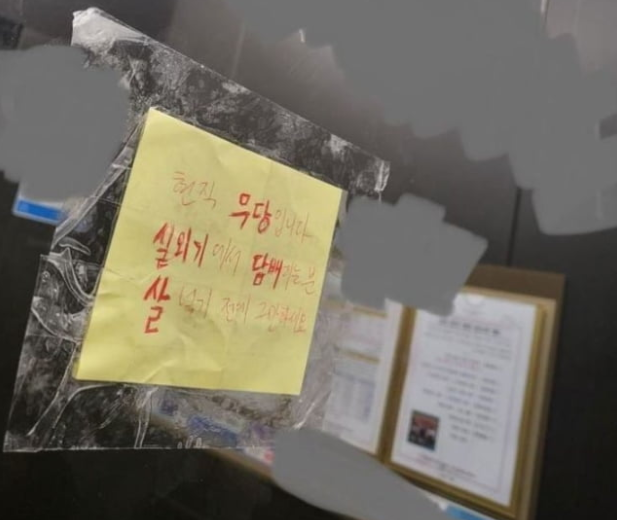
According to the Academy of Korean Studies, Sal (煞) is a religious term referring to a harmful and harsh energy that damages people, living beings, or objects. The concept of Sal from shamanistic beliefs and pungsujiri (Korean geomancy) has spread among the public, leading to common expressions such as ‘sal-i gada’ (sal going), ‘sal-i kkida’ (sal sticking), and ‘sal matda’ (sal hitting). ‘Sal-i gada’ means that something was carelessly touched and unfortunately damaged or broken, indicating the invasion of evil spirits. When everything one does fails, it is believed that ‘sal-i kkyeotda’ (sal has stuck). This is also expressed as ‘sal-i seoda’ (sal standing). Sal-puri (exorcism of Sal) is a ritual performed by a Mudang when it is determined that a person has been affected by Sal from birth or in interpersonal relationships.
Netizens who read the story responded with comments such as, "It must have been really bad for them to do that," "What happens if you get cursed?" and "People who smoke like that never change until they suffer themselves."
Smoking near outdoor units requires caution as it is highly likely to lead to fires during the summer when air conditioner usage surges. Causes of air conditioner fires include electrical factors due to aging wires, heat accumulation from objects piled around the outdoor unit, and sparks caused by dust. Since outdoor units are mostly installed in high places like apartment balconies or narrow spaces between buildings, flames can spread extensively throughout the entire building.
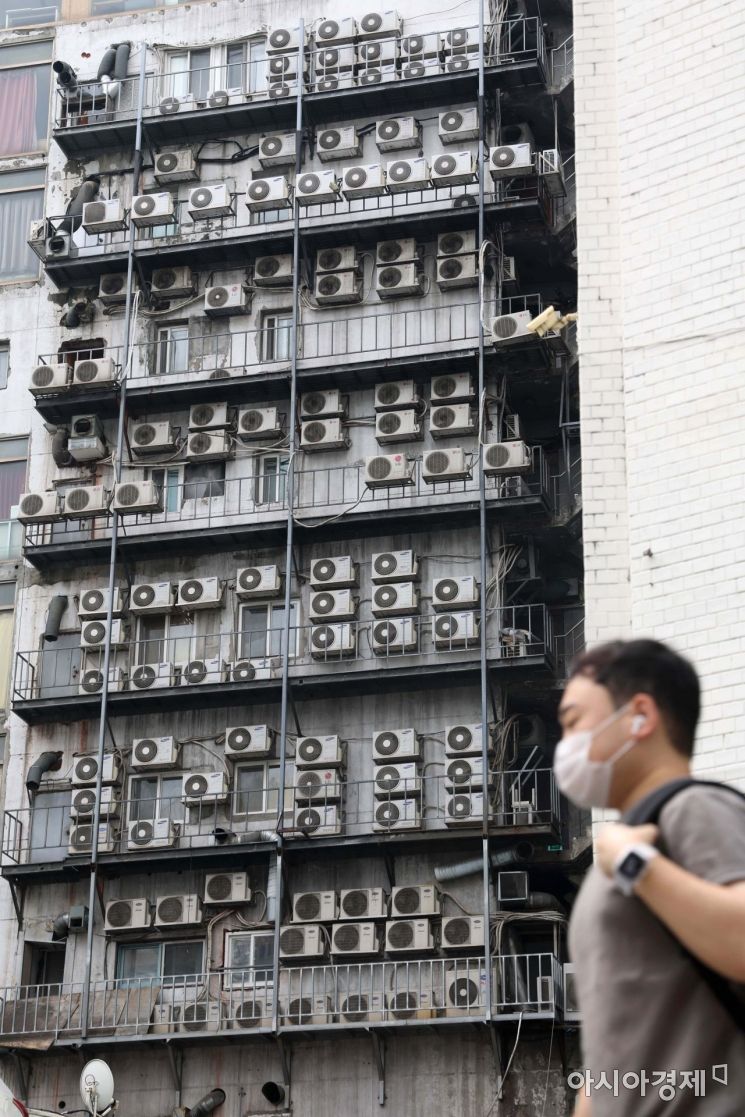 The exterior wall of a building in Jung-gu, Seoul, is filled with outdoor air conditioning units. Photo by Moon Ho-nam munonam@
According to the Jinju Fire Station in Gyeongnam, the biggest cause of air conditioner outdoor unit fires is ignition caused by cigarette butts. There were 13 outdoor unit-related fires in the Jinju Fire Station jurisdiction in 2022 (property damage of 36,488,000 KRW), 19 fires in 2023 (property damage of 33,892,000 KRW, 1 injury), and 4 fires (property damage of 12,112,000 KRW) occurred just by May this year. Among the causes, fires caused by cigarette butts were the most frequent, followed by electrical factors, carelessness, and unattended fire sources.
According to the National Fire Agency, a total of 14,112 apartment fires occurred over the past five years until last year, with 4,018 fires (28.5%) occurring in summer (June to August), which is more than the 3,555 fires (25.2%) in winter (December to February). The National Fire Agency urged, "As air conditioner usage increases, fires frequently occur at outdoor units. It is important to regularly manage them by not placing combustible materials around the outdoor unit and cleaning to prevent foreign substances from acting as ignition sources."
© The Asia Business Daily(www.asiae.co.kr). All rights reserved.
![Clutching a Stolen Dior Bag, Saying "I Hate Being Poor but Real"... The Grotesque Con of a "Human Knockoff" [Slate]](https://cwcontent.asiae.co.kr/asiaresize/183/2026021902243444107_1771435474.jpg)
















