5 out of 9 are left broken and abandoned
Seeking new uses such as onboard restaurants
The Hangang Water Taxi, introduced with the goal of "commuting via the Hangang River" for busy office workers, is reportedly set to be discontinued after 17 years. Seoul City announced plans to completely revamp the Hangang water taxi service into tourism, sightseeing, or floating restaurants, removing its commuting function due to the aging fleet and the near absence of users.
On the 11th, Maeil Business Newspaper reported that according to the "Comprehensive Reform Plan for the Water Tourism Call Taxi Project" prepared by Seoul City's Future Hangang Headquarters, the ferrying function of the Hangang water taxi (crossing rivers or seas) will be abolished. Seoul City explained to Maeil Business Newspaper, "The usage of the water taxi has been extremely low, leading to ongoing external criticism and complaints," adding, "With the future introduction of River Bus, the commuting role of the water taxi is expected to no longer be necessary." The water taxi commuting routes, which operated between Magok, Yeouido, and Jamsil at 5,000 KRW per person, will disappear.
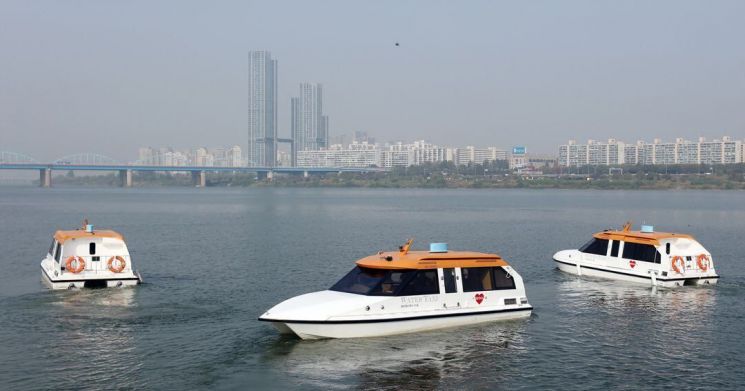 The Hangang Water Taxi, introduced with the goal of "commuting via the Hangang River" for busy office workers, is exiting after 17 years. The Seoul Metropolitan Government announced plans to completely revamp the water taxi service, removing its commuting function and focusing instead on tourism, cruises, and floating restaurants, as the aging service had been largely unused and neglected.
 [Photo by Seoraenaru Hangang Water Taxi]
Since its introduction by Seoul City in 2007, the Hangang water taxi has faced many difficulties. Cheonghaejin Marine, a subsidiary of the Semo Group, stopped operations after the Sewol ferry disaster in 2014, and the service only resumed in 2016 when the operator changed to the Korea Special Mission Veterans Association. However, ridership continued to decline sharply, with only 26 to 32 passengers boarding during commuting hours annually from 2020 to 2023. Even the sightseeing course passengers, who paid 25,000 KRW for routes such as Seoraenaru to Yeouido, Jamsil, and Bamseom (7 courses in total), dropped from 5,017 in 2019 to 881 last year.
Private operators, unable to generate profits from taxi fares, repeatedly offset losses by running some food and beverage facilities like chicken restaurants within the mooring areas (ports where ships stay). Due to lack of investment in facilities, the Hangang water taxi stations are left with only old boats. Out of nine vessels, four are aged and five are broken down. Since the contract with the private operator is valid until 2027, Seoul City plans to specialize the service for tourism using the existing boats. The city will first negotiate with the operator to remodel four old boats by next month and introduce two leisure vessels with capacities of 12 and 32 seats. The five broken vessels are beyond repair and will be scrapped.
The two newly introduced vessels will be used as sightseeing boats for tourists, such as Hangang tours. The leisure vessel, which can accommodate up to 32 people, will be available for corporate seminars, events, or wedding photo shoots.
Seoul City also proposed to the private operator to "build new boats to operate floating restaurants." The plan is to invest 1 billion KRW by July next year to launch a 20-seat sightseeing boat. This model is similar to the "Yakatabune" that cruises the Sumida River in Tokyo, Japan. Yakatabune is a type of dinner cruise where passengers enjoy Tokyo’s night view for about two hours while dining. Although some Hangang sightseeing boats offer food, the Yakatabune-style course meal operated by reservation will be introduced for the first time.
© The Asia Business Daily(www.asiae.co.kr). All rights reserved.
![Clutching a Stolen Dior Bag, Saying "I Hate Being Poor but Real"... The Grotesque Con of a "Human Knockoff" [Slate]](https://cwcontent.asiae.co.kr/asiaresize/183/2026021902243444107_1771435474.jpg)















