'Construction Industry Crisis Diagnosis and Response Strategies' Seminar
Decline in Profitability Due to Increase in Number of Construction Companies and Production Costs
Need for BM Innovation to Overcome Business Area Limitations
Last Year's Construction Industry Operating Profit Margin at 2.5%
General Construction Industry Net Profit Margin Stands at 0.5%
"The domestic construction industry is facing a major crisis due to three highs (interest rates, prices, exchange rates), three lows (productivity, technology, profitability), and three negatives (negativity, distrust, insolvency)." (Professor Lee Bok-nam, Seoul National University)
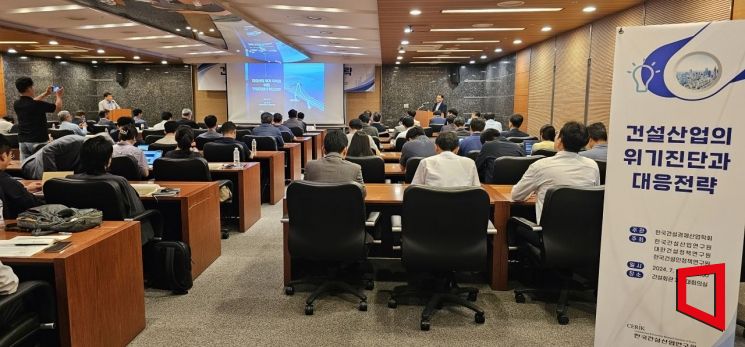
With the continuation of high interest rates and high prices, and the deterioration of productivity and profitability in the construction industry, the management of construction companies is worsening day by day. There have been calls within the construction industry to develop capabilities from the planning stages such as business planning and design, and to innovate business models by exploring new businesses.
On the 11th, the Korea Construction Economy and Industry Association held a seminar titled "Diagnosis of the Construction Industry Crisis and Response Strategies" at the Construction Hall in Nonhyeon-dong, Seoul. This seminar was jointly hosted by the Korea Construction Industry Research Institute, the Korea Construction Policy Research Institute, and the Korea Construction Human Policy Research Institute.
Professor Lee Bok-nam of Seoul National University, who delivered the keynote speech, pointed out, "Changes in the ecosystem of population, industry, and national land that Korean society is facing are greatly affecting construction, leading to difficulties such as labor supply shortages, digital technology challenges, and national land imbalance."
Professor Lee said, "The United States faced similar problems and derived the necessity of construction industry innovation to prevent the negative impacts of deteriorating national infrastructure in transportation, energy, and water resources on people's lives and the economy. While the White House took the lead in establishing national construction goals in the U.S., in Korea, it is necessary for construction associations and organizations to lead with government support."
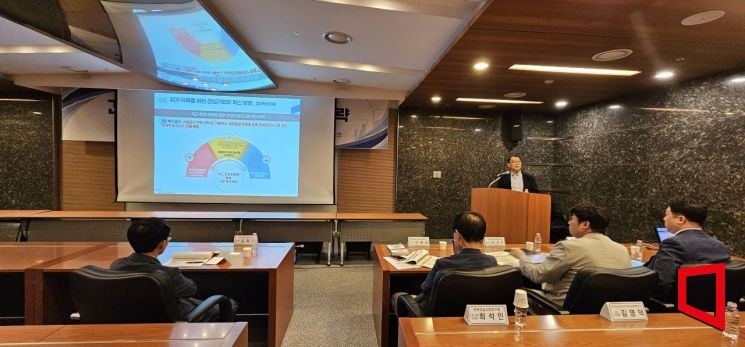 Kim Young-deok, Senior Research Fellow at the Korea Construction Industry Research Institute, is giving a presentation on "Innovation Strategies for Construction Companies to Overcome the Crisis in the Construction Industry."
Senior Research Fellow Kim Young-duk of the Construction Industry Research Institute presented on "Innovation Strategies for Construction Companies to Overcome the Construction Industry Crisis." Kim diagnosed, "As the domestic and international construction markets rapidly shift toward the private sector, the qualitative changes in demand for facilities have intensified. Competition has intensified due to the increase in the number of construction companies, and management is deteriorating due to continuous rises in production costs and declines in productivity."
Senior Research Fellow Kim pointed out, "Efforts to innovate construction technology, which is key to construction productivity and efficiency, are still insufficient. In fact, the number of construction-related technology patent applications is decreasing, and the utilization of digital technology is low. The qualitative decline in manpower due to aging and young people's aversion to the construction industry is also serious."
Kim proposed three major innovation tasks for construction companies: △ strengthening construction project management capabilities and technological innovation △ innovating management systems such as organization and manpower △ innovating construction companies' business models. He said, "To overcome the limitations of business areas, a strategic approach to creating new business models is necessary. Horizontal diversification such as overseas construction markets or high-end housing, vertical diversification such as facility management or eco-friendly materials, and new business creation such as real estate development or environment and energy are possible. It is also important to establish investment resources, professional manpower, and management capabilities in new business areas."
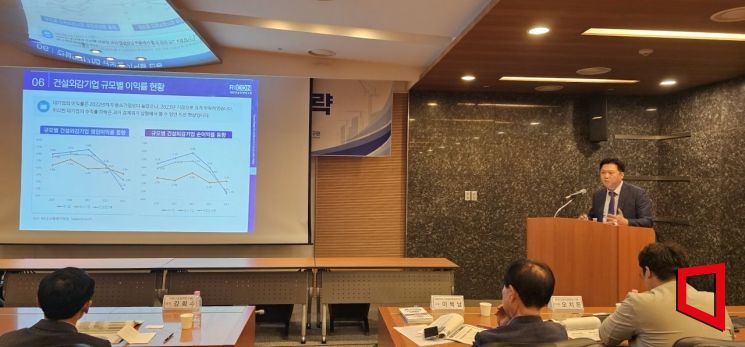 Kim Tae-jun, Head of the New Growth Strategy Research Office at the Korea Construction Policy Institute, is giving a presentation on "Management Status of Construction Companies Subject to External Audit and Strengthening Competitiveness of Specialized Small and Medium Construction Companies through Analysis of Companies in Distress" at a seminar held at the Construction Hall on the 11th.
Kim Tae-jun, Head of the New Growth Strategy Research Office at the Korea Construction Policy Research Institute, presented on "Management Status of Construction Companies Subject to External Audit and Competitiveness Enhancement Measures for Specialized Small and Medium Construction Companies through Analysis of Companies at Risk."
Analyzing the 2023 management performance of construction companies subject to external audit, Kim reported that the operating profit margin fell from 6.0% in 2021 to 2.5% in 2023, and the net profit margin decreased from 4.9% in 2021 to 1.1% in 2023. The net profit margin of general construction companies performing primary contracts was 0.5%, effectively not realizing profits. The debt ratio of the construction industry in 2023 rose by 5.7% from the previous year to 151.1%, far exceeding the overall industry debt ratio of 84.6%.
Kim Tae-jun explained, "With ongoing uncertainty in external variables, the management performance of construction companies will worsen further, and from a mid- to long-term perspective, proactive responses are needed to the entry into the decline phase of the construction industry. Small and medium-sized enterprises and specialized construction companies need to implement profit-centered sales strategies and cost reduction in the short term, and in the mid- to long-term, establish themselves as regionally specialized or technologically specialized companies."
© The Asia Business Daily(www.asiae.co.kr). All rights reserved.
![Clutching a Stolen Dior Bag, Saying "I Hate Being Poor but Real"... The Grotesque Con of a "Human Knockoff" [Slate]](https://cwcontent.asiae.co.kr/asiaresize/183/2026021902243444107_1771435474.jpg)

















