Need to Build Software Ecosystem in AI Era
Cooperate with Domestic Companies of Various Fields and Sizes
Promote Achievements Made in Korea Abroad
"Intel's collaboration with Naver was driven by a shared understanding of the need for an open ecosystem. Based on this, the pursuit of core values became an important background for the cooperation."
Kwon Myung-sook, President of Intel Korea, recently stated this in an interview with Asia Economy at Intel Korea's headquarters in Yeouido, Seoul, explaining the reason for choosing Naver as a partner for AI accelerator development. She emphasized that to enhance responsiveness in the AI era, it is important not to be dependent on specific companies or technologies.
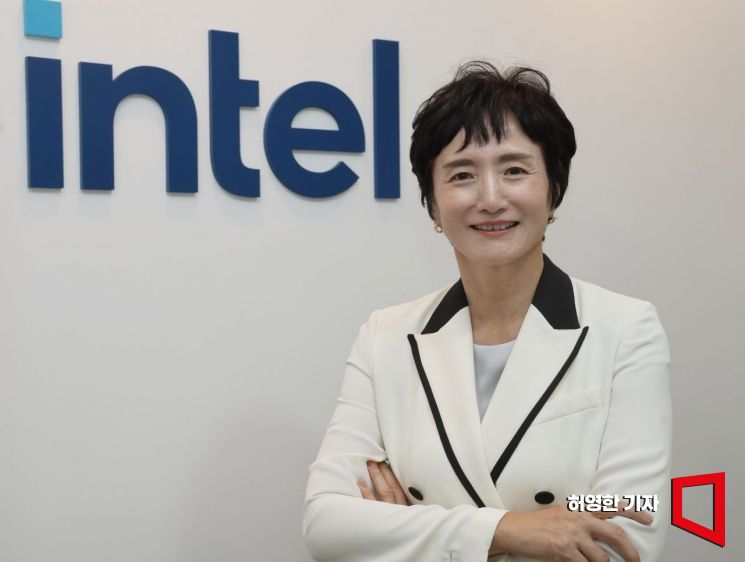
In April, Intel announced plans to create an open ecosystem based on its AI accelerator 'Gaudi' in collaboration with Naver. Due to the high dependence on AI accelerators provided by the US company Nvidia, supply shortages have occurred, causing delays in product availability and price increases. To address these issues, the two companies joined forces. This is the first time the President of Intel Korea has given a media interview since announcing the collaboration with Naver.
The two companies established an AI joint research center to develop open-source-based software in collaboration with institutions such as Seoul National University while testing Gaudi. President Kwon said, "Once software development is complete, it will be released to the open-source ecosystem," adding, "Then other developers or companies can further develop it, leading to innovation." She continued, "By creating a virtuous cycle and activating the open ecosystem while distributing Gaudi, companies can achieve higher efficiency in terms of total cost of ownership (TCO)," emphasizing, "This is why building a software ecosystem is important."
Intel's business model is undergoing significant changes. As an integrated device manufacturer (IDM), it previously focused on PC-centered business but is now diversifying into related products for data centers, networks, automobiles, and even re-entering the foundry (semiconductor contract manufacturing) market. In this process, cooperation cases with Korea are increasing due to the domestic market's advantages of quickly adopting the latest technologies and strong innovation willingness.
President Kwon, a founding member of Intel Korea in 1988 and its president since 2015, leading the company for nine years, said, "When I joined, much of Intel's business was related to PCs. Now, the business portfolio has diversified, and the importance of Korean companies has greatly increased in this process." She added, "We are expanding business not only with existing customers but also with new ones."
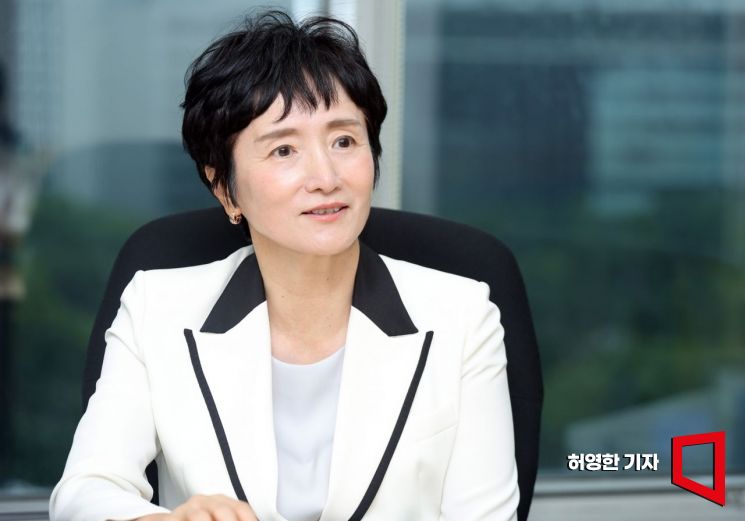 Kwon Myung-sook, President of Intel Korea, is being interviewed by Asia Economy at the Seoul Yeouido office. Photo by Huh Young-han younghan@
Intel is collaborating not only with major domestic companies such as Samsung Electronics, SK Hynix, LG Electronics, and SK Telecom but also with emerging companies like AI startup Upstage. Last year, Intel gained attention by enhancing solutions in the retail sector with Shinsegae I&C, an IT affiliate of Shinsegae. President Kwon explained, "Until a few years ago, there were no joint projects, but AI has led to these collaborations."
Intel plans to actively create opportunities to promote achievements made with domestic companies overseas. President Kwon explained, "Cooperation does not end in Korea; helping companies expand globally is also part of the collaboration."
She expressed her vision, saying, "AI is said to change everything, but ultimately, the agents of AI innovation are people," and added, "We will take a comprehensive approach aimed at improving human life and optimizing benefits."
© The Asia Business Daily(www.asiae.co.kr). All rights reserved.
![Clutching a Stolen Dior Bag, Saying "I Hate Being Poor but Real"... The Grotesque Con of a "Human Knockoff" [Slate]](https://cwcontent.asiae.co.kr/asiaresize/183/2026021902243444107_1771435474.jpg)
















