Bank of Korea's 'June Financial Market Trends'
Bank Household Loans Increase for Third Consecutive Month
Mortgage Loans Show Largest Growth in 10 Months
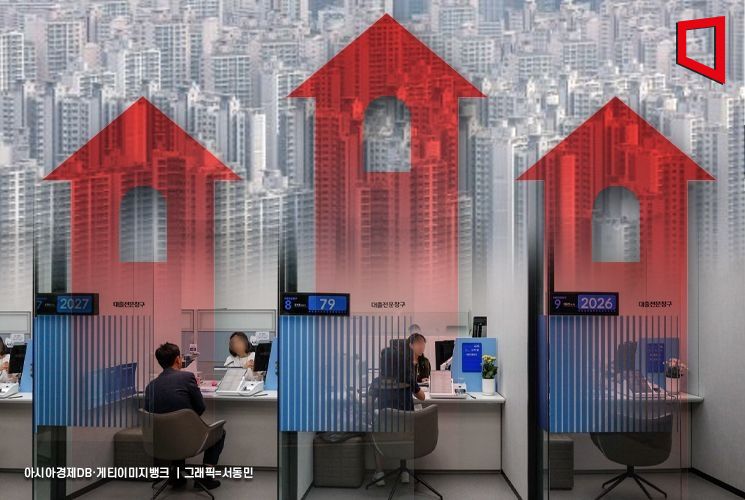
As housing transactions increase mainly in the Seoul metropolitan area, mortgage loans have grown at the fastest rate in 10 months. Bank household loans have been rising for three consecutive months.
According to the "Financial Market Trends in June" released by the Bank of Korea on the 10th, bank household loans (including policy mortgage loans) increased by 6 trillion won compared to the previous month. Bank household loans decreased by 1.7 trillion won in March this year but turned to an increase in April and have been rising for three consecutive months.
Mortgage loans increased at the fastest rate in 10 months since August last year (7 trillion won). The increase in mortgage loans narrowed to 4.9 trillion won in January, 4.7 trillion won in February, and 500 billion won in March this year, but the increase expanded again in April (4.5 trillion won) and May (5.7 trillion won).
Won Ji-hwan, deputy head of the Bank of Korea's Market General Team, explained the increase in bank household loans, saying, "Recently, household loans have been increasing mainly in mortgage loans, but when including direct loans that are part of household credit statistics, the increase was below 6 trillion won, showing a similar pace to the previous month. Across the entire financial sector, the decrease in non-bank loans has expanded, resulting in an increase of around 4 trillion won."
He added, "Since non-bank loans are decreasing while bank loans are increasing, it is necessary to consider the shift in demand from non-bank loans as well."
The Housing and Urban Fund executes loans using fund resources through 'direct loans' and 'secondary interest subsidies.' Direct loans use fund money and therefore are not included in bank loans. On the other hand, when loans are executed through the secondary interest subsidy method, bank household loans increase.
Meanwhile, other loans decreased by 300 billion won, turning to a decline for the first time in three months due to the sale and write-off of non-performing loans at the end of the half-year.
In June, bank corporate loans increased by 5.3 trillion won. Loans to large corporations slightly increased by 700 billion won due to improved business performance and temporary repayments for managing financial ratios at the end of the half-year, narrowing the increase compared to the previous month (1.1 trillion won). Loans to small and medium-sized enterprises increased by 4.6 trillion won, narrowing the increase compared to the previous month (5.8 trillion won) as non-performing loan sales and write-offs proceeded despite continued demand for facility funds from small and medium-sized corporations.
Deputy Head Won said, "On an annual scale, household loans are at a manageable level," but added, "Considering the housing market situation and changes in loan interest rate conditions, upward pressure has somewhat increased, so it is difficult to predict future trends."
He continued, "Housing transactions are increasing mainly in the Seoul metropolitan area, but not in other regions, so there is a differentiated situation by region," and added, "The recent increase in housing transactions is expected to exert upward pressure on household loan volumes in the future with a time lag."
Regarding whether the last-minute demand before the additional stress total debt service ratio (DSR) regulation scheduled for July was reflected, he said, "Since the notice of implementation has been announced for some time, there has been a pre-reflection in the increase of household loans," and evaluated, "The possibility of it acting as an upward factor for bank household loans in the future is minimal."
© The Asia Business Daily(www.asiae.co.kr). All rights reserved.
![Clutching a Stolen Dior Bag, Saying "I Hate Being Poor but Real"... The Grotesque Con of a "Human Knockoff" [Slate]](https://cwcontent.asiae.co.kr/asiaresize/183/2026021902243444107_1771435474.jpg)















