Statistics Korea June Employment Trends
June Employment Increased by Only 96,000
Construction Industry Employment Down by 66,000
Self-Employed Without Employees Down by 135,000
The increase in the number of employed persons last month fell below 100,000 for the second consecutive month. Employment in the construction sector decreased for the second month in a row, and there was a notable sharp decline in self-employed individuals without employees.
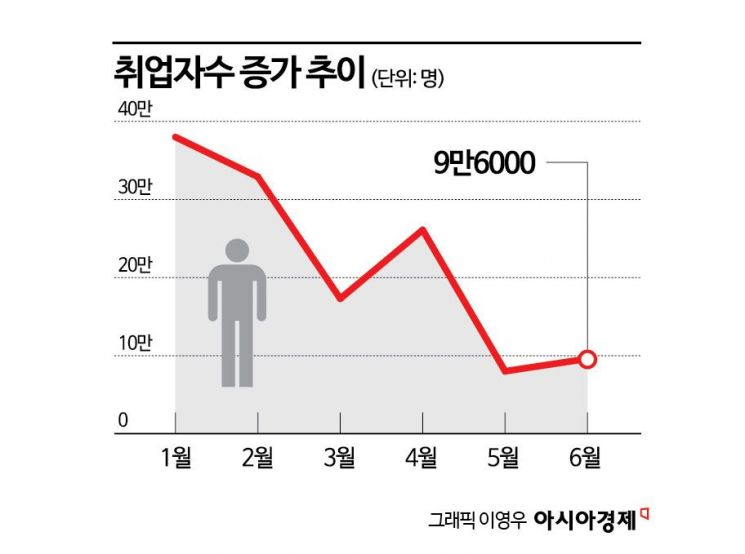
According to the 'June Employment Trends' released by Statistics Korea on the 10th, the number of employed persons aged 15 and over last month was 28,907,000, an increase of 96,000 compared to the same month last year. Following a slowdown to an increase of 80,000 in May, the growth in employment remained below 100,000 for two consecutive months. Excluding the COVID-19 period, the last time employment growth was below 100,000 for two consecutive months was December 2018 and January 2019.
The decrease in employment was particularly pronounced in the construction industry. Employment in construction fell by 66,000, continuing a decline for the second month following a 47,000 decrease in May. Seounju, Director of the Social Statistics Bureau at Statistics Korea, explained, "While factors such as the (early summer) heatwave, which necessitated limiting outdoor activities, had an impact, the downturn is not only due to weather but also reflects a continued sluggishness in the industry itself." Employment also declined in education services (-63,000) and business facility management, business support, and rental services (-62,000). A Ministry of Economy and Finance official said, "The prolonged slump in construction orders seems to have had a significant impact," adding, "This is an area we need to monitor closely going forward."
Self-employed without employees decreased by 135,000 in June
Among non-wage workers, the number of self-employed without employees also sharply declined by 135,000. This group, considered small-scale self-employed, has been decreasing since March (-35,000), continuing through April (-94,000) and May (-114,000). This trend appears to reflect an increase in self-employed individuals ceasing operations due to sluggish domestic demand. Meanwhile, self-employed with employees increased by 34,000.
However, the Ministry of Economy and Finance explained that the decrease in self-employed numbers cannot be attributed solely to weak domestic demand. A ministry official analyzed, "Self-employed individuals are mainly linked to wholesale and retail sectors, and industries more closely related to domestic demand, such as food and accommodation, have seen an increase in employment," adding, "It is difficult to say that the decrease in self-employed numbers is solely due to weak domestic demand."
Employment in manufacturing increased by 9,000, continuing a seven-month growth trend. However, the growth rate has slowed compared to April (100,000) and May (38,000). Director Seo noted, "Although the increase in manufacturing employment is slowing, there are differences by industry," explaining, "Employment has increased in sectors such as automobiles and food products."
By employment status, among wage workers, daily workers decreased by 121,000, expanding the decline from the previous month. In May, daily workers decreased by 116,000. However, regular workers increased by 139,000, significantly more than the 75,000 increase in the previous month. Temporary workers increased by 204,000.
The Ministry of Economy and Finance diagnosed that accumulated base effects and the heatwave influenced these trends. Since the lifting of social distancing in May 2022, employment numbers increased significantly over two years, creating a base effect, and the heatwave during the survey week further constrained employment growth. During the June survey week (9th to 15th), heatwaves occurred in 73 regions for six days, likely limiting employment growth in industries with high outdoor activity.
By age group, employment increased by 258,000 among those aged 60 and over, 91,000 in their 30s, and 2,000 in their 50s. Conversely, employment among the youth population (ages 15?29), which is declining in population, decreased by 149,000, and those in their 40s decreased by 106,000. The employment rate for those aged 15 and over was 63.5%, unchanged from a year ago. This is the highest May employment rate since related statistics began in 1987. The OECD-comparable employment rate for ages 15?64 was 69.9%, also unchanged from a year ago.
The unemployment rate was 2.9%, up 0.2 percentage points from the same month last year. The number of unemployed persons was 857,000, an increase of 50,000 (6.2%) compared to the same month last year. The number of unemployed increased notably among those in their 30s (24,000), 40s (18,000), and those aged 60 and over (17,000).
The economically inactive population was 15,786,000, an increase of 21,000 (0.1%) from a year ago, marking the first increase in 40 months. By gender, the number of inactive males was 5,887,000, up 96,000 (1.7%) from the same month last year, while inactive females numbered 9,899,000, down 74,000 (-0.7%).
© The Asia Business Daily(www.asiae.co.kr). All rights reserved.
![Clutching a Stolen Dior Bag, Saying "I Hate Being Poor but Real"... The Grotesque Con of a "Human Knockoff" [Slate]](https://cwcontent.asiae.co.kr/asiaresize/183/2026021902243444107_1771435474.jpg)















