Ruling Coalition Ensemble Shows Little Seat Difference with Far-Right Party
Left-Wing Alliance NFP Fails to Secure Majority Seats
Macron Requests Incumbent Prime Minister to Retain Premiership
As a result of the early parliamentary elections held in France on the 7th (local time), the far-right party's rise to power was thwarted through an alliance between the left-wing coalition and centrist forces. However, with the three parties securing a similar number of seats, political turmoil is expected to continue.
 Jean-Luc M?lenchon, leader of La France Insoumise (LFI) within the French left-wing coalition, raised both arms high in the air on the 7th (local time) in central Paris after the exit poll results of the second round of the legislative election were announced. In the second round of the French legislative election held that day, the left-wing coalition New Popular Front (NFP) was expected to surpass the far-right party and secure the position of the largest party. Photo by AFP Yonhap News
On the 9th (local time), the leading French media outlet Le Monde analyzed, "President Emmanuel Macron hoped for a 'purge' against the far-right surge through the early elections but ultimately failed, and the political equation, which was already complicated before the dissolution of parliament for the early elections, has now become a situation of despair."
In this election, although falling short of a majority, the left-wing coalition 'New Popular Front' (NFP) secured 182 seats, becoming the largest party in the National Assembly and is preparing to nominate a new prime minister. Meanwhile, President Macron's request to retain the incumbent prime minister has shown signs of escalating conflict between the two sides.
President Macron asked Prime Minister ?lisabeth Borne, who tendered her resignation taking responsibility for the election defeat, to "maintain the prime minister position for the time being for national stability."
Macron's request came amid confusion within the left-wing camp. According to the U.S. political media outlet Politico, the NFP, which consists of four major parties including the far-left party La France Insoumise (LFI), the Socialist Party, the Communist Party, and the Green Party, contested the election without a party leader. This contrasts with the pro-government camp, which put forward the current prime minister Gabriel Attal, and the far-right National Rally (RN), which nominated Jordan Bardella as their leader.
Politico reported that dozens of newly elected left-wing lawmakers are expected to enter the race for the prime minister position. Currently, the most prominent candidate for prime minister is LFI leader Jean-Luc M?lenchon.
LFI holds the largest number of seats among the four parties in the left-wing coalition with 74 seats. If the right to nominate the prime minister is given to LFI, M?lenchon is the most likely candidate to become the next prime minister. However, concerns have been raised even within LFI that if M?lenchon, known for his radical socialist stance, becomes prime minister, social division and political conflict will intensify.
M?lenchon's strong rivals include party competitors and presidential hopeful Fran?ois Ruffin and Cl?mentine Autain, who has taken a critical stance toward M?lenchon.
Other LFI figures mentioned as candidates include Manuel Bompard, parliamentary leader Mathilde Panot, Cl?mence Guett?, and ?ric Coquerel, chairman of the parliamentary finance committee.
Within the Socialist Party, Olivier Faure, the party leader, and Boris Vallaud, the parliamentary leader, could also run for prime minister. Politico identified Vallaud as a leading candidate within the Socialist Party, noting, "Like Macron, he studied at the ?cole Nationale d'Administration (ENA), France's top public administration school, and served as deputy chief of staff at the ?lys?e Palace, similar to Macron."
To avoid inter-party conflicts within the NFP, a non-political candidate might be sought. Among such candidates, Politico reported that Laurent Berger, former chairman of the Democratic French Labor Confederation (CFDT), who is recognized for his ability to build consensus and resolve conflicts across both left and right, is being considered.
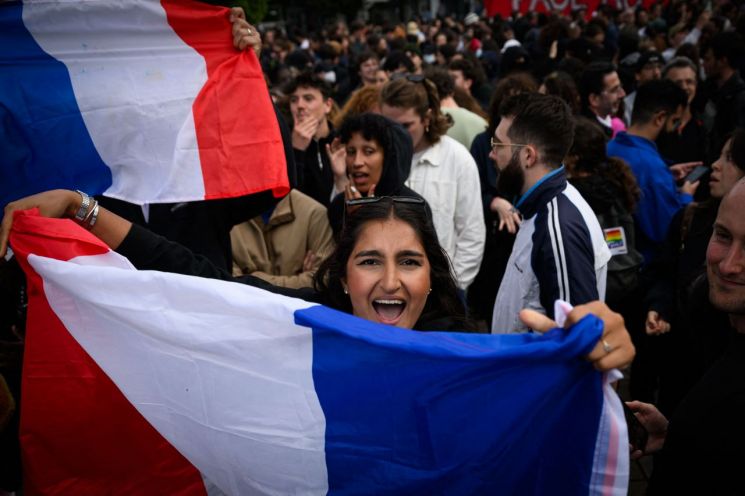 On the 7th (local time), protesters gathered in downtown Nantes, France, holding the tricolor flag and celebrating the results of the second round of the legislative election announced that day. In the second round of the French legislative election held that day, the left-wing coalition New Popular Front (NFP) was expected to secure the first place, surpassing the far-right party. Photo by AFP Yonhap News
Some predict that it may take considerable time before the prime minister is appointed. The U.S. daily The New York Times (NYT) forecasted, "With the Paris Olympics and holiday season approaching, discussions on government formation could be delayed until autumn."
NYT also pointed out, "Although the NFP demanded that President Macron form a government by announcing the prime minister appointment next week, this overlooks the fact that the French constitution grants the president the right to appoint the prime minister, and that the NFP secured the largest party status in the National Assembly thanks to the left and centrists forming an 'anti-far-right front' in this election."
NYT predicted, "President Macron will spend time consulting with various parties to explore coalition possibilities."
It is expected that President Macron will avoid forming a coalition with the far-right RN and the LFI, which has been accused of anti-Semitism, but will seek alliances with moderate left parties including the Socialist Party and the Green Party, as well as the traditional conservative Republicans.
© The Asia Business Daily(www.asiae.co.kr). All rights reserved.
![Clutching a Stolen Dior Bag, Saying "I Hate Being Poor but Real"... The Grotesque Con of a "Human Knockoff" [Slate]](https://cwcontent.asiae.co.kr/asiaresize/183/2026021902243444107_1771435474.jpg)

















