Government Support Enables Establishment and Operation Next Year
Priority Establishment Within Science Creativity Foundation Followed by Independent Operation Goal
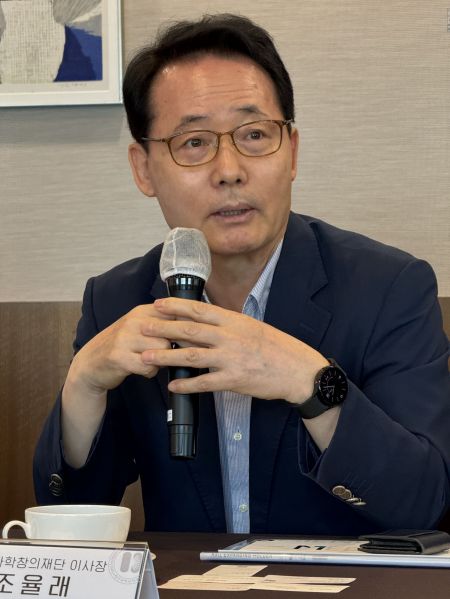 Chairman Jo Yullae of the Science Creativity Foundation is speaking at a press conference on the 9th. Photo by Baek Jongmin
On the 9th, Jo Yullae, Chairman of the Korea Foundation for the Advancement of Science and Creativity, emphasized the urgency of establishing the Science Media Center (SMC) in Korea at a press conference held at the Press Center in Jung-gu, Seoul.
SMC is a science and technology information provision organization that started in the UK in 2002 and is currently operating in seven countries including Australia, New Zealand, Kenya, Taiwan, Germany, and Spain. It plays a role in quickly delivering objective scientists' opinions to the media when science and technology-related issues that could become social issues arise, supporting the public's awareness. In Korea, the establishment is being promoted centered around the Korea Foundation for the Advancement of Science and Creativity.
Chairman Jo cited the case of 'LK-99,' which caused confusion among both the scientific community and the public last year, as an example where the Science Media Center could have responded. The material claimed to be a room-temperature superconductor became a major social and economic issue, but if there had been an entity scientifically responding to it, the confusion would not have spread so widely.
Besides LK-99, there have been many cases where scientific issues caused social upheaval. Objective opinions from scientists based on scientific thinking are needed, but in reality, it is difficult for not only the public but also the media to seek scientists' opinions. The Korea Foundation for the Advancement of Science and Creativity explains that once the SMC is established, the media will find it easier to access researchers, and scientists will be able to convey their views to the media and the public without distortion when issues arise.
Chairman Jo explained, "In the case of the Fukushima contaminated water discharge, not only science reporters but almost all departments of media companies covered the story, but they had difficulty finding experts in the relevant field," adding that the center can respond by having a pool of experts who can provide accurate information.
Chairman Jo stated, "If the government supports a budget of 300 to 400 million KRW, the center can operate from next year." He explained that if such an amount can prevent national confusion, it is rather cost-effective. He also expressed the opinion that not only the Ministry of Science and ICT and the Ministry of Economy and Finance but also the National Assembly should take an interest.
The direction of the center is especially important. In Japan, the SMC was stranded after the Fukushima nuclear power plant explosion accident in 2011. Chairman Jo added that although the center may start operations with government support in the early stages of establishment, the goal should be to operate independently through donations and other means later on for this reason.
Chairman Jo said, "Once the center is established, governance must be maintained transparently to keep a scientific and objective perspective." He expected that through this direction, the center could play a significant role in building public trust in science and technology.
© The Asia Business Daily(www.asiae.co.kr). All rights reserved.
![Clutching a Stolen Dior Bag, Saying "I Hate Being Poor but Real"... The Grotesque Con of a "Human Knockoff" [Slate]](https://cwcontent.asiae.co.kr/asiaresize/183/2026021902243444107_1771435474.jpg)
















