A heavy sentence has been handed down to the main culprit of the 'Kamko City' incident, which caused the bankruptcy of Busan Savings Bank due to bad loans worth hundreds of billions of won.
According to the legal community on the 9th, the Supreme Court's 2nd Division (Presiding Justice Kim Sang-hwan) upheld the original court ruling sentencing Lee, who was indicted on charges of embezzlement and breach of trust under the Act on the Aggravated Punishment of Specific Economic Crimes, obstruction of compulsory execution, and violation of the Depositor Protection Act, to four years in prison. However, the court overturned and directly ruled on the part of the original ruling ordering the confiscation of 7.812 billion won, stating that it did not fall under the category of "cases where it is extremely difficult to recover damages for the crime victims."
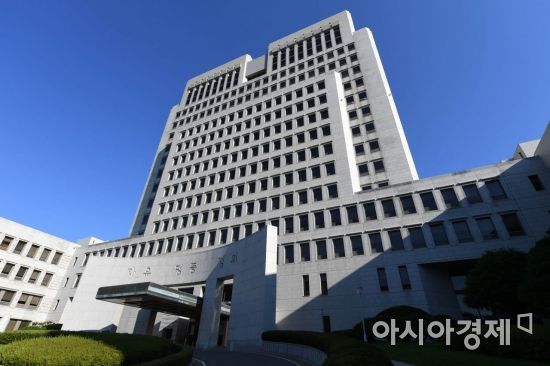
The court explained the reason for dismissing the prosecutor's appeal, stating, "There is no error in the original court's judgment that violates the rules of logic and experience, exceeds the limits of free evaluation of evidence, or misinterprets relevant laws affecting the judgment."
Additionally, the court stated the reason for dismissing Lee's appeal, saying, "There is no error in the original court's judgment that violates the rules of logic and experience, exceeds the limits of free evaluation of evidence, or misinterprets the laws concerning the establishment of the crime of violating the Act on the Aggravated Punishment of Specific Economic Crimes."
The construction company World City, operated by Lee, received large loans from the Busan Savings Bank group in the 2000s and promoted the Kamko City project to build a new city in Phnom Penh, the capital of Cambodia.
The business structure involved a domestic corporation called Landmark Worldwide (LMW) and a local Cambodian corporation, World City, conducting the project.
However, the project was halted due to bankruptcy caused by reckless project financing investments, and Busan Savings Bank, which had invested 236.9 billion won in the project, also went bankrupt.
The Korea Deposit Insurance Corporation, unable to recover bonds worth about 670 billion won including delayed interest, requested an investigation by the prosecution. The prosecution detected charges of embezzlement and breach of trust against Lee and brought the case to trial in July 2020.
Lee was accused of embezzlement for falsely contracting consulting services provided by his spouse between September and November 2017 and paying 6 million dollars from funds of a separate overseas corporation he operated.
The prosecution also included in the indictment the charge that Lee deliberately did not recover about 2.31 million dollars from the overseas corporation to avoid compulsory execution, causing damage to LMW.
The first trial court acquitted Lee of the charge of obstruction of compulsory execution among the four charges but found him guilty of the other three, sentencing him to three years in prison with a four-year probation.
The second trial court acquitted Lee of violating the Depositor Protection Act but sentenced him to four years in prison and ordered his immediate detention. It also ordered the confiscation of 7.812 billion won, equivalent to 6 million dollars at the exchange rate at the time.
The Supreme Court found no error in the second trial court's judgment regarding guilt or innocence but found issues with the confiscation ruling.
Regarding the confiscation, the court stated, "The original court found Lee guilty of embezzling 6 million dollars of corporate funds under his custody and, unlike the first trial, ruled that this case falls under Article 6, Paragraph 1 of the Act on the Confiscation of Proceeds from Corruption Crimes, which stipulates 'cases where it is extremely difficult for the crime victim to exercise claims for property return or damages against the offender,' and ordered confiscation of the embezzled amount."
It continued, "The original court reasoned that since Lee, as the corporate CEO, exercised de facto control over the 6 million dollars deposited in the corporate account by freely withdrawing and depositing funds as needed, the money could be withdrawn at any time by Lee. Furthermore, unless Lee himself took special measures to prevent arbitrary withdrawal or repayment of debts to the actual victim of the embezzlement, the mere fact that the money remained in the account does not mean the damage was effectively recovered. However, such reasoning by the original court is difficult to accept."
The court explained, "Article 6, Paragraph 1 of the Act on the Confiscation of Proceeds from Corruption Crimes lists as a condition for confiscation and seizure 'cases where it is extremely difficult for the crime victim to exercise claims for property return or damages against the offender.' The confiscation and seizure based on this law by the prosecutor is a preliminary procedure to return the crime proceeds to the victim."
It added, "The transaction statement attached to the defense counsel's appeal shows the account number and confirms that the 6 million dollars remain continuously deposited. The prosecutor's indictment related to confiscation assumes that the victim of Lee's embezzlement is the corporation. Therefore, since Lee deposited the 6 million dollars into the corporate account, unless there are special circumstances, the property damage suffered by the victim corporation should be considered restored to the state before the crime."
The court noted, "If Lee arbitrarily withdraws and uses the 6 million dollars deposited in the account, as the original court feared, a new embezzlement crime would be established against him."
Furthermore, the court stated, "Confiscation as a substitute for criminal forfeiture is a subsidiary disposition pronounced in a guilty verdict for the defendant in a criminal trial and has a punitive nature, so it must be interpreted strictly. The original court's judgment appears to interpret and apply the confiscation requirements of the law in a way unfavorable to the defendant beyond the ordinary meaning of the text, making it difficult to accept."
Finally, the court concluded, "Therefore, this case does not fall under 'cases where it is recognized that it is extremely difficult to recover damages for the victim' as stipulated in Article 6, Paragraph 1 of the Act on the Confiscation of Proceeds from Corruption Crimes concerning Lee's violation of the Act on the Aggravated Punishment of Specific Economic Crimes (embezzlement). It is reasonable to hold that confiscation under this law cannot be ordered against the defendant. Thus, the original ruling ordering confiscation of the embezzled 6 million dollars contains an error in interpreting the law related to confiscation under Article 6, Paragraph 1 of the Act on the Confiscation of Proceeds from Corruption Crimes, which affected the judgment."
While pointing out the illegality of the second trial court's confiscation ruling, the court stated, "Since no separate confiscation will be ordered against the defendant, it is sufficient to overturn the original ruling on this matter," and did not remand the case.
© The Asia Business Daily(www.asiae.co.kr). All rights reserved.
![Clutching a Stolen Dior Bag, Saying "I Hate Being Poor but Real"... The Grotesque Con of a "Human Knockoff" [Slate]](https://cwcontent.asiae.co.kr/asiaresize/183/2026021902243444107_1771435474.jpg)















