Nearby Office Workers and Merchants Suffer Near Accident Site
No National-Level Support for Accident
Classified as 'Medium Scale' Considering Number of Victims
"This is a place I come to every day. I still can't believe that people died here."
On the 1st, the intersection near City Hall Station in Jung-gu, Seoul, where 9 people died in a traffic accident, was mostly cleared. Although the fence damaged in the accident was still under repair, the neatly maintained sidewalk was bustling with office workers trying to have lunch as if nothing had happened. However, nearby merchants and office workers passing through the area still showed signs of lingering shock from the accident.
Mr. Lee (34), an employee of a commercial bank who lost 4 colleagues in the accident, said, "I pass through here every day to enter the Bukchang-dong food alley during lunch or dinner gatherings. It still feels like a dream that 9 people died at the place where I usually wait for the signal while chatting with my colleagues," adding, "These days, I’m scared to wait for the signal on the sidewalk, so I stand far away from the road."
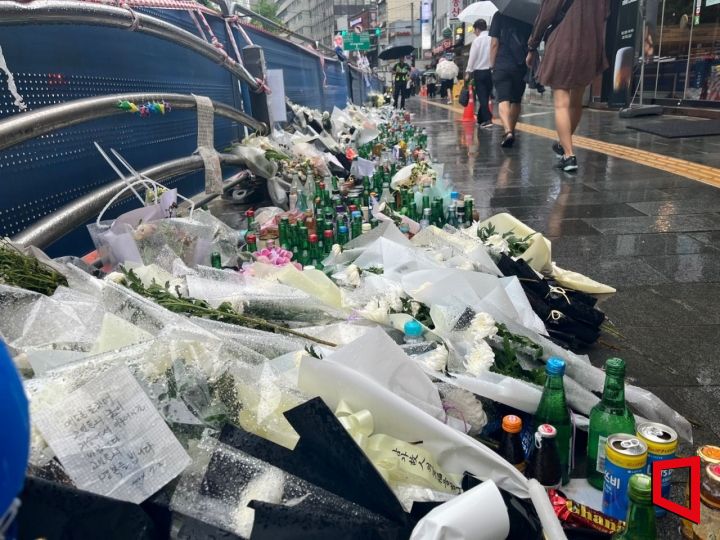 Flowers, alcohol, and beverages left by citizens are placed near the City Hall Station intersection in Jung-gu, Seoul, where a traffic accident occurred.
 [Photo by Lee Seohee]
Accident site cleaned up, but citizens’ pain remains
With two major accidents occurring about a week apart?the Hwaseong Arisel factory fire in Gyeonggi Province and the City Hall Station traffic accident?more citizens are reporting psychological distress (trauma). Experts emphasize the importance of government-level psychological treatment, noting that social disasters with multiple casualties in everyday spaces can cause emotional pain not only to the victims’ families and close acquaintances but also to ordinary citizens.
On the afternoon of the 8th, Mr. Han (38), who was standing alone at the memorial space set up at the accident site, recalled the day of the incident, saying, "I narrowly escaped the accident myself." On that day, Mr. Han stayed late at the office for overtime work as usual. Feeling too tired to finish all his tasks, he left work earlier than planned around 9 p.m., and upon arriving home, he learned about the accident through messages from his colleagues on KakaoTalk.
Mr. Han said, "I left earlier than usual because I was too tired to finish my work. Later, I saw messages from colleagues asking if I was okay, and when I checked, I found out that the accident happened right in front of the company around 9:27 p.m. I wonder if I would have been involved if I had left after finishing all my work."
Nearby merchants who witnessed the scene firsthand also expressed their distress. Mr. Choi (47), who works at a meat restaurant near City Hall Station, heard a loud 'thud' and screams, then rushed outside his shop. Upon hearing the commotion and approaching, he saw citizens who had been hit by a car lying on the ground. Mr. Choi said, "I watched the ambulance arrive and the injured being taken away. Since then, the sound of ambulances and people’s screams, as well as the accident scene, suddenly come to mind and sometimes appear in my dreams. When I think about it too much, my heart races, and I often have to take deep breaths alone."
City Hall Station accident lacks government-level support... no clear guidelines
Experts advise that the psychological fear and mental distress felt by ordinary citizens can be much greater when an accident with multiple casualties involves unrelated people in everyday places. According to the National Trauma Center, post-traumatic stress disorder (PTSD) initially involves extreme stress but can develop over time into anxiety, fear, grief, guilt, and if symptoms worsen, despair and suicidal thoughts. Therefore, experts stress the importance of national-level psychological treatment support immediately after a disaster.
Professor Kim Hyun-soo of Myongji Hospital’s Department of Psychiatry said, "The fear felt by ordinary citizens can be greater when accidents happen in familiar places. Many citizens may have developed trauma indirectly by watching accident videos and reading articles through the media. National-level psychological treatment support is important."
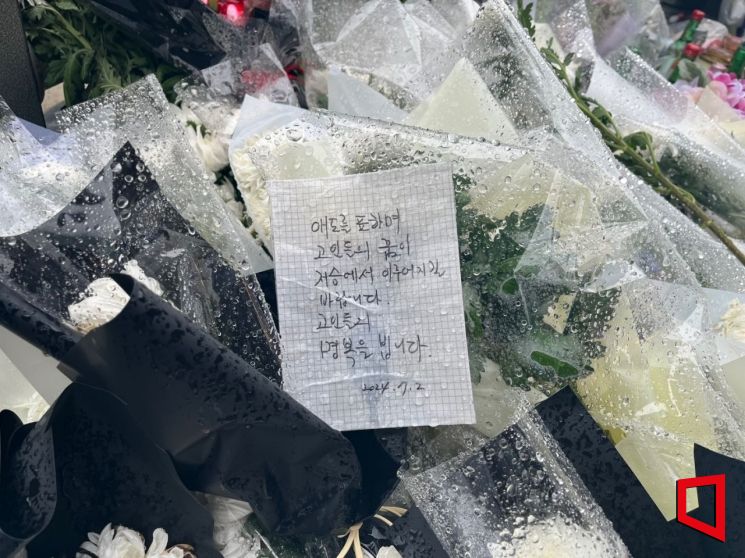 Flowers, alcohol, and beverages left by citizens are placed near the City Hall Station intersection in Jung-gu, Seoul, where a traffic accident occurred.
 [Photo by Lee Seohee]
There are many criticisms that the government-wide psychological support system after social disasters is still insufficient. Due to the lack of clear guidelines, the formation of integrated psychological support teams led by the Ministry of Health and Welfare (National Trauma Center) is being done in a makeshift manner.
Currently, trauma treatment related to the City Hall Station traffic accident is being conducted mainly through the Seoul Jung-gu Basic Center and the Seoul Metropolitan Mental Health Welfare Center. This is because the City Hall Station accident was classified as a "medium-scale" accident considering the number of victims. According to the National Trauma Center, the government classifies accident scales into three levels based on the number of victims: small-scale accidents are handled by basic local governments, medium-scale by metropolitan governments, and large-scale by the National Trauma Center and other government agencies providing trauma treatment.
The government announced that for the Hwaseong Arisel factory fire accident, starting from the 25th of last month, a government-wide integrated psychological support team linked with the National Trauma Center, Disaster Psychological Recovery Support Center, and Gyeonggi Province Mental Health Welfare Center is being operated in cooperation with government and local governments.
Shim Min-young, director of the National Trauma Center, explained, "We need to observe the situation first, but there are currently no plans to form an integrated psychological support team related to the City Hall Station traffic accident. Although there are no clear guidelines, according to internal protocols, the accident scale is divided into three levels, and this decision was made accordingly. In the case of the Hwaseong factory fire accident, there were 23 victims, which is much higher, and many of them were foreigners, making metropolitan-level support difficult. Therefore, government-wide support was decided."
© The Asia Business Daily(www.asiae.co.kr). All rights reserved.
![Clutching a Stolen Dior Bag, Saying "I Hate Being Poor but Real"... The Grotesque Con of a "Human Knockoff" [Slate]](https://cwcontent.asiae.co.kr/asiaresize/183/2026021902243444107_1771435474.jpg)












