US Presidential Candidates Take Hardline Stance on China for Victory
Control Difficult if South China Sea and Taiwan Disputes Erupt
Cooperation Needed First in Non-Security Areas Like Education and Health
Amid escalating trade tensions between the US and China due to the recent US tariffs on Chinese goods, Chinese scholars have also expressed a bleak outlook, suggesting there is little room for improvement in US-China relations.
According to Bloomberg on the 7th (local time), Chinese scholars attending the Beijing World Peace Forum (WPF) hosted by Tsinghua University last weekend agreed that US-China relations are in a turbulent period, with tensions likely to rise due to disputes over Taiwan and the South China Sea. Some scholars expressed skepticism about the possibility of long-term improvement in US-China relations.
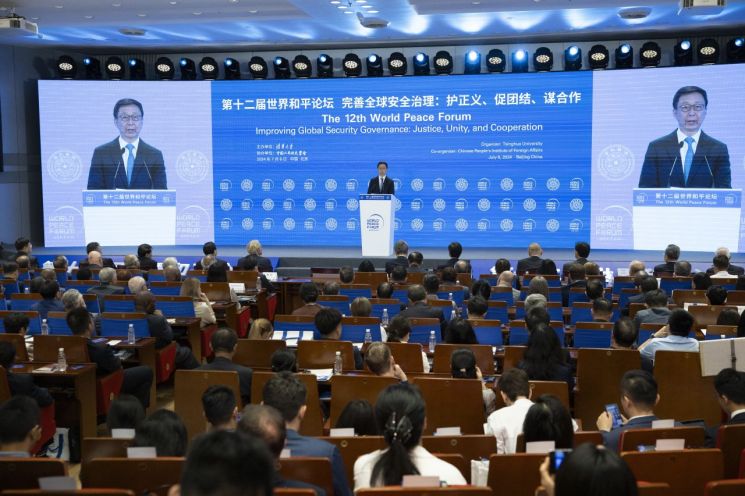 Han Zheng, Vice President of China, is delivering the opening speech at the 12th World Peace Forum (WPF) held in Beijing on the 6th (local time).
 [Photo by Yonhap News]
Da Wei, director of the International Security Strategy Center at Tsinghua University, stated, "We have probably reached the maximum limit for stabilizing this bilateral relationship," adding, "The fundamental distrust between the two countries is so high that if the current relationship continues, new types of crises and confrontations are likely to occur."
Yan Xuetong, director of the Institute of International Relations at Tsinghua University, said at a press conference before the forum, "It is more likely that relations between the two countries will worsen rather than improve from now until the first half of 2025." He cited the US election campaign as one of the reasons. Both President Joe Biden and former President Donald Trump are appealing to voters by playing the China trade tariff card to protect jobs ahead of the US presidential election in November. Trump has pledged to impose a 60% tariff on Chinese imports if re-elected. The Biden administration has decided to raise tariffs on Chinese electric vehicles from the existing 25% to 100%.
Among the various issues where the US and China have clashed, including geopolitics, advanced technology, and trade wars, the biggest risks were identified as the South China Sea and Taiwan issues. Douglas Paal, a researcher at the Carnegie Endowment for International Peace, pointed out during the US-China relations panel discussion at the forum, "The dispute over the Second Thomas Shoal shows that the risk of US-China conflict is highest in the South China Sea," adding, "This is due to a lack of mechanisms and understanding on how to resolve conflict situations."
Wu Xinbo, director of the Center for American Studies at Fudan University, who identified the Taiwan issue as a time bomb worsening US-China relations, said, "China and the US are seriously mentally prepared for contingencies surrounding the Taiwan issue," and added, "Whether intentional or not, once conflict occurs, it will be very difficult to de-escalate or control the situation."
Some scholars also offered recommendations for improving US-China relations. Susan Thornton, a former US diplomat at Yale Law School’s Paul Tsai China Center, emphasized that both countries should stop exaggerating the threats posed by the other and focus on areas with relatively less security tension such as health, education, environment, and food. Earlier, Kurt Campbell, US Deputy Secretary of State, argued that the US should accept more Chinese students majoring in humanities rather than science to minimize security concerns.
© The Asia Business Daily(www.asiae.co.kr). All rights reserved.
![Clutching a Stolen Dior Bag, Saying "I Hate Being Poor but Real"... The Grotesque Con of a "Human Knockoff" [Slate]](https://cwcontent.asiae.co.kr/asiaresize/183/2026021902243444107_1771435474.jpg)
















