"Supporting Adult Children for 10 Years" US Parents
30% in 2013 → 60% in 2023 ↑
In Japan, the Issue of 'Middle-aged Kangaroo Tribe'
Although they have reached an age to be socially and economically independent, the number of 'Kangaroo Tribe'?young adults who live with and depend on their parents instead of living independently?is rapidly increasing worldwide. This seems to be because the younger generation, facing difficulties not only in finding jobs but also in managing various expenses such as housing costs, is avoiding independence to prevent financial hardship.
Recently, the American Business Insider reported the atmosphere that "young people continue to live with their parents even after graduating from college, and parents are dissatisfied with this situation," describing it as the "endless safety net of Generation Z."
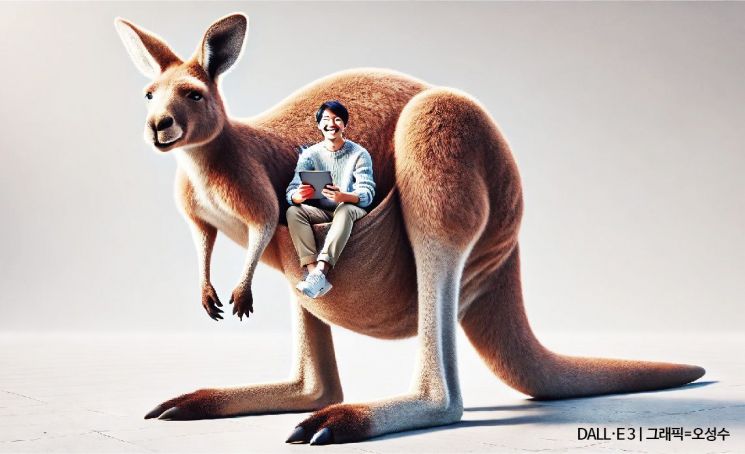
According to a survey by the American polling organization Pew Research Center, the percentage of 18- to 24-year-olds in the U.S. who reported being financially independent from their parents dropped from 32% in 1980 to 16% last year, halving over the period. The proportion of American parents who reported supporting their adult children increased from 30% in 2013 to 60% last year. Some parents stated that living with their children cost them an average of $1,400 (about 1.93 million KRW) per month.
David Nunez, a 24-year-old living in Tampa, Florida, is part of the Kangaroo Tribe living with his parents. While he covers expenses such as communication fees, online video services (OTT), and food, he pays no rent at all. The average rent in the area exceeds $2,000 per month. Nunez explained that with his annual salary of $33,000, he cannot afford this rent. He said, "I am lucky to have a family that understands I am going through a tough time." He added, "I've always heard that by around 18 or 19, you should be independent and live your own life, but among my friends, only one does not live with their parents."
Business Insider reported that although Generation Z has higher education levels and better chances of securing full-time employment than previous generations, they are struggling financially. With U.S. college tuition having more than doubled over the past 20 years to an average of $37,000, the point at which young people become financially capable is increasingly delayed. Additionally, as in South Korea, rising housing prices in the U.S. are a significant burden to independence.
Monica Kirkpatrick Johnson, a sociology professor at Washington State University, explained, "Young people are staying in school longer, delaying the time when they become financially capable," adding, "They are finding jobs but are not yet at a level to be independent." She further stated, "Without policy support such as student loan relief or public health insurance, parents will continue to play this protective role."
Some parents tolerate their children becoming part of the Kangaroo Tribe because they themselves experienced economic difficulties in their youth. In particular, Generation X parents in the U.S., who suffered during the 2008 global financial crisis, tend to be relatively generous in providing financial support to their precious children.
The increase in the Kangaroo Tribe is not a problem unique to the U.S. According to a paper titled "The Status and Characteristics of the 2030 Kangaroo Tribe Based on the Youth Panel Survey," published last month by Kwanghoon Hwang, a senior researcher at the Korea Employment Information Service, about 80% of Koreans aged 25 to 29 belong to the Kangaroo Tribe. Although the proportion of Kangaroo Tribe among those aged 30 to 34 was 53.1% in 2020, which seems lower, it actually increased by 7.2 percentage points compared to 45.9% in 2012, leading the growth of the Kangaroo Tribe.
Japan, which coined the term Kangaroo Tribe, has regarded this as a social problem since the 1990s and has been seeking solutions but has yet to find a suitable one. As a result, recently, a significant number of young Kangaroo Tribe members continue to depend on their parents even into middle age, creating a "middle-aged Kangaroo Tribe" phenomenon.
As the Kangaroo Tribe phenomenon increases worldwide, concerns are growing that the parent generation may suffer setbacks in preparing for their old age. Senior researcher Hwang pointed out, "For the parent generation, as they approach retirement from the labor market, they will face situations where they cannot engage in various activities for their own retirement planning and preparation, and instead must invest time and financial effort to support their children's economic foundation."
© The Asia Business Daily(www.asiae.co.kr). All rights reserved.
![Clutching a Stolen Dior Bag, Saying "I Hate Being Poor but Real"... The Grotesque Con of a "Human Knockoff" [Slate]](https://cwcontent.asiae.co.kr/asiaresize/183/2026021902243444107_1771435474.jpg)















