Number of Startups from January to April Hits 5-Year Low
High Interest Rates and Inflation Drive Up Closure Rates Amid Economic Downturn
Government to Invest 40 Trillion Won in Self-Employed Businesses
Mr. Lee, in his 40s, who works for a gas pipe supplier, gave up after preparing to open an unmanned ice cream discount store for a year. He spent a year doing fieldwork, completed a commercial area analysis, and even pinpointed a location for the store. However, due to the unrelenting loan interest rates, he ultimately had to abandon the startup. Mr. Lee said, “I thought it would be easy since it was a relatively low-capital startup, but seeing the high loan interest rates, electricity bills, and the fact that vacancies in the surrounding commercial area have continued for a year, I judged that now is not the right environment to start a business.”
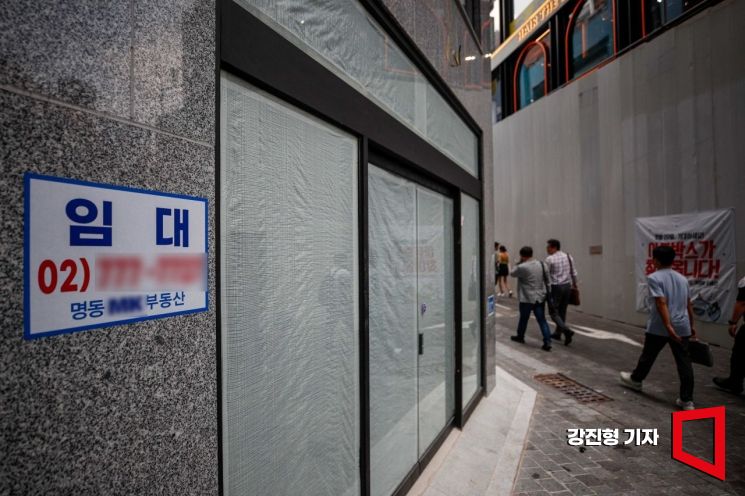 A rental notice is posted at a commercial building in Myeongdong, Jung-gu, Seoul. Photo by Jinhyung Kang aymsdream@
From January to April this year, the number of startups (both corporate and individual businesses) in Korea was more than 150,000 fewer than during the COVID-19 period. It is expected that the total number of startups this year will decrease further compared to last year. As the domestic and global economic recession prolongs and high interest rates persist, Korea is becoming a ‘country that does not start businesses.’
According to the startup trends from the Ministry of SMEs and Startups on the 5th, the number of startups this year is the lowest in the past five years. As of January to April this year, the number of startups was 411,107. This is more than 20,000 fewer than the 434,824 startups during the same period last year. The difference is even greater compared to 2020, when the economy began to contract due to the spread of COVID-19. The number of startups from January to April 2020 was 567,302, which is 156,195 more than this year.
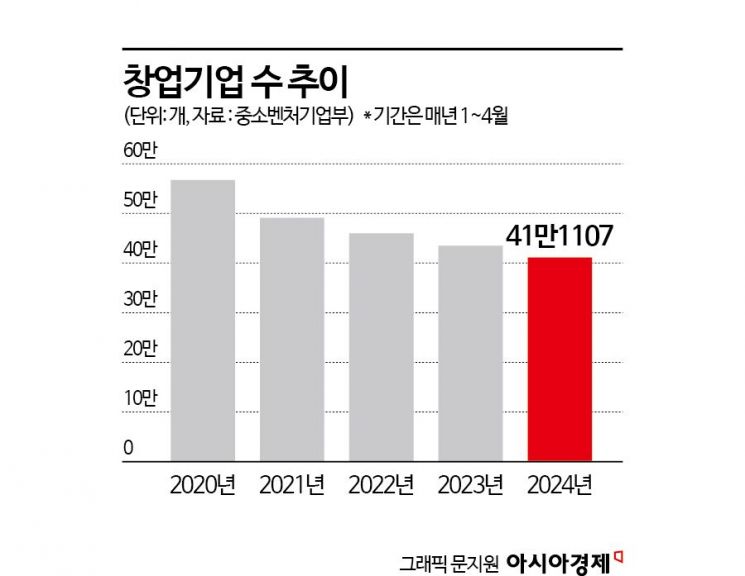
The sharp decline in the number of startups is due to the economic downturn caused by high interest rates and high inflation. According to the Ministry of SMEs and Startups’ analysis, since the declaration of the COVID-19 endemic, the accommodation and food service sectors have shown signs of recovery in startups. However, startups have decreased in most other sectors such as wholesale and retail, construction, and technical services. If this trend continues, the total number of startups this year is expected to decline further compared to last year.
An official from the Ministry of SMEs and Startups explained, “The reasons for the decrease in startups are believed to be a combination of factors including high interest rates, economic recession, and reduced investment,” adding, “Although the number of startups from January to April is low, there was a slight increase compared to the previous year as of April, leaving open the possibility of a rebound.”
It is not only startups that have decreased. Despite the annual decline in the number of startups, the closure rate has actually increased. The closure rate for individual businesses was 9.5% as of the end of last year, up 0.8 percentage points from the previous year. The number of closures increased by 111,000 to 911,000. As of April this year, the delinquency rate on individual business loans at domestic banks was 0.61%, the highest since 2012. The number of self-employed people reaching their limits is increasing daily, so the closure rate may rise further this year.
The government included policies to support the recovery of small business owners and self-employed individuals and to ease management burdens in the recently announced ‘Second Half Economic Policy Direction.’ This is to revitalize startups and reduce closures.
Specifically, the New Start Fund will be expanded from the existing 30 trillion won scale to 40 trillion won, an increase of more than 10 trillion won. The New Start Fund was introduced in October 2022 to alleviate the debt burden of small business owners affected by the COVID-19 pandemic. In addition, the government is promoting the ‘New Start Hope Project’ to support employment and re-startups for small business owners, providing support for store demolition costs after closures and assisting with re-startups.
© The Asia Business Daily(www.asiae.co.kr). All rights reserved.
![Clutching a Stolen Dior Bag, Saying "I Hate Being Poor but Real"... The Grotesque Con of a "Human Knockoff" [Slate]](https://cwcontent.asiae.co.kr/asiaresize/183/2026021902243444107_1771435474.jpg)
















