1.1% of Youth Experience Sexual Image Distribution Victimization
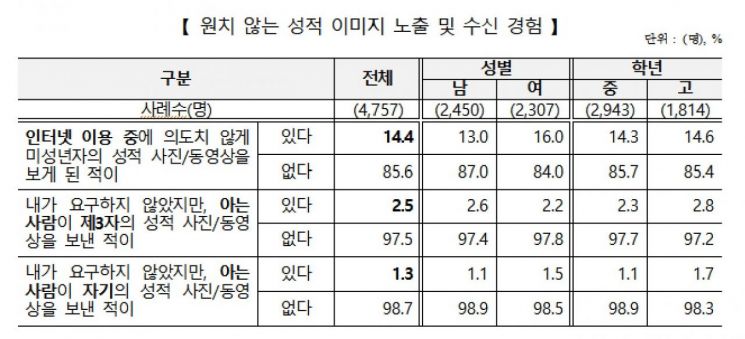
14.4% Exposed to Minor Sexual Images Online
Youth Strongly Recognize Need for Punishment of Sexual Exploitation Materials
28.1% of Illegal Sexual Exploitation Sites Involve Minors
It was found that about 4% of middle and high school students have experienced requests from others to send or share sexual images. Additionally, 0.6% of youths reported being threatened or coerced with the distribution of sexual images.
On the 4th, the Ministry of Gender Equality and Family conducted a survey last year targeting 4,757 middle and high school students nationwide regarding their awareness and experiences of child and youth sexual exploitation materials. The results showed that 3.9% of youths had experienced requests from someone to send or share their sexual images. Among these, requests from people known only online (2.4%) were higher than those from offline acquaintances (1.1%), and the rate of receiving requests to send or share sexual images was higher among female students (5.8%) than male students (2.2%).
The percentage of youths threatened or coerced with the distribution of sexual images was 0.6%. The highest rate was for being forced to meet offline (24.7%), followed by additional requests for sexual images (23.9%). There were also cases of interference or intrusion into daily life (17.3%), requests for sexual photos or videos from acquaintances (14.4%), and demands for sexual intercourse (12.3%).

It was estimated that 1.1% of surveyed youths experienced one or more incidents of sexual image sharing or distribution harm. Most of these cases involved the distribution of so-called 'deepfake' videos, where sexual images were synthesized into ordinary photos. The rate of false video harm was higher among male students (1.4%) than female students (0.6%), and the distributors were mainly friends (64.4%).
14.4% of middle and high school students reported having been unintentionally exposed to sexual images of minors while using the internet. The most common exposure route was social networking services (SNS), accounting for 68.3%.
Youths strongly recognized the need for punishment for acts such as the production and distribution of child and youth sexual exploitation materials. On a 5-point scale, the average score was 4.7, indicating a perception that such acts should be severely punished. They regarded 'sexual photos and videos of minors taken by others' (3.64 points) as the most serious, followed closely by 'false videos synthesizing minors’ faces into sexual photos and videos' (3.62 points).
Among 2,033 adults aged 19 and over surveyed simultaneously nationwide, 92.7% believed that child and youth sexual exploitation materials are directly or indirectly related to sexual crimes against children and youths. Regarding the need for punishment for acts related to child and youth sexual exploitation materials, the average score was 4.6 (on a 5-point scale), indicating recognition of the need for strict punishment.
Searching 58 related keywords on SNS platforms revealed that posts related to child and youth sexual exploitation materials appeared in 32 keywords. Among these, about 0.9% of posts were related to child and youth sexual exploitation materials, mostly involving sales or exchanges. Additionally, on one illegal sexual video site with high daily page views, child and youth sexual exploitation materials accounted for nearly 28.1%.
This survey was conducted last year for the first time commissioned by the Ministry of Gender Equality and Family and carried out by the Korea Institute of Criminology and Justice Policy, among others. It will be conducted every three years under the 'Youth Protection Act.' The Ministry stated that based on these survey results, it plans to further strengthen support for digital sexual crime victims, proactive monitoring and deletion support for child and youth sexual exploitation materials, and related education.
© The Asia Business Daily(www.asiae.co.kr). All rights reserved.
![Clutching a Stolen Dior Bag, Saying "I Hate Being Poor but Real"... The Grotesque Con of a "Human Knockoff" [Slate]](https://cwcontent.asiae.co.kr/asiaresize/183/2026021902243444107_1771435474.jpg)
















