Apple and Pear Retail Prices Surge Up to 170% YoY
Spinach and Carrot Prices Also Rise 30%
Government Expands Supply to Stabilize Prices
Following the early heatwave in June, the full-scale monsoon season began in July, causing fluctuations in agricultural product prices. With climate change intensifying heavy rains and heatwaves every year, concerns are growing over the stable supply of major agricultural products and the resulting price increases.
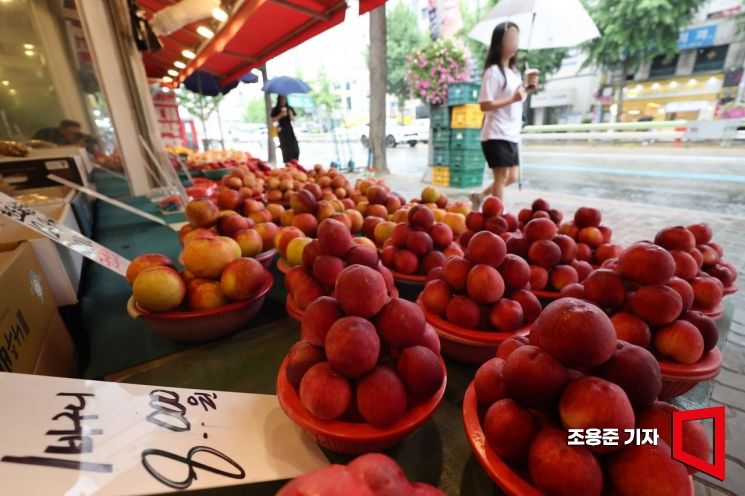 On the 2nd, as the consumer price inflation rate remained in the 2% range for three consecutive months and fruit prices such as apples continued to rise, fruits are displayed at a store near the Cheonggwan Market in Yeongdeungpo-gu, Seoul. Photo by Jo Yongjun jun21@
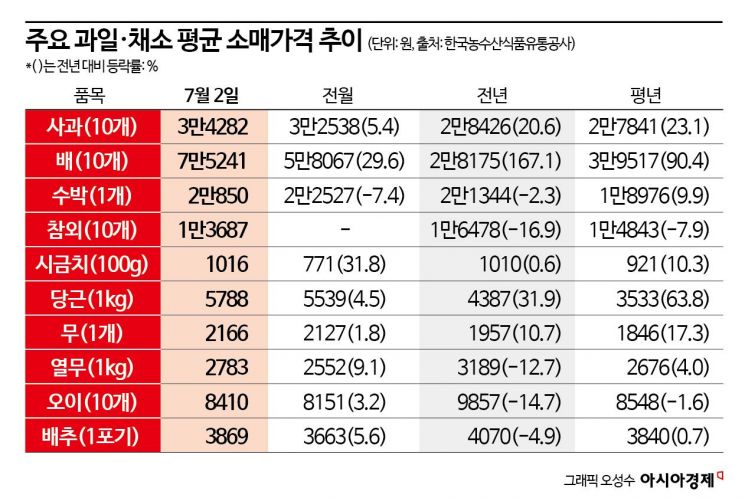
According to the Agricultural Products Distribution Information (KAMIS) from the Korea Agro-Fisheries & Food Trade Corporation (aT) on the 3rd, the price of spinach rose 31.8% from 771 won a month ago to 1,016 won per 100g. Carrot prices also increased by 31.9% compared to last year (4,387 won) to 5,788 won per 1kg, and were 63.8% higher than the average year (3,533 won). Young radish, widely used as a kimchi ingredient in summer, rose 9.1% in one month to 2,783 won per 1kg, and radish prices increased by 10.7% and 17.3% compared to the same period last year (1,957 won) and the average year (1,846 won), respectively, reaching 2,166 won each.
The retail price of Fuji apples (10 pieces) was 34,282 won, up 5.4% from 32,538 won a month ago. This is 20.6% higher than last year (28,426 won) and 23.1% higher than the average year (27,841 won). The price increase of pears is even steeper. As of the 2nd, the price of Singo pears (10 pieces) was 75,241 won, a 29.6% increase from 58,067 won a month ago. Compared to the same period last year (28,175 won), it surged by a staggering 167.1%, and it is 90.4% higher than the average year (39,517 won).
Apples and pears are representative items with large price fluctuations depending on domestic crop conditions, as imports are not possible. Both items saw a decrease in production last year, leading to reduced storage. As a result, more farms ended shipments early this year, and prices have remained strong due to reduced supply. Since production volume can vary depending on weather conditions and growth status ahead of the harvest season this year, price volatility based on supply remains valid. However, for apples, the early-ripening Tsugaru (Aori) variety is expected to start shipping from the end of this month, and the overall growth condition of pears is reported to be better than last year.
However, seasonal fruits have stable prices due to favorable crop conditions. Watermelon prices per piece are 20,850 won, 7.4% lower than a month ago (22,527 won) and 2.3% cheaper than last year (21,344 won). Korean melons (chamoe) cost 13,687 won for 10 pieces, down 16.9% from a year ago (16,478 won) and 7.9% from the average year (14,843 won). Watermelon growth has recovered due to rising temperatures and increased sunlight, leading to increased market supply. Chamoe also saw increased fruit set compared to last year’s poor growth, with reduced damage from diseases and pests, resulting in good crop conditions and increased shipments. However, if shipments of watermelon and chamoe are disrupted due to the monsoon or other factors, temporary price fluctuations remain possible.
Recently, heavy rains nationwide have caused delays in shipment and reduced market supply, leading to sharp increases in agricultural product prices. The Korea Meteorological Administration forecasts that this summer’s rainfall will be higher than average, suggesting that prices of summer fruits and vegetables are likely to continue rising. After the monsoon, a full-scale heatwave is expected, which could exacerbate supply instability for agricultural products. Not only could production of major crops be disrupted, but logistics networks may also be severely affected, potentially leading to widespread price surges known as ‘heatflation’ (heat + inflation), increasing the burden on everyday food prices for ordinary citizens.
In response, the government plans to thoroughly prepare before and after weather disasters such as concentrated summer rains and heatwaves to prevent instability in agricultural product supply. The Ministry of Agriculture, Food and Rural Affairs, the main responsible agency, plans to secure a total of 28,000 tons of government-available stock for summer supply stability, including 15,000 tons of stockpiled radish and napa cabbage, 7,000 tons of contract-grown produce, and 6,000 tons through local shipment control facilities.
Meanwhile, according to Statistics Korea, consumer prices last month rose 2.4% compared to a year earlier, marking the lowest level in 11 months since July 2023 (2.4%). However, prices of agricultural, livestock, and fishery products rose 6.5%, led by pears, which recorded the highest-ever rate of increase, driving the overall inflation.
© The Asia Business Daily(www.asiae.co.kr). All rights reserved.
![Clutching a Stolen Dior Bag, Saying "I Hate Being Poor but Real"... The Grotesque Con of a "Human Knockoff" [Slate]](https://cwcontent.asiae.co.kr/asiaresize/183/2026021902243444107_1771435474.jpg)
















