Safety Threatened by Disaster-Level Heatwave
Increasing Users, Decreasing Budget
"Even when I stay at home, sweat pours down like rain."
On the evening of the 3rd at 9 PM, Choi (65), a resident of the Changsin-dong gosiwon village, whom we met at Hyundaiok Sauna in Changsin-dong, Jongno-gu, Seoul, cooled off with the fan breeze and said, "The heat came earlier than last year, so it was very tough. I'm really grateful that a place like this exists." Hyundaiok Sauna is one of the 'Night Heat Shelters' operated by the Seoul Metropolitan Government during the summer for gosiwon village residents.
The heat, which arrived earlier than usual, has made the shelter extremely popular. Visitors change into sauna clothes on the first floor and then go up to the second floor to use the sleeping room. Inside the sleeping room, gosiwon village residents were resting comfortably. Park (70), a resident of the Donui-dong gosiwon village, praised the facility, saying, "There is no separate place to wash where I live now," and added, "I hope the project goes well so that we can use it for a long time."
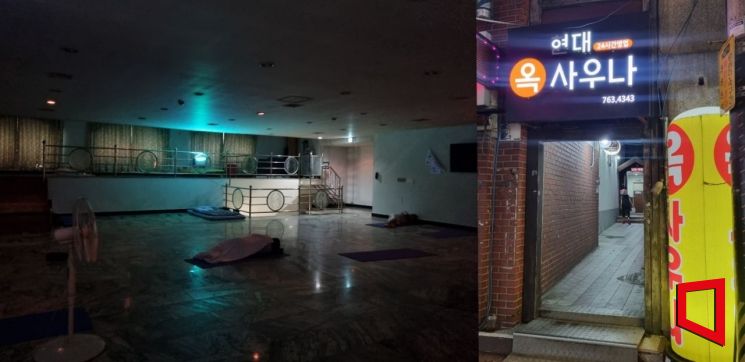 At 9 p.m. on the 3rd, visitors at Hyundaiok Sauna in Changsin-dong, Jongno-gu, Seoul, are trying to sleep while enjoying the cool breeze.
 [Photo by Shim Seong-a]
Since last year, the Seoul Metropolitan Government has been operating night heat shelters for gosiwon village residents. They can be used without limits on the number of visits or hours during July and August. The number of night heat shelters increased from three last year to six this year. Currently, there is one shelter each in Jongno-gu, Jung-gu, Seodaemun-gu, and Yeongdeungpo-gu, and two shelters have been set up in Yongsan-gu, where the largest gosiwon village, Dongja-dong, is located among the five major gosiwon villages in Seoul (Changsin-dong, Donui-dong, Namdaemunro 5-ga, Dongja-dong, Yeongdeungpo-dong).
However, compared to the past when the gosiwon village office operated in a single room, the number of users at the night heat shelters has increased while the budget has decreased. According to the Seoul Metropolitan Government, the number of users of the nighttime heat shelters increased from 770 in 2022 to 1,191 in 2023, nearly doubling, while the budget decreased from 56,875,000 KRW in 2022 to 23,530,000 KRW in 2023, roughly halving.
A Seoul city official said, "We will continuously monitor on-site demand and resident responses and reflect these to expand the program," adding, "We will operate the night heat shelter project well so that it can become a model project that can later be expanded to the general low-income population and the local community."
© The Asia Business Daily(www.asiae.co.kr). All rights reserved.
![Clutching a Stolen Dior Bag, Saying "I Hate Being Poor but Real"... The Grotesque Con of a "Human Knockoff" [Slate]](https://cwcontent.asiae.co.kr/asiaresize/183/2026021902243444107_1771435474.jpg)















