Genesis to Introduce 3 EV Models
Simultaneous Production of Body Parts Achieves 30% Weight Reduction
Possibility of Introducing High-Performance Genesis Electric Vehicles
Improved Energy Efficiency and Reduced Component Costs
Hyundai Motor Company has decided to first apply a production innovation method that simultaneously molds the vehicle body and parts to its Genesis electric vehicles. Completing the body and parts at the same time saves production time, reduces the vehicle body weight, and increases the driving range of electric vehicles. This move is interpreted as an intention to prioritize production innovation in its premium brand to maximize electric vehicle performance.
According to a compilation of reports on the 3rd, Hyundai recently held a briefing for the Materials and Production Technology Division and announced plans to introduce three Genesis electric vehicle models to the new 'Hyper Casting' factory, which will begin operations in 2026. Starting from the second half of 2026, Genesis electric vehicles will be sequentially assigned to the Hyper Casting factory. Although Hyundai had previously announced the introduction of Hyper Casting, the establishment of a dedicated factory, and the timing of mass production, this is the first time the specific models to be applied have been disclosed.
Hyper Casting is an advanced manufacturing method that pours aluminum alloy castings into a large mold and presses the vehicle body and parts simultaneously under high pressure. It is similar to making fish-shaped bread (Bungeoppang) by pouring dough into a mold and stamping out identical shapes. Tesla was the first in the world to introduce this method in 2020 under the name 'Giga Casting.' Hyundai has adopted this technique and is developing its own manufacturing method under the name Hyper Casting.
Industry insiders speculated that the first model to apply the Hyper Casting process would be the Genesis brand’s flagship electric sports utility vehicle (SUV), the GV90. However, Hyundai clarified that the first vehicle to adopt this process is not the Genesis GV90. While they could not disclose the specific models, they stated that three Genesis electric vehicle models will be sequentially introduced starting in the second half of 2026, and discussions on the full-scale transition of production personnel will take place by the end of this year.
Hyundai chose Genesis as the first target for this method to push electric vehicle performance to the extreme. Electric vehicles equipped with high-voltage batteries inevitably have heavier curb weights, which negatively affect energy efficiency and driving performance. On the other hand, using the Hyper Casting method can drastically reduce the weight of the vehicle body and parts. Tesla utilized this method to reduce the weight of its electric vehicles by more than 30% compared to previous models.
Performance improvements through manufacturing innovation can expand into the 'high-performance electric vehicle' domain that Genesis has recently emphasized. In March, Genesis introduced the high-performance project 'Magma Program' and officially declared its entry into the high-performance vehicle market. To develop Genesis and high-performance vehicles, they also made a surprise hire of Manfred Harrer, a former executive from Porsche and Apple, as vice president.
The Hyper Casting method also helps reduce costs. Although initial equipment investment is substantial due to the introduction of large press machines, once the equipment is established, production efficiency can be maximized. This is because it reduces the time, labor, and costs involved in assembling parts individually. Tesla reduced parts costs by 40% using the casting method. With the conveyor belts eliminated, the factory production area also decreased by 20%.
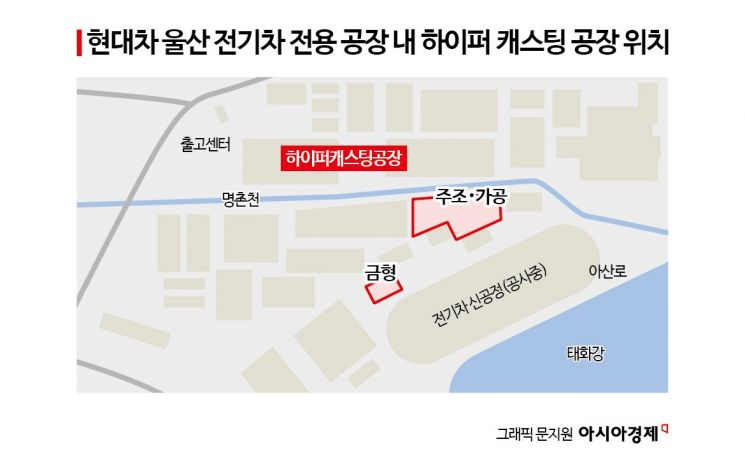
Hyundai plans to build a separate Hyper Casting factory within its Ulsan electric vehicle-dedicated plant. On a site of approximately 79,338 square meters (about 24,000 pyeong), production facilities related to Hyper Casting, including casting, processing, and mold factories, will be established. Construction will begin this month, with mass production starting in 2026.
© The Asia Business Daily(www.asiae.co.kr). All rights reserved.

















