"M&A Possible Between Gongmo REITs and Non-Public REITs"
The government is pushing to allow mergers and acquisitions (M&A) between public REITs and non-public REITs to expand the real estate investment trust (REITs) market. Until now, mergers between REITs were only possible among public REITs. The government aims to support the recovery of the real estate market by growing the REITs market through this regulatory relaxation.
On the 2nd at 2 p.m., the Ministry of Land, Infrastructure and Transport (MOLIT) announced at a 'REITs Revitalization Plan Briefing' held by the Korea REITs Association in Yeouido, Seoul, that it will ease regulations on M&A between REITs. Seungbeom Kim, Director of the Real Estate Investment System Division at MOLIT, said, "We will activate REITs to develop the real estate industry."
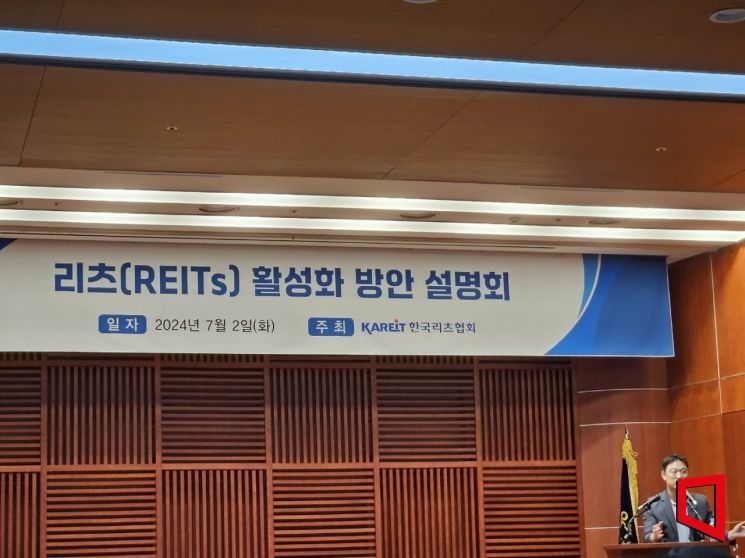 The Korea REITs Association held a "REITs Activation Plan Briefing" at 2 p.m. on the 2nd in Yeouido, Seoul.
 Photo by Seungwook Park
About 200 representatives from member companies of associations related to housing, real estate, and finance, including the Korea REITs Association, the Real Estate Development Association, the Housing Association, the Housing Construction Association, and the Korea Financial Investment Association, attended the briefing.
MOLIT plans to pursue legislative amendments to allow M&A between public REITs and non-public REITs. It intends to propose a revision to the 'Real Estate Investment Company Act' containing the relevant provisions as early as next month. This move accepts industry concerns that the current regulation, which only allows M&A among the same type of public REITs, makes it difficult for the REITs market to grow. The REITs Association had requested in February as part of the '2024 Institutional Improvement Agenda' that M&A between different types of REITs be permitted.
REITs are indirect investment vehicles that collect funds from multiple investors to invest in real estate and return operating income. For example, 10 people pool money into one REIT to buy a building and share rental income as dividends. All REITs must be public offerings, but if funds from pension funds or similar sources are involved, they are recognized as having a public nature and classified as non-public REITs.
MOLIT expects that if M&A between REITs becomes more active, the size of the REITs market will grow further. Currently, the market capitalization of domestic REITs is about 8 trillion KRW, which is negligible compared to the U.S. (1,604 trillion KRW) and Japan (152 trillion KRW). The number of listed REITs in Korea is only 25, whereas the U.S. and Japan have 204 and 60, respectively. However, if M&A activation allows listed REITs to acquire unlisted REITs, the market size can expand and the number of listed REITs can increase accordingly.
Officials from MOLIT and the REITs Association said, "Since this is a legislative amendment, parliamentary approval is required, but the opposition party also agrees on revitalizing REITs for the advancement of the real estate market, so it should not be difficult."
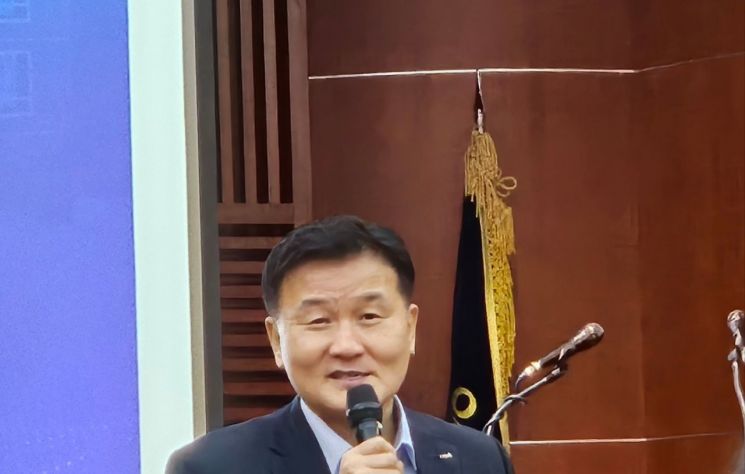 Jung Byung-yoon, Chairman of the Korea REITs Association, is speaking at the "REITs Activation Plan Briefing" held on the 2nd in Yeouido, Seoul.
 [Photo by Park Seung-wook]
Recently, the government has been seeking to stabilize the real estate market through REITs. Corporate restructuring (CR) REITs to resolve unsold housing, and public-supported private rental REITs to address non-started real estate project financing (PF) defaults are emerging as market stabilization measures. To accelerate REIT activation and projects, project REITs operated under a registration system from the development stage are also being introduced.
Director Kim said, "REITs have recently been mentioned as a way to promote the growth of real estate PF," adding, "Until now, real estate PF projects were carried out by small-scale developers with a self-capital ratio of about 2-3%, which posed a risk factor. In contrast, REITs conduct development projects with a high level of self-capital ratio, reducing risks."
According to MOLIT, the average self-capital ratio of REITs is about 38%. Activating REITs can solve the structure where small developers cover 95% of project costs with loans in real estate PF projects. For example, in April, the Korea Land and Housing Corporation (LH) publicly offered the Hwaseong Dongtan Healthcare REIT in Gyeonggi Province, where the developer had to invest more than 20% of self-capital ratio.
At the briefing, Byungyun Jeong, Chairman of the Korea REITs Association, said, "The REITs revitalization plan announced this time is the result of the government reflecting almost all of the industry's demands," and added, "The association will continue to serve as a bridge between the industry and the government."
© The Asia Business Daily(www.asiae.co.kr). All rights reserved.
![Clutching a Stolen Dior Bag, Saying "I Hate Being Poor but Real"... The Grotesque Con of a "Human Knockoff" [Slate]](https://cwcontent.asiae.co.kr/asiaresize/183/2026021902243444107_1771435474.jpg)

















