Resolving Medical Situations... Both Government and Medical Community Need to Take a Step Back for Negotiation
Gwangju and Jeonnam Regional National University Hospitals... Expecting Government Support for New Hospital Construction
"I believe the government's medical policy direction to make regional base national university hospitals responsible for essential regional medical care and to establish a regionally self-sufficient medical system is correct. In that sense, the new construction of Chonnam National University Hospital, the regional base national university hospital for the Gwangju and Jeonnam areas, must pass the preliminary feasibility study by considering the government's policy direction."
Jeong, who began his duties as the 34th director of Chonnam National University Hospital on January 29, is managing the hospital amid difficult medical circumstances, including the government's announcement on February 1, two days after his inauguration, to increase medical school quotas by 2,000.
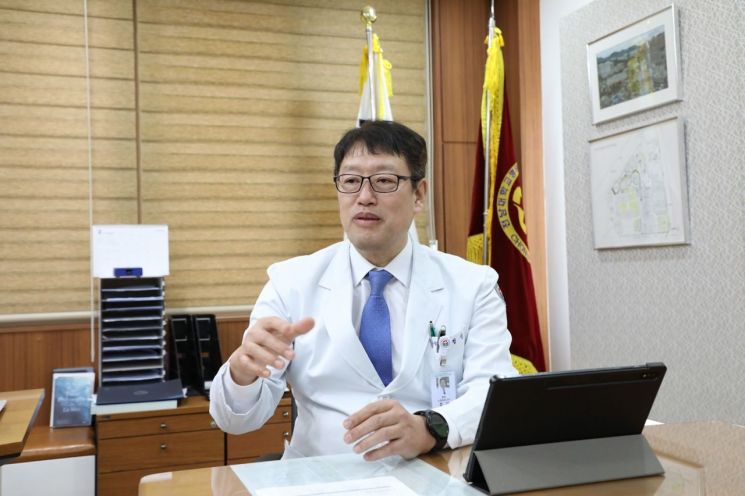
Director Jeong said, "I strongly support the government's policy to reduce regional medical disparities by developing regional base national university hospitals to the level of Seoul's 'Big 5' hospitals. In this context, just as President Yoon Suk-yeol promised on April 5 during his visit to Pusan National University Hospital to fully support the 700 billion KRW cost of new ward construction through a special regional essential medical account for balanced regional development, I expect that the construction cost for Chonnam National University Hospital, the regional base national university hospital for Gwangju and Jeonnam, will receive corresponding support."
We asked Director Jeong about his reflections since taking office, the medical conflicts, and the new hospital construction project.
Right after his inauguration, the medical situation worsened and has yet to be resolved, prolonging the crisis. Regarding this, Director Jeong expressed his apologies to not only the citizens but also the hospital medical staff and employees.
Despite the difficult situation, as a regional base hospital and a national university hospital, the hospital must fulfill its role. Director Jeong explained that they are striving to reduce medical service gaps through various methods and will continue to do their best with the staff of Chonnam National University Hospital to overcome these difficulties.
Since the government's announcement on February 1 to increase medical school quotas by 2,000, the hospital's management situation has been difficult due to unresolved medical issues. After the collective resignation of residents, the hospital is operating under an emergency medical system, but the cumulative loss compared to the same period last year has reached approximately 63.1 billion KRW.
Director Jeong stated, "We have declared emergency management and are pushing for strong cost reductions, but as the situation prolongs, we will have no choice but to intensify emergency management from the second half of the year."
He diagnosed the medical conflict as a problem caused by broken trust between the government and doctors.
He said, "The government ignored the sincerity of doctors regarding the nationwide medical issues and framed the doctors' opinions as a 'fight over their livelihood,' making it difficult to find solutions. The current deadlock is a head-to-head confrontation with no exit in sight, which is very unfortunate as the public and patients suffer. I believe operating the hospital under an emergency medical system has now reached its limit."
He continued, "Essential medical services are being maintained at all costs, but if outpatient care and surgery schedules are delayed due to collective strikes, a chain collapse is expected. The current medical-government conflict is similar to two trains running towards each other. Both sides must sit at the negotiation table for the sake of the public and patients. Also, a permanent dialogue system for future medical care must be established promptly. I believe true courage lies in both the government and the medical community taking a step back."
He also mentioned the necessity of constructing a new hospital for Chonnam National University Hospital.
Director Jeong explained, "Jeonnam has many island areas, and even traveling to Seoul or Gwangju can take several hours, making it difficult to receive medical benefits geographically. Especially for diseases requiring golden time such as cardiovascular and cerebrovascular diseases, pediatrics, severe trauma, and emergency patients, it is difficult to go to Seoul, so these must be addressed regionally. Therefore, Chonnam National University Hospital plays a very important role as the central medical institution of the southwest region, covering Gwangju, Jeonnam, Jeonbuk, and remote island areas."
He added, "Recently, medical systems by disease group have been standardized, so most diseases can receive the same treatment without going to large hospitals in the metropolitan area. The regional cancer patient treatment at Hwasun Chonnam National University Hospital, a representative successful case of the government's regional cancer center project, supports this. Since excellent medical staff capabilities are also supported regionally, if only modern facilities are provided, patient outflow to the metropolitan area is expected to decrease significantly."
He continued, "The new hospital construction project was selected as a preliminary feasibility study target by the Ministry of Economy and Finance in December 2022. Since then, the Korea Development Institute (KDI) has been conducting the preliminary feasibility study since February last year, and it is still ongoing. When applying for the preliminary feasibility study in 2022, the project cost was planned at 1.2146 trillion KRW, but during the study, the scale was reduced to 1.1438 trillion KRW. According to the cost-benefit analysis from an independent study, the ratio exceeds 1, indicating sufficient feasibility."
Furthermore, he said, "If the government's policy to expand essential regional medical care centered on regional base national university hospitals and to establish a regionally self-sufficient medical system is reflected, we expect to pass the preliminary feasibility study. Once passed, the new hospital will be constructed in two phases to minimize patient inconvenience. The east building will be completed by 2030 in the first phase, and the west building by 2034 in the second phase, but if possible, we want to expedite the schedule for early completion."
Regarding the plan to raise the 1.1438 trillion KRW construction cost, he explained, "Currently, about 300 billion KRW is expected from national treasury support. This amount is based on the Ministry of Education's support standards for national university hospitals. Accordingly, Chonnam National University Hospital may secure the remaining 900 billion KRW in the long term. However, since the hospital must focus on generating revenue during this process, the medical development in the Gwangju and Jeonnam areas may inevitably be delayed."
He continued, "The government has already announced bold investments to elevate regional base national university hospitals to the level of the metropolitan 'Big 5' hospitals. Subsequently, on April 5, President Yoon Suk-yeol visited Pusan National University Hospital and promised full support of 700 billion KRW for its new construction. Therefore, residents of the Gwangju and Jeonnam areas expect the government to provide corresponding support for the construction cost of Chonnam National University Hospital."
He added, "From the perspective of national land balanced development and regional equity, this is a reasonable expectation. I hope the government will provide bold financial support so that long-term investments can continue through regional medical development funds and other means reflecting regional characteristics to improve the infrastructure of regional base hospitals."
Director Jeong also spoke about his plans after retirement.
He said, "Having worked as a public official and doctor at a national university hospital for 36 years, I want to try things I haven't done for various reasons. In particular, I want to devote a lot of time to medical volunteering and medical staff education in developing countries. Therefore, I plan to work as a neurosurgeon in small cities, which young doctors tend to avoid, to cover part of the essential specialized medical care in the region and to engage in overseas medical volunteer activities."
© The Asia Business Daily(www.asiae.co.kr). All rights reserved.
![Clutching a Stolen Dior Bag, Saying "I Hate Being Poor but Real"... The Grotesque Con of a "Human Knockoff" [Slate]](https://cwcontent.asiae.co.kr/asiaresize/183/2026021902243444107_1771435474.jpg)















