Impact of Chinese Low-Cost Retailers
Last Month's US Spot Freight Prices
More Than Double Compared to 2019
Amazon Also Announces Entry into Ultra-Low-Price Market
There are forecasts that air cargo rates, which have surged due to export offensives by Chinese low-cost shopping companies Temu and Shein, may continue to soar. This is because competition for air cargo space is fierce as retailers try to stockpile goods in preparation for the year-end peak season, and because Amazon, the world's largest e-commerce company, has announced plans to enter the ultra-low-price market in the second half of the year.
On the 1st (local time), the Wall Street Journal (WSJ) reported, citing maritime transport information company Xeneta, that as of the end of last month, the average spot shipping price between southern China and the United States was $5.27 per kilogram, more than double compared to 2019. According to the International Air Transport Association, global air cargo demand increased by 12.7% in the first four months of this year compared to the previous year.
Industry experts believe that the skyrocketing air cargo rates are the result of the rapid growth of Temu and Shein shipping customer goods via air cargo. These Chinese companies, leveraging ultra-low prices, have succeeded in rapidly expanding their reach amid the high inflation era, attracting attention from people worldwide, including in the United States.
Tim Scharwath, CEO of multinational freight forwarding company DHL Global Forwarding, said, “On some Asia departure routes, more than 30% of cargo space is occupied by Chinese e-commerce companies.”
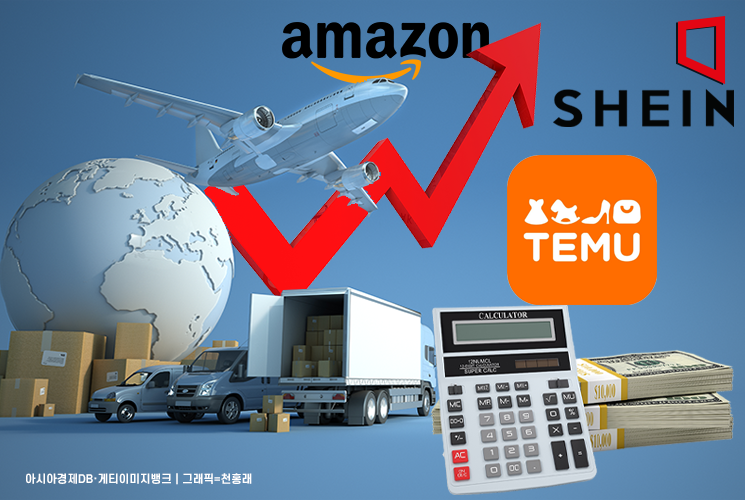
Because air cargo costs are generally higher than sea freight, it has mainly been used for high-value items such as smartphones and laptops, and perishable goods like fish and flowers. However, Temu and Shein are also using air cargo flights to transport inexpensive clothing and household goods overseas. Some analysts suggest that the U.S. duty-free policy on imported packages under $800 has made it easier for these companies to absorb bleeding costs. As a result, air cargo has become a haven for such low-cost Chinese manufactured goods, leading to the surge in freight rates.
The attacks on commercial ships in the Red Sea by Yemen’s Houthi rebels, which began earlier this year, also fueled the rise in rates as exporters turned to air cargo as an alternative. Air cargo industry analysis firm WorldACD mentioned in a report on the 13th of last month, “In recent weeks, port congestion and vessel capacity issues in certain key markets have worsened the chaos, driving more cargo owners to airlines.”
Despite high air cargo rates, fierce competition among companies to secure transport space is ongoing. Retailers are flocking to stockpile goods for the year-end holiday season, including Christmas, Thanksgiving, and Halloween. Because of this, some air cargo companies are reportedly urging clients to sign shipping contracts immediately, warning that it will be too late to finalize year-end volume contracts by around October.
The WSJ analyzed that if Amazon launches an ultra-low-price section targeting Temu and Shein starting this fall, air cargo rates could surge once again. Amazon recently revealed at a private conference its plan to directly ship orders from China to the U.S. with a goal of delivering ultra-low-price items under $20 within 9 to 11 days.
© The Asia Business Daily(www.asiae.co.kr). All rights reserved.
![Clutching a Stolen Dior Bag, Saying "I Hate Being Poor but Real"... The Grotesque Con of a "Human Knockoff" [Slate]](https://cwcontent.asiae.co.kr/asiaresize/183/2026021902243444107_1771435474.jpg)

















