Companies Introducing Robots Reduce Employment by About 2% Compared to Non-Adopters
Bank of Korea Economic Research Institute Analysis Shows Clear Robot Labor Substitution Effect
Companies Adopting AI Actually Increase Employment
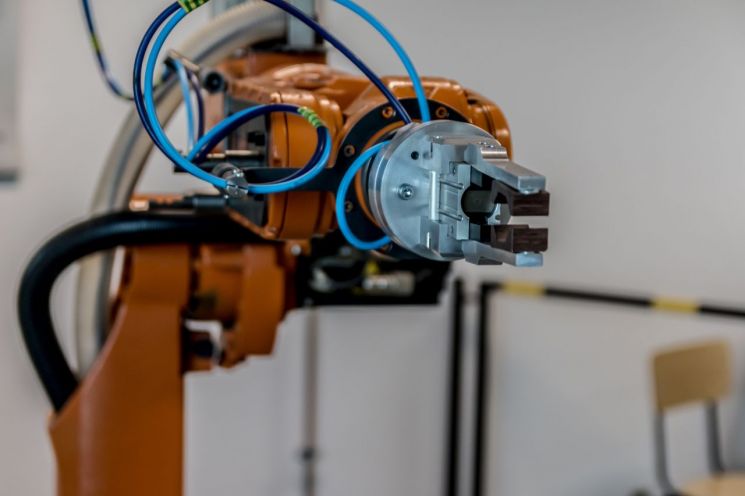
Companies that have introduced robots were found to have reduced employment compared to those that have not. On the other hand, artificial intelligence (AI) was found to have some employment creation effects, leading to calls for continued policy support.
According to the paper titled "An Empirical Analysis of the Impact of Automation Technology Adoption on Employment and Wages in Korean Companies," published in the Economic Analysis section of the Bank of Korea Economic Research Institute on the 2nd, the employment change rate of companies that introduced robots in Korea was on average about 2% lower compared to companies that did not. Employment refers to the total number of employees in the surveyed companies, and the analysis suggests that robots introduced in companies replaced about 2% of the workforce.
The study was conducted on 8,771 companies with 50 or more regular employees and capital of 300 million KRW or more, based on the Statistics Korea's Business Activity Survey.
Increasing Number of Companies Adopting Innovative Technologies such as Robots and AI
According to the survey, companies that adopted at least one of the Fourth Industrial Revolution technologies such as AI, robots, Internet of Things, and big data increased from 9.2% in 2017 to 15.4% in 2021. By individual innovative technology, the number of companies adopting AI increased about 2.5 times, and those adopting robots increased about 2.2 times from 2017 to 2021.
The top five industries with relatively high robot adoption were automobile, metal processing, electrical equipment, electronic components, and other machinery equipment, all belonging to manufacturing. The top five industries with high AI adoption included four service industries: computer programming, system integration and management, publishing, finance, and retail, with medical, precision, and optical instruments being the only manufacturing industry.
This indicates that in Korea, robots have mainly spread in manufacturing, while AI has mainly spread in services. However, the paper analyzed that if robots equipped with AI become widely distributed in the future, AI could rapidly be utilized in manufacturing as well, making it difficult to clearly distinguish between robots and AI.
In Korea, robots are mainly used for product and service development and production processes. In particular, in the automobile and trailer manufacturing industry, the proportion of companies using robots in production processes was remarkably high at 70.8%. Also, when considering all industries, companies using robots for marketing strategies or organizational management were only 1.0% and 1.6%, respectively, which is very low, and in the top five industries, almost no companies used robots in these two areas.
Unlike robots, AI is used not only in production processes but also extensively in other fields. In computer programming, system integration and management, and publishing industries, 66.7% and 89.8% of AI-adopting companies respectively used AI for product and service development, while in the finance industry, 45.0% adopted AI in marketing strategy.
Companies Introducing Robots Reduced Employment Compared to Non-Adopting Companies
Robots had a negative impact on employment. During the survey period, the average change rates of employment and real wages in companies that introduced robots were 0.9% and 1.8%, respectively, lower than the overall company period averages of 1.1% and 2.2%. The paper suggested that robot adoption likely reduced labor demand, negatively affecting employment and real wages.
Especially when limiting the analysis to companies with 300 or more employees, the employment growth rate of companies that introduced robots was on average 4.2% lower than that of non-adopting companies. This indicates that labor substitution by robots is more clearly observed in large companies with 300 or more employees.
On the other hand, companies adopting AI showed higher employment growth rates compared to all companies, but lower real wage growth rates. It is evaluated that AI played a positive role in employment through complementary interaction with human labor but did not lead to an increase in real wages.
Jeong Sora, a doctoral candidate in the Department of Economics at University of Seoul who authored the paper, stated, "The study confirmed the labor substitution effect of robots but found no evidence proving the labor substitution effect of AI. Rather, it is notable that the employment creation potential of AI was partially confirmed."
She added, "Considering the importance of international trade in our economy, promoting the adoption of automation technology is inevitable. However, since labor substitution by automation technology may cause technological unemployment in some industries, policy efforts to mitigate this are necessary."
© The Asia Business Daily(www.asiae.co.kr). All rights reserved.
![Clutching a Stolen Dior Bag, Saying "I Hate Being Poor but Real"... The Grotesque Con of a "Human Knockoff" [Slate]](https://cwcontent.asiae.co.kr/asiaresize/183/2026021902243444107_1771435474.jpg)















