"'I don't understand words like '섭취·급여·일괄'' Complaints Rise
Declining Literacy Becomes a Social Issue"
A daycare teacher expressed frustration over difficulties in communicating with parents, pointing out their literacy issues.
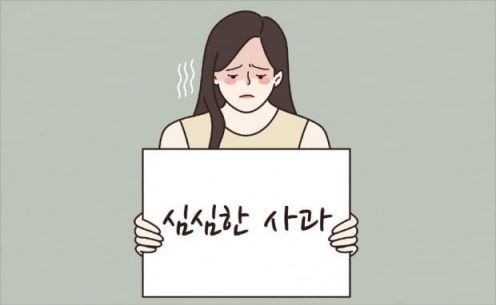 The phrase "sincere apology," which means a deep apology from the heart, sparked controversy among some people who questioned, "Why is the apology described as sincere?" [Image source=Getty Images Bank]
On the 1st, a person identifying as a daycare teacher named A shared on an online community that they were having trouble communicating with some parents. A said, "Usually, when we say '○○ is prohibited,' doesn't that naturally mean it is forbidden?" but added, "However, some parents interpret '금' (geum) as meaning 'the best' because the word contains '금'." A also mentioned, "When we announce a location change to ○○ due to rain, some ask if we are moving to the ○○ area 'during rain'," and lamented, "The number of parents who contact us without understanding words like 'consumption,' 'feeding,' or 'batch' has increased significantly compared to before."
A further explained, "Not only words, but they also have difficulty grasping the context of sentences," sharing, "When I said, 'It is allowed, but we recommend not doing it,' four parents asked, 'So is it allowed or not?'"
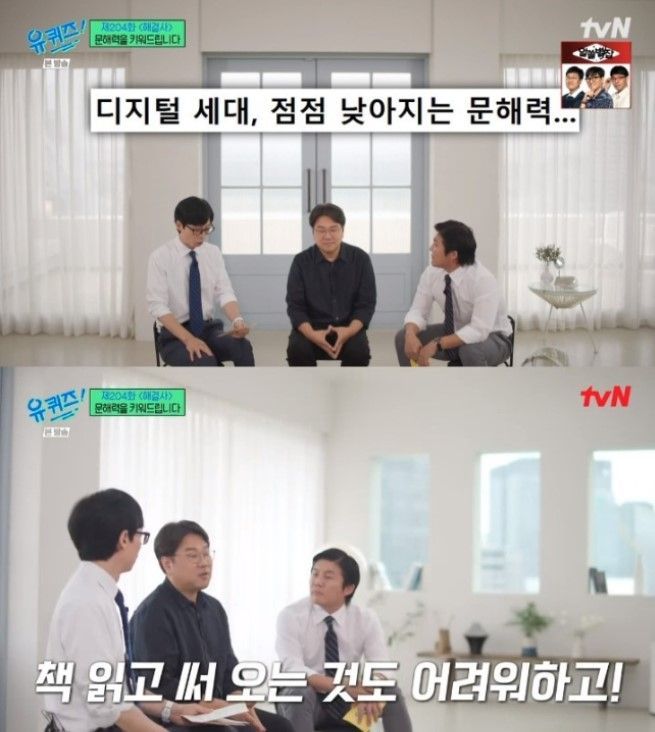 Professor Cho Byung-young of Hanyang University’s Korean Language Education Department appeared on tvN's 'You Quiz on the Block' last year and pointed out the phenomenon of declining literacy skills among some people.
 [Image source=tvN 'You Quiz on the Block' capture]
The controversy over some parents' literacy is not new. Professor Jo Byung-young of Hanyang University's Department of Korean Language Education appeared on tvN's 'You Quiz on the Block' last year and said, "When parents saw 'lunch provided' in a field trip notice, they asked, 'Why provide lunch? Please provide Korean food for our child,'" and added, "There was even an incident where parents returned textbooks to the librarian because they misunderstood the notice 'Return textbooks to the librarian in the library'."
Professor Jo pointed out, "They get information through videos and rarely read texts. They find reading long texts difficult," and noted, "Even at university, when told to read papers and study, their expressions turn sour." He continued, "Parents tell their children to read texts and books, but they themselves do not even read the home notices."
On the 26th of last month, Professor Jo attended the Seoul Metropolitan Office of Education's literacy and numeracy diagnostic test briefing and emphasized, "It is difficult to live with only functional literacy that finds the correct answer," adding, "Literacy that can handle questions from various perspectives is necessary in this era."
Meanwhile, a 2020 literacy test conducted by EBS on 2,400 middle school students showed that 27.0% of them did not understand their textbooks. This trend was also evident in academic achievement assessments conducted by the Ministry of Education. The proportion of students with average or above-average Korean language skills dropped from 77.5% in 2019 to 54.0% in 2022, a decrease of 23.5 percentage points. Conversely, the proportion of students below basic Korean proficiency doubled from 4.0% in 2019 to 8.0% in 2022.
© The Asia Business Daily(www.asiae.co.kr). All rights reserved.
![Clutching a Stolen Dior Bag, Saying "I Hate Being Poor but Real"... The Grotesque Con of a "Human Knockoff" [Slate]](https://cwcontent.asiae.co.kr/asiaresize/183/2026021902243444107_1771435474.jpg)
















