Deputy Prime Minister-Level Launch of the Ingu Jeonryak Gihwaegbu
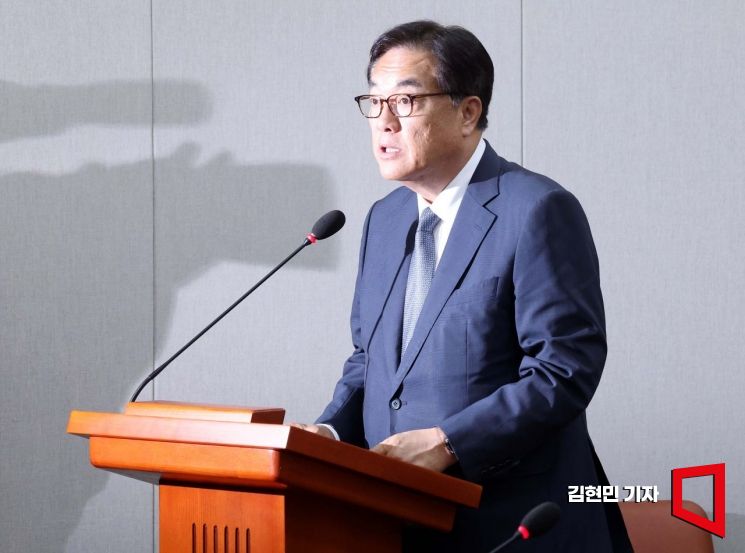 Jung Jin-seok, Chief of Staff to the President, is giving a greeting at the full meeting of the Steering Committee held at the National Assembly on the 1st. This Steering Committee meeting marks the first attendance of President's Office aides, including Chief of Staff Jung Jin-seok, since the opening of the 22nd National Assembly. Photo by Kim Hyun-min kimhyun81@
On the 1st, the Presidential Office announced that it plans to establish a Minister of Political Affairs position to overcome the 'minority ruling party' situation and strengthen communication with the opposition parties. This move comes as the need for cooperation has grown stronger following the ruling party's defeat in the April 10 general election. The government also plans to create a new ministry called the 'Population Strategy Planning Department' to address low birth rates through amendments to the Government Organization Act. The idea is to establish a deputy prime minister-level ministry with budget review authority to control population-related projects across various ministries.
On the morning of the 1st, the Ministry of the Interior and Safety and related ministries held a joint briefing at the Government Complex Seoul to announce the 'Government Organization Restructuring Plan' containing these details.
Jung Jin-seok, Chief Secretary of the Presidential Office, stated at the National Assembly Steering Committee plenary meeting that day, "We will establish the Minister of Political Affairs position to strengthen effective and substantial communication between the National Assembly and the government." He emphasized, "We will fully listen to the opinions of assembly members on major policy and state affairs, provide thorough explanations, and continue consultations."
The Minister of Political Affairs will serve as a cabinet member who is not the head of a specific ministry or agency but acts as a bridge between the Presidential Office, government, and National Assembly. Initially, the position started as a minister without portfolio and was called Minister of Political Affairs during the administrations of Chun Doo-hwan, Roh Tae-woo, and Kim Young-sam. The position was abolished during the Kim Dae-jung administration, revived as 'Special Minister' under the Lee Myung-bak administration, and abolished again during the Park Geun-hye administration.
In previous administrations, the Minister of Political Affairs was entrusted with the important role of swiftly conveying the president's messages to both ruling and opposition parties and maintaining close communication with the National Assembly, so influential figures in the administration typically held the post. A Presidential Office official said, "President Yoon has continuously considered strengthening political functions while emphasizing bipartisan cooperation following the recent general election defeat. We understand that candidates for the Minister of Political Affairs have not yet been decided, and related procedures will proceed depending on the National Assembly situation."
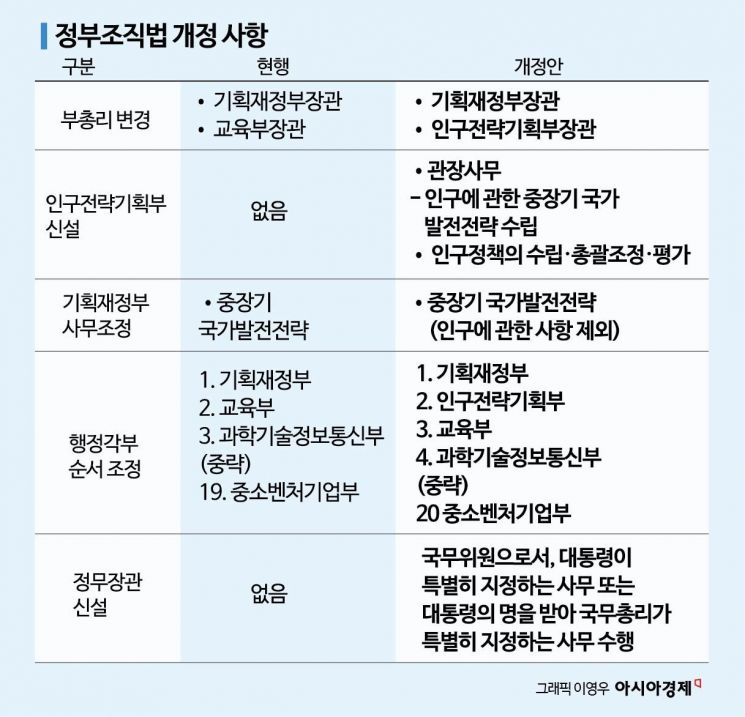
On the same day, the government also announced plans to establish the Population Strategy Planning Department, a deputy prime minister-level ministry that can comprehensively cover population policies including low birth rates, aging society, workforce, and immigration. The department will serve as a control tower responsible for planning, evaluation, budget allocation, and coordination related to population policies, with a social deputy prime minister. However, detailed policies and projects will be handled by respective ministries (Ministry of Health and Welfare, Ministry of Employment and Labor, Ministry of Gender Equality and Family), while the Population Strategy Planning Department will focus on broad strategic and planning functions.
To this end, population-related strategic tasks previously handled by the Ministry of Health and Welfare and the Ministry of Economy and Finance will be transferred to the Population Strategy Planning Department. The new department will have newly established functions for research, analysis, evaluation, and budget allocation and coordination. It will be responsible for preliminary research and analysis of low birth rate projects in each ministry and budget distribution. Additionally, the social deputy prime minister position will be changed from the Minister of Education to the Minister of the Population Strategy Planning Department. The Ministry of Education will be reassigned to assist the social deputy prime minister.
To establish the new ministry, the government will also pursue amendments to the Government Organization Act and the Framework Act on Low Birth Rate and Aging Society. The government plans to propose the amended bills within this month, as changes to the Government Organization Act are necessary for creating new ministries and adjusting functions between ministries. Furthermore, with the amendment of the Framework Act on Low Birth Rate and Aging Society, the current Presidential Committee on Low Birth Rate and Aging Society will be changed to an advisory committee under the Minister of the Population Strategy Planning Department. The committee's name will be changed to the 'Population Crisis Response Committee.'
© The Asia Business Daily(www.asiae.co.kr). All rights reserved.
![Clutching a Stolen Dior Bag, Saying "I Hate Being Poor but Real"... The Grotesque Con of a "Human Knockoff" [Slate]](https://cwcontent.asiae.co.kr/asiaresize/183/2026021902243444107_1771435474.jpg)
















