Kukgeum Center H2 Global Economy and International Financial Market Outlook Briefing
Fed, September Pivot + Possibility of 2 Rate Cuts Within the Year ↑
US Presidential Election, Expansionary Fiscal Policy to Continue Regardless of Winner
This year, the uncertainty of the global economy in the second half is expected to be greater than ever in the global policy process.
According to the "2024 Second Half Global Economy and International Financial Market Outlook and Key Issues" released by the International Finance Center on the 1st, the global economy in the second half of this year is expected to face increased uncertainty due to ▲ the direction of monetary policy between revitalizing the real economy and stabilizing prices ▲ the conflict between efforts to maintain fiscal soundness and increased spending during election seasons ▲ and policy pledge competition during the U.S. presidential election process.
The global economy is expected to continue moderate growth following the first half. This is due to improved demand conditions from a strong labor market in advanced countries, financial improvements in households and businesses, and China's economic stimulus measures. However, growth is expected to remain moderate due to burdens from high interest rates, depletion of excess savings, and sluggishness in China's real estate market. If mixed signals from U.S. indicators at year-end, weak recovery in the Eurozone, prolonged restrictive monetary policy in China, political instability in Europe, and U.S.-China protectionist measures continue, there is a possibility of growth slowing down.
The international financial market is expected to show moderate improvement due to widespread interest rate cuts in major countries, but concerns about the sustainability of the artificial intelligence (AI) boom and volatility expanding depending on each country's monetary policy and real economic growth pace are expected to persist.
Fed Likely to 'Pivot in September + Two Rate Cuts Within the Year'
The International Finance Center expects the U.S. Federal Reserve's (Fed) monetary easing to occur as a 'pivot in September + two rate cuts within the year.'
This is because although disinflation is delayed due to strong consumption and investment in the U.S. economy, ▲ the Fed's accommodative stance ▲ disinflation outlook for lagging items due to sustained high policy rates (such as housing costs, medical services, and auto insurance premiums) ▲ signs of labor market imbalance improvement and rising unemployment rate suggest that the Fed is likely to start rate cuts and expand the magnitude of cuts based on 'imperfect but substantial' disinflation.
Major investment banks (IBs) expect that following rate cuts in the Eurozone and Canada in June, the U.S. and Europe will continue to cut rates at a pace similar to the Eurozone's 'once per quarter.' The Eurozone is expected to reach its terminal rate by the end of next year.
China's Growth Rate Likely to Reach 5% This Year... Real Estate as a Variable
China's economic growth rate is expected to likely reach 5% this year. However, whether the real estate market bottoms out in the second half will be a key variable. China's economic growth rate in the first quarter was 5.3%, exceeding the forecast of 4.8%, and investment, production, and export indicators showed stability in April and May. However, the consumption growth rate slowed to 3.0%, and deflationary pressures persist.
The Chinese government plans to continue expansionary fiscal policy, including issuing special national bonds worth 1 trillion yuan this year, to stimulate domestic demand through infrastructure investment and replacement of old consumer goods. As a result, the fiscal deficit ratio is expected to expand to 7.4% of gross domestic product (GDP). However, as China's real estate market enters a structural transition period, there remains a significant risk of simultaneous contraction in the economy and consumer sentiment.
U.S. Presidential Election to Maintain 'Expansionary Fiscal Spending Stance' Regardless of Outcome
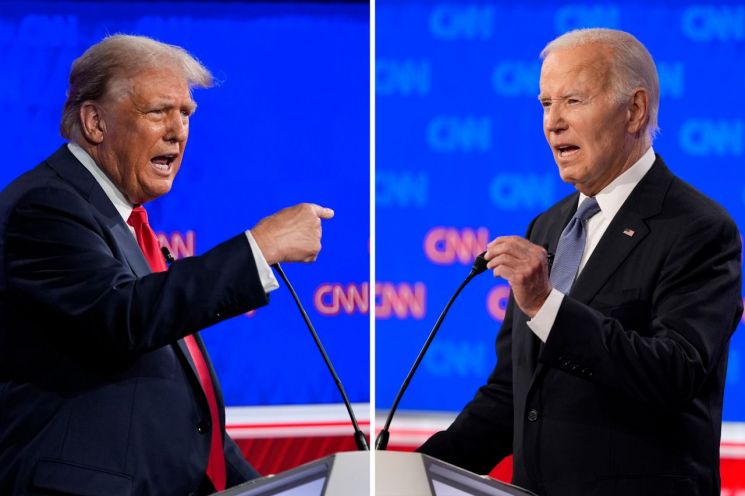
Regardless of whether Biden or Trump wins the U.S. presidential election, the 'expansionary fiscal spending stance' is expected to be maintained. However, since the two candidates have clear differences in areas such as the continuation of the Inflation Reduction Act (IRA), corporate and personal income tax levels, universal tariff imposition, China and Russia strategies, green policies, and immigration systems, significant differences in specific directions are anticipated. Since the stock market has mostly risen before and after U.S. presidential elections since the 1980s, the overall upward trend in stock prices is expected to continue.
The U.S.-China confrontation is expected to continue regardless of the election outcome, and its impact is analyzed to extend beyond the two countries. With the global trade share relative to GDP rising to 63% in 2022, concerns about the expanded impact of trade sanctions have been raised. In fact, amid the strengthening of global protectionism, new trade restrictions have increased more than fivefold in the past six years. As the international order changes with economic bloc formations among advanced and emerging countries, some countries are expected to experience a balloon effect with expanded new export demand replacing China.
The AI industry is currently analyzed to be in an early phase focused on infrastructure investment. Future points of interest will be the direction of large-scale capital expenditure competition among big tech companies and the performance of AI-related stocks. Currently, AI adoption in actual industrial sites remains low compared to large-scale infrastructure investment, and monetization of investments is slow. Also, sales increases in AI semiconductor companies such as Nvidia are limited to a few companies, so while AI is expected to establish itself as a long-term theme in the stock market, short-term correction pressures are expected to increase in the second half.
© The Asia Business Daily(www.asiae.co.kr). All rights reserved.
![Clutching a Stolen Dior Bag, Saying "I Hate Being Poor but Real"... The Grotesque Con of a "Human Knockoff" [Slate]](https://cwcontent.asiae.co.kr/asiaresize/183/2026021902243444107_1771435474.jpg)















