330 million 50,000-won Bills in Circulation... Record High
Half of the Banknotes in Circulation Are 50,000-won Bills
"Due to Increased Foreign Exchange Demand and Reserve Value Storage Purpose"
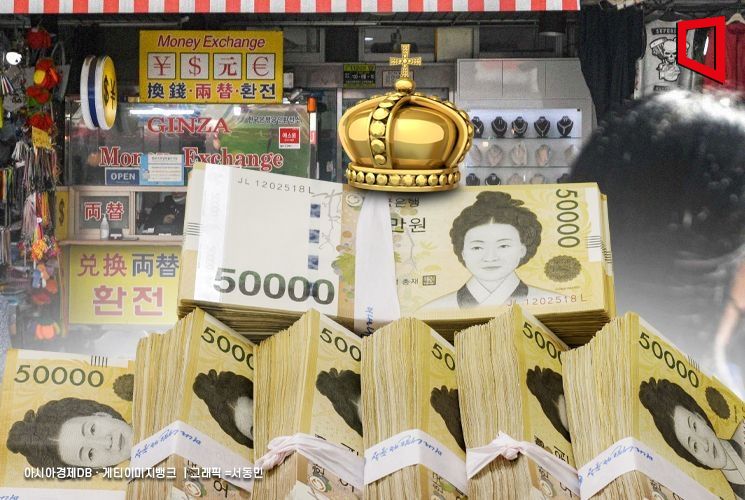
Although cash usage is decreasing, the number of 50,000 won bills circulating in the market has reached an all-time high.
According to the Bank of Korea's Economic Statistics System (ECOS) on the 1st, the outstanding amount of 50,000 won bills by denomination (based on the end balance and number of bills) last month was 3.312 billion bills, the highest since the introduction of the 50,000 won bill in June 2009.
The outstanding amount of currency refers to the scale of cash circulating in the market, excluding the money withdrawn by the Bank of Korea from the currency supplied to the market.
The issuance volume of 50,000 won bills has steadily increased since its introduction in June 2009. After about 50 million bills were issued in June 2009, it surpassed 1.05 billion bills in November 2014, 2.05 billion bills in August 2019, and 3.03 billion bills in April 2022 consecutively.
It was found that about half of the bills circulating in the market are 50,000 won bills. Last month, the outstanding amount by denomination (based on the end balance and number of bills) was 6.799 billion bills, with 3.312 billion bills of 50,000 won issued, accounting for about 49% of the total. The 10,000 won bills accounted for 23%, 5,000 won bills 4%, and 1,000 won bills about 24%.
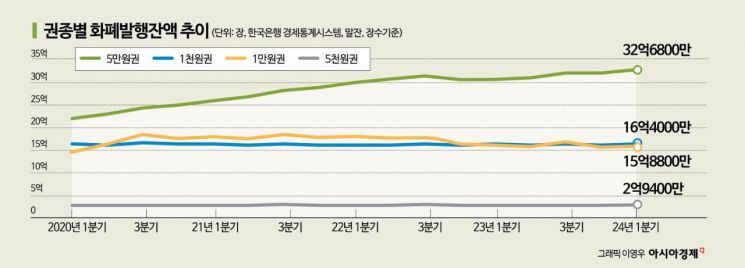
The issuance volume of 50,000 won bills surpassed that of 10,000 won bills for the first time in May 2017. In June 2009, when the 50,000 won bill was introduced, out of the total issuance volume of 3.99 billion bills by denomination, 10,000 won bills accounted for 2.559 billion bills, or 64% of the total. However, in May 2017, the issuance volume of 50,000 won bills (1.6 billion bills) surpassed that of 10,000 won bills (1.594 billion bills) for the first time, and at that time, 10,000 won bills accounted for only about 32% of the total issuance volume.
The issuance volume of bills other than the 50,000 won bill is gradually decreasing. The issuance volume of 10,000 won bills peaked historically at 2.923 billion bills in January 2009, then showed a declining trend, decreasing to 1.569 billion bills last month. The 1,000 won bills showed a slight increase but have slowed down at around 1.6 billion bills since August 2019.
Even in terms of the outstanding amount by value, the share of 50,000 won bills is overwhelming. Last month, out of the total currency outstanding amount (based on the end balance and value) of 186.8184 trillion won, 50,000 won bills accounted for 88.6%. In contrast, 10,000 won, 5,000 won, and 1,000 won bills accounted for 8.4%, 0.78%, and 0.9%, respectively.
This is interpreted as a result of changes in the usage of denominations due to the activation of non-cash payment methods, inflation, and improved income levels. A Bank of Korea official explained, "With the recent activation of non-cash payment methods such as mobile payments and credit cards, the utilization of low-denomination bills like 1,000 won and 5,000 won has significantly decreased," adding, "The 10,000 won bill used to be considered a high denomination and was evenly used for commerce, ceremonial occasions, and as a means of value storage, but now its denomination value has decreased."
The expansion of currency demand as a means of reserve value storage and the increase in foreign tourists have also influenced the rise in 50,000 won bills. A Bank of Korea official said, "The 50,000 won bill is used as a means of reserve value storage and for commercial purposes, replacing the former 10,000 won bill," adding, "Recently, the demand for currency exchange has increased significantly as foreigners travel to Korea, and the demand for currency as a means of reserve value storage has also increased due to the decline in interest rates."
© The Asia Business Daily(www.asiae.co.kr). All rights reserved.
![Clutching a Stolen Dior Bag, Saying "I Hate Being Poor but Real"... The Grotesque Con of a "Human Knockoff" [Slate]](https://cwcontent.asiae.co.kr/asiaresize/183/2026021902243444107_1771435474.jpg)

















