Hyundai Glovis CEO Investor Day
Securing Rapidly Increasing Export Volume of Chinese Cars
Massive Investment of 9 Trillion KRW by 2030
Increasing Circulating Shares through Free Stock Dividend
Hyundai Glovis has set an aggressive goal to increase the proportion of non-affiliated company sales to 40% by 2030. The plan is to secure the growing volume of Chinese car exports worldwide and expand its new customer base. It will invest 9 trillion won by 2030 for new investments such as car carriers.
On the 28th, Hyundai Glovis CEO Lee Gyubok announced this at the '2024 CEO Investor Day' held at the Fairmont Hotel in Yeouido, Seoul. CEO Lee said, "We will expand our main customer base to non-affiliated OEMs and broaden our business scope from the automotive industry to other industries," adding, "We plan to exceed the non-affiliated sales ratio target of 40% and ultimately achieve 50%." Currently, Hyundai Glovis's non-affiliated sales ratio is around 20%.
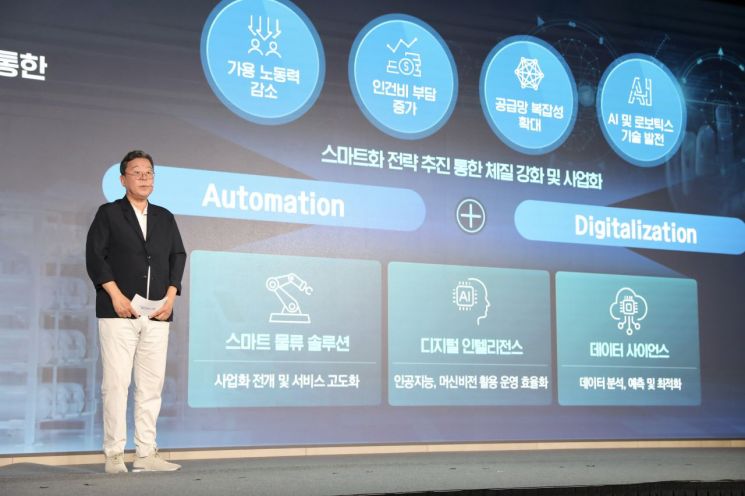 Hyun Kyu-bok, CEO of Hyundai Glovis, is presenting the mid- to long-term business strategy at the '2024 CEO Investor Day' held on the 28th at the Fairmont Hotel in Yeouido, Seoul.
 [Photo by Hyundai Glovis]
To achieve this goal, Hyundai Glovis plans a large-scale investment of about 9 trillion won by 2030. Compared to the average annual investment of 400 billion won over the past five years, this is a very bold investment. Specifically, 36% will be allocated to logistics business, 30% to shipping, 11% to distribution, and 23% to strategic investments for new business expansion.
In particular, the company will increase investment in ultra-large vessels in the car carrier sector, which is its cash cow. The current annual volume of finished car maritime transport, about 3.4 million units, is planned to increase to approximately 5 million units by 2030. This corresponds to a 20% market share of the global finished car maritime transport volume (24 million units) expected by the industry. CEO Lee said, "Our goal is a very high figure even considering Hyundai Motor and Kia's global sales targets," and confidently added, "If the plan goes as expected, we can aim to become the number one in the global car carrier market."
Hyundai Glovis's confidence in the automotive maritime transport sector stems from the recent rapid increase in global exports by Chinese finished car manufacturers. Chinese car exports, which were only 2.5 million units in 2022, increased to about 5 million units last year, and this year is forecasted to reach 6 million units.
CEO Lee said, "Chinese OEMs are likely to explore entry into emerging markets, and we have already built a network focused on emerging countries," adding, "We leverage this strength to propose total logistics services to Chinese companies." He continued, "Some Chinese OEMs have even counter-proposed that if we allocate space on car carriers, they would offer logistics service collaboration opportunities in emerging markets."
According to the industry, the current scale of car exports that Chinese finished car and shipping companies can transport on their own is about 1.5 to 2 million units. This is far below the annual export volume of 5 million units from China. Hyundai Glovis plans to penetrate the rapidly growing Chinese car export market and increase the proportion of non-affiliated company sales. To this end, it will expand its car carrier fleet to 128 vessels by 2030. Six vessels are already being newly built with an investment of 1 trillion won, and 22 vessels have been leased long-term. Moreover, the new vessels will be ultra-large ships capable of carrying up to 10,000 units, improving operational efficiency per vessel by 15% compared to current ships.
Hyundai Glovis will also increase orders from non-affiliated companies in automotive semi-knocked down (KD) parts exports and used car supply chain management (SCM). It will strengthen the 'end-to-end (E2E) logistics solution business' covering the entire logistics process from cargo departure to final arrival. While previously only automotive parts were transported, the scope will now expand to upstream and downstream industries such as electric vehicle batteries, construction machinery, and energy equipment. Additionally, it plans to expand the eco-friendly business of used electric vehicle batteries as a pillar of sales growth.
At the same time, Hyundai Glovis has set a sales target of about 40 trillion won by 2030 and aims to raise its operating profit margin to 7%. To enhance shareholder value, it will conduct a 1:1 stock dividend, increasing the number of issued shares from 37.5 million to 75 million.
© The Asia Business Daily(www.asiae.co.kr). All rights reserved.
![Clutching a Stolen Dior Bag, Saying "I Hate Being Poor but Real"... The Grotesque Con of a "Human Knockoff" [Slate]](https://cwcontent.asiae.co.kr/asiaresize/183/2026021902243444107_1771435474.jpg)











