TableOrder Installed Stores Account for Only 3% of Potential Demand
Industry Leader TOrder's Sales Up 77% Year-on-Year
Fierce Competition as Large Corporations Like KT Enter the Market
#. Minchae Kim (32), who has been running a salad shop in Dongjak-gu, Seoul for three years, installed a table order system eight months ago. Table order is a service where customers place orders directly using a tablet installed on the table, which is linked in real-time to the kitchen and POS system. The tablets installed on about 10 tables in the salad shop perform the work equivalent to 1.5 staff members. Kim said, "When hiring employees, you inevitably have to pay a lot of attention, but table order requires less effort, so it is convenient," adding, "If I expand the store, I plan to sign another contract."
#. Yongsun Jo (39), who works at a fish cake soup restaurant in Yeouido, has significantly reduced work stress thanks to table order. Since customers order directly via the tablet, mistakes such as missed orders do not occur. Jo said, "I can focus on other tasks during the time I used to spend taking orders and entering them into the POS system."
As the popularity of table order grows, the market is rapidly expanding. It is being presented as a solution to high labor costs and labor shortages, and many stores are adopting table order. Employee satisfaction at stores using the system is also high. Currently, stores equipped with table order account for only about 3% of the estimated potential demand in the industry, and fierce competition among companies to capture this market is expected to intensify.
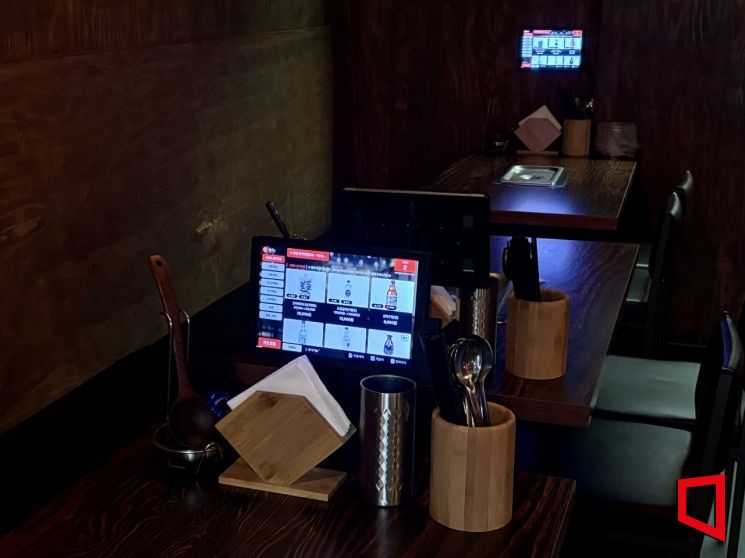
According to the related industry on the 1st, it is estimated that there are 300,000 stores capable of introducing table order services, such as those with more than 10 tables and annual sales exceeding 100 million KRW. This is based on the 2022 data on domestic restaurants, pubs, and other food service establishments surveyed by the Korea Agro-Fisheries & Food Trade Corporation. Among these, about 10,000 stores have adopted table order.
The industry expects that by 2028, more than 150,000 stores will be using table order services. When using table order, an average contract period of about three years is set, and a monthly usage fee of around 30,000 KRW per tablet is charged. If a store with 10 tables pays 3.6 million KRW annually, expanding to 300,000 stores would mean the market could grow into a 1 trillion KRW industry. An industry official said, "Although it is difficult to grasp the exact figures, as of June, less than 10% of restaurants in the domestic food service market have installed table order," adding, "Since the domestic adoption rate is low and there is demand overseas as well, the table order market is bound to grow further."
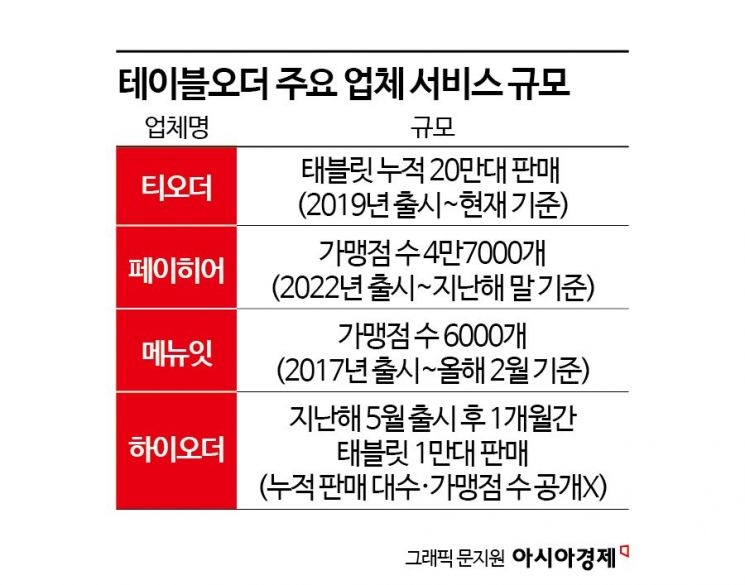
The company holding more than half of the current table order market share is TOrder. Founded in 2019, TOrder has sold over 200,000 tablets to date. Leveraging the advantage of being compatible with more than 30 types of POS systems, it sells about 13,000 tablets monthly on average, generating revenue. TOrder's sales last year reached 58.7 billion KRW, a 77% increase compared to the previous year, showing steady growth since its establishment. Major clients include Yeokjeon Halmeoni Maekju, Cheongdam Schedule, and Jeju Grand Hyatt, and recently, it has signed agreements with franchises such as Uhujuksun and Dadahada.
Startups like PayHere and MenuIt are also securing clients through partnerships with franchise stores. Since its launch in 2022, PayHere has surpassed 47,000 franchise stores by last year, and MenuIt has provided services to about 6,000 stores from 2017 until February this year, mainly through tablet rentals. Recently, table order services that allow ordering via QR codes attached to store tables or smartphone Near Field Communication (NFC) tags have also been launched. These include TagHere, HandOrder, and TableRo. Since they do not require separate electronic devices like tablets, there is no installation cost, and they do not interfere with interior design, which drives demand.
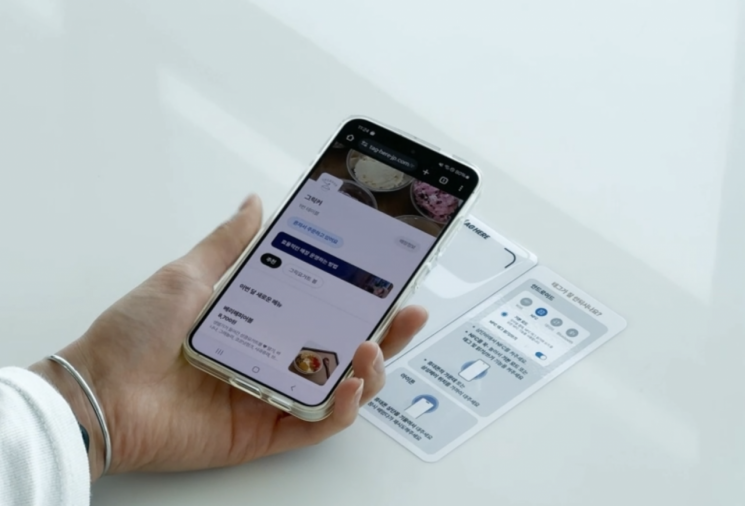 Table order service through Taghere's smartphone Near Field Communication (NFC) tags
 [Photo by TM Rfounders]
Large corporations have also entered the table order business, intensifying competition. KT launched 'HiOrder' in May last year and set a record by selling 10,000 tablets within one month. A KT official said, "As of June, we have partnered with 69 franchises including Kyochon Chicken, Hyundaiok, and SNS Company," adding, "Our goal is to become the number one in monthly new subscriptions in the market based on KT's stable network expertise."
© The Asia Business Daily(www.asiae.co.kr). All rights reserved.
![Clutching a Stolen Dior Bag, Saying "I Hate Being Poor but Real"... The Grotesque Con of a "Human Knockoff" [Slate]](https://cwcontent.asiae.co.kr/asiaresize/183/2026021902243444107_1771435474.jpg)


















