In the 2000s, when feature phones were the cutting-edge communication devices, phone decoration was popular and has now shifted to messenger “Puku (Profile Decoration)” mainly among the MZ generation. It involves expressing one’s unique personality by adding decorative elements such as cutout photos, stickers, emoticons, and playlists to profile background pictures.
Despite advances in the digital environment, the desire to decorate communication channels remains strong. B2B2C (business-to-business-to-consumer) communication services, which were predicted to naturally disappear due to digitalization, still maintain a solid presence today.
Lettering (caller information display) services show sender information or phrases pre-designated by companies or individuals on the recipient’s mobile phone. First introduced in 2003, it has evolved into smart lettering that displays various content such as company logos, videos, illustrations, and advertisements. Recently, original lettering services have been gaining more prominence.
Sejong Networks’ lettering service provides more professional communication infrastructure based on the technology and know-how accumulated as a leading domestic long-distance telecommunications operator. It offers ‘Biz Lettering’ for institutions with a high volume of outgoing calls such as financial institutions, customer centers, and insurance companies, and ‘Office Lettering’ for small and medium-sized enterprises, startups, and individual customers with relatively fewer outgoing calls, allowing users to choose plans according to their needs. Various companies including MG Credit Information, Woongjin Coway, and Naver are using the lettering service. For example, MG Credit Information uses the lettering service to display its name on the mobile phone screens of customers using Saemaeul Geumgo insurance products, and Woongjin Coway uses the service for various wired customer center tasks such as rental reception confirmation and happy calls.
Local governments are also actively adopting lettering services. Jeonju City and Gochang County in Jeollabuk-do are implementing lettering services to prevent phone scams impersonating government offices and to enhance the reliability of administrative calls. When calling citizens, the smartphone screen of the citizen displays the image of the relevant government office such as city or county hall, along with the department name and phone number. At the end of the call, card news and promotional videos are shown to provide information about various local events. The service is initially provided only on Android-based smartphones with the ‘Visible ARS Service Sharing App’ installed. Due to Apple’s policies, iPhones and Android phones without the app installed are replaced by a ‘missed call notification’ service via Kakao AlimTalk.
The short message service (SMS), which opened the era of text communication in 1997, remains a major communication service including international SMS and RCS messages, despite mobile messenger apps equipped with additional functions such as shopping, calendars, and maps becoming essential tools for modern people.
It is commonly used for sending sign-up codes and account recovery authentication by global platforms like Meta and Google, and is also popular as a communication service with global fandoms. Last month, NHN Cloud supplied its proprietary messaging-specialized solution ‘NHN Notification’ international SMS service to the fandom business total solution ‘Bstage.’ About 130 artists (idols) and e-sports teams have adopted ‘Bstage’ as a communication channel with fans. Through this international SMS service integration, they notify global fans about artists’ and teams’ events and schedules, and provide information on fandom membership registration, merchandise/ticket orders, and delivery status.
Additionally, in the recent messaging market, ‘RCS (Rich Communication Suite)’ is gaining attention among users who complain about fatigue from spam and smishing. RCS is a text message standard developed and adopted by the Global System for Mobile Communications Association (GSMA) to provide mobile carriers’ text services with more extensible specifications. It supports functions such as text, image and video transmission between users, message recall, group chat, and action buttons.
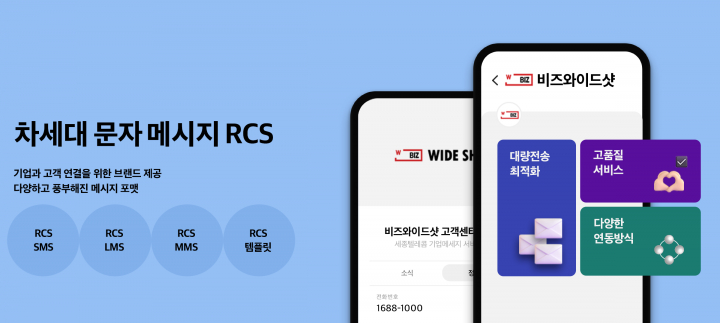
Since 2022, Sejong Networks has been providing next-generation business solutions by building an integrated messaging platform equipped with RCS messaging.
Sejong Networks’ ‘WideShot Biz Messaging’ solution is an integrated messaging platform that allows sending text (SMS, LMS, MMS), RCS messages, and KakaoTalk messages all at once anytime and anywhere through a website without separate apps or system integration. In particular, the smart module-based ‘RCS message’ carries an official certification mark, guaranteeing the sender’s identity, making it clearly distinguishable from spam and smishing messages, which is driving increased demand.
It also offers various templates such as card type and thumbnail type, enabling more intuitive message sending through large images and action button insertion. Thanks to advanced administrator functions, filtering and reporting are easy. Integration with the 080 free opt-out service automatically filters out opt-out lists, and real-time transmission success rates, usage status, and sending results of messages can be checked in detail, helping focus on more efficient channels.
Vice President Kang Hyo-sang of Sejong Networks said, “As the corporate messaging market volume continues to grow, we are developing and planning differentiated functions to expand user experience and support broader business means. Despite the rapid development of communication environments, we will continue to strive to fulfill our role as a telecommunications operator by ensuring that advanced technologies are used properly in daily life under the value that technology should aim for people and public interest.”
© The Asia Business Daily(www.asiae.co.kr). All rights reserved.

















