Coast Guard Strengthens Summer Water Leisure Safety Management
Free Inspection of Water Leisure Equipment and Campaign to Promote Safety Culture
The Korea Coast Guard announced on the 27th that it will strengthen safety management for water leisure activities until October, coinciding with the peak summer season.
The Coast Guard plans to enhance on-site inspections and safety patrols focusing on 225 major water leisure vessel departure and arrival points nationwide and 174 accident-prone maritime areas. Additionally, to prevent drifting accidents, which account for more than 80% of accident types, free inspections of powered water leisure vessels will be conducted mainly by 20 Coast Guard stations across the country.
Along with this, to ensure safe water leisure activities for the public, safety guideline videos will be produced and promoted, and a self-check promotional video for outboard motors (engines) will also be created and distributed to local governments nationwide.
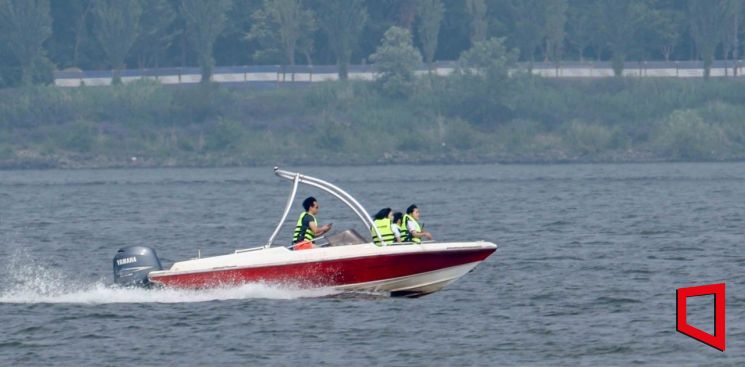 Citizens are enjoying motorboats on the Han River in Yeouido, Seoul. Photo by Jinhyung Kang aymsdream@
According to the Coast Guard, from 2021 to last year, 71% (321 out of 452) of all water leisure vessel accidents occurred during the peak summer season from May to October.
By accident type, grounding was the most frequent with 126 cases (27.9%), followed by collisions with 104 cases (23.0%), capsizing with 94 cases (20.8%), and flooding with 61 cases (13.5%). When including drifting accidents, which numbered 1,993 cases, the total water leisure vessel accidents over the past three years reached 2,445.
The Coast Guard analyzed that most accidents were caused by safety negligence such as poor engine maintenance and failure to comply with navigation rules.
The Coast Guard plans to intensively crack down on violations directly related to safety, including unlicensed operation, failure to report long-distance water leisure activities, lack of insurance, failure to undergo safety inspections, drunk operation, and not wearing life jackets.
In particular, the actual wearing rate of life jackets, known as the "seatbelt of the sea," was found to be very low. Among about 5,000 people involved in coastal accidents over the past five years, only about 630 (14%) were wearing life jackets. Moreover, among approximately 550 fatalities, about 500 (91%) were not wearing life jackets.
Wearing a life jacket prevents sinking if one falls into the water, helps maintain body temperature underwater, and makes it easier to be spotted for quick rescue.
On the 1st of this month, at Mallipo Beach in Taean, Chungnam, one person drowned after playing in the water without wearing a life jacket, and on the 31st of last month, a resident collecting seafood near Suwon Neulhang in Namhae, Gyeongnam, drowned after slipping, and it was also confirmed that the person was not wearing a life jacket.
Kim Jong-wook, Commissioner of the Coast Guard, said, "We plan to conduct thorough safety management and intensive crackdowns so that the public can enjoy safe water leisure activities," and urged, "Please follow safety rules such as checking the condition before departure, confirming the weather, and wearing life jackets."
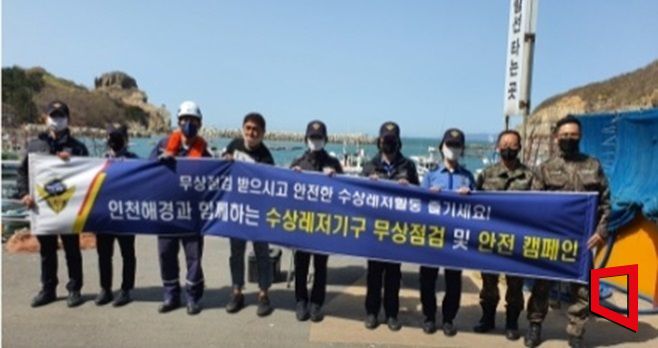 The Coast Guard is strengthening campaigns and crackdowns for water leisure safety management in response to the peak summer season.
 [Photo by Korea Coast Guard]
© The Asia Business Daily(www.asiae.co.kr). All rights reserved.
![Clutching a Stolen Dior Bag, Saying "I Hate Being Poor but Real"... The Grotesque Con of a "Human Knockoff" [Slate]](https://cwcontent.asiae.co.kr/asiaresize/183/2026021902243444107_1771435474.jpg)
















