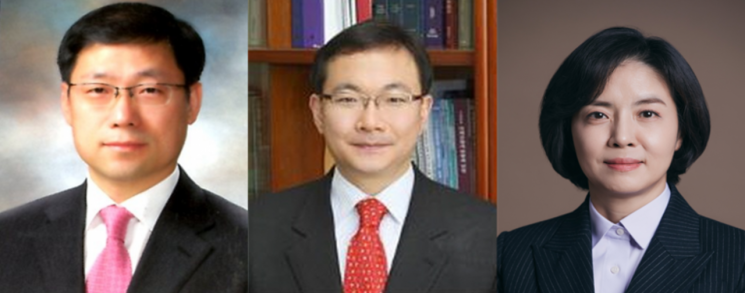
 On the 27th, Chief Judge Noh Kyung-pil of Suwon High Court, Chief Judge Park Young-jae of Seoul High Court, and Judge Lee Sook-yeon of the Patent Court were nominated as candidates for Supreme Court Justice. (From left) Photo by the Supreme Court
Chief Justice Cho Hee-dae on August 27 recommended to President Yoon Seok-yeol the appointment of No Kyung-pil, Chief Judge of Suwon High Court (59, Judicial Research and Training Institute Class 23), Park Young-jae, Chief Judge of Seoul High Court (55, Class 22), and Lee Sook-yeon, High Court Judge of the Patent Court (55, Class 26) as successors to Supreme Court Justices Kim Seon-su, Lee Dong-won, and Noh Jeong-hee, who are retiring on August 1 upon completion of their terms.
On the same day, the Supreme Court stated, "The Chief Justice, considering opinions from various sectors of society to appoint the most suitable candidates as Supreme Court Justices, disclosed the major rulings or work records of nine candidates recommended by the Supreme Court Justice Candidate Recommendation Committee and established an official opinion submission process to gather diverse views from both inside and outside the judiciary."
It added, "The Chief Justice listened to the public's call for diversification of the Supreme Court's composition and respected the recommendations of the Candidate Recommendation Committee. Among the candidates, those who possess professional legal knowledge and rational, fair judgment abilities to resolve disputes fairly and promptly through rulings faithful to law and principles, a firm belief in judicial independence, a commitment to protecting socially vulnerable and minority groups, insight and inclusiveness to reflect societal changes and diverse values, as well as morality and excellent character aligned with the public's expectations, were selected and recommended."
Once President Yoon submits the appointment consent bill to the National Assembly, the process for appointing successors to the Supreme Court Justices, including confirmation hearings, will officially begin.
No Kyung-pil, Chief Judge, graduated from Gwangju High School and Seoul National University Law School. He passed the 33rd Judicial Examination in 1991, completed the Judicial Research and Training Institute as Class 23, and was appointed as a judge at Seoul District Court in 1997.
Since his appointment as a judge at Seoul District Court in 1997, he has handled various civil, criminal, and administrative cases at courts nationwide including Seoul, Suwon, Gwangju, and Daejeon for about 27 years. He is known as a judge trusted by litigants due to his expertise in trial practice and profound legal knowledge.
In particular, he served as a Supreme Court Judicial Researcher for five years in the Constitutional and Administrative Division, deeply reviewing numerous disputes related to constitutional and administrative law, leading efforts to promote and realize citizens' fundamental rights, participation rights in administrative procedures, and tax justice. While serving at Seoul High Court and Suwon High Court, he was in charge of the Administrative Trial Division and was praised for issuing reasonable rulings that anyone could accept regarding facts and legal principles.
As a leading expert in constitutional and administrative law, he authored several research papers on administrative litigation and administrative acts and served as a member of the Ministry of Justice's Administrative Litigation Law Revision Committee, faithfully bridging theory and practice. He also contributed to the revision and co-authorship of the court practice manual on administrative matters, which serves as a reference for frontline judges, helping establish efficient administrative litigation practices. Additionally, Judge No has strived to write concise and readable rulings.
While serving as Chief Judge of Suwon High Court, he presided over the appeal trial of the so-called 'Cheongdam-dong Stock Tycoon Parents Murder Case,' in which the parents of Mr. Lee, known as a stock tycoon in Cheongdam-dong, were murdered by Mr. Kim and Chinese nationals. When the defendants were additionally indicted on charges such as conspiracy to commit robbery in the first trial, he pointed out procedural errors for failing to clearly confirm the defendants' intention for a citizen participation trial. Respecting the defendants' wish for a citizen participation trial in the appeal, he overturned the first trial's life imprisonment sentence and remanded the case to the first trial court. While fully guaranteeing the defendants' procedural rights, he apologized to the victims and bereaved families for the court's error that led to retrial, playing a flexible mediator role between the conflicting parties.
Park Young-jae, Chief Judge, graduated from Baejeong High School and Seoul National University Law School and first donned the judicial robe as a judge at Seoul District Court Eastern Branch in 1996. He served at Busan High Court and Seoul High Court and worked as a professor at the Judicial Research and Training Institute in 2009. He has extensive judicial administrative experience, having served as Personnel Officer and Planning and Coordination Director at the Court Administration Office, and as Deputy Director of the Court Administration Office during former Chief Justice Kim Myung-soo's tenure.
He has handled various civil, criminal, and administrative cases at courts nationwide including Seoul, Daejeon, Suncheon, and Busan for about 28 years. Having served as a professor at the Judicial Research and Training Institute, deliberator and Planning and Coordination Director at the Court Administration Office, and Deputy Director of the Court Administration Office, he is highly regarded for his judicial administrative capabilities and for promoting various policies to improve the judicial system.
In 2015, he led the Judicial Training Reform TFT team established at the Court Administration Office, preparing reform plans for the judicial training system to respond to changes in the judicial environment such as the unification of the legal profession and demands for strengthening the practical educational function of judicial training. From 2016 to 2017, he served as head of the Gender Equality Research Group established at the Court Administration Office under the Gender Law Research Association, introducing gender-sensitivity education into judicial training, respecting victims' wishes, and establishing victim recovery support measures including procedures led by gender equality judges and a gender equality counseling committee system. He also contributed to establishing a culture of gender equality within the courts by producing a gender equality guidebook and achieving various outcomes.
While serving as Chief Judge of Seoul High Court, he ruled that even if a worker reaches retirement age during a lawsuit seeking invalidation of suspension and dismissal disciplinary actions, if the disciplinary action results in disadvantages such as reduction of retirement benefits, the worker has an interest in seeking invalidation of the disciplinary action. Furthermore, if the disciplinary review decision was not made within the deadline set by the collective agreement without justifiable reasons, and the worker reached retirement age before the review decision, the original disciplinary action becomes invalid. This ruling is praised for broadly recognizing the interest in disputing disciplinary actions and clearly stating that procedural requirements must be observed in disciplinary reviews, thereby strongly protecting workers' rights.
Meanwhile, Judge Park successfully promoted various judicial policies by smoothly building internal and external cooperative relationships and widely listening to diverse opinions inside and outside the courts, based on his excellent communication skills and leadership while serving as Planning and Coordination Director and Deputy Director of the Court Administration Office.
He devoted himself to improving the quality of judicial services to the public by focusing on increasing the number of judicial researchers, establishing the criminal electronic litigation system and future registration system, improving the criminal deposit system, preparing measures to respond to abuse of litigation rights, introducing a system for submitting civil appeal briefs, opening new courts, and constructing or expanding courthouses at various levels.
Lee Sook-yeon, High Court Judge, graduated from Yeouido Girls' High School and Pohang University of Science and Technology with a degree in Industrial Engineering. She was appointed as a judge at Seoul District Court Western Branch in 1997. She has served in the Court Administration Office's Planning and Coordination Office and as an Information Technology Deliberator. Currently, she chairs the Supreme Court's Artificial Intelligence Research Committee and works as an adjunct professor in the Department of Computer Science at KAIST, known for her expertise in information and communication technology and intellectual property rights.
Since her appointment in 1997, Judge Lee has handled various civil, criminal, patent, and administrative cases at courts nationwide including Seoul, Jeju, and Changwon for about 27 years, demonstrating outstanding work ability based on profound legal principles and deep understanding of social phenomena.
While focusing on judicial duties, she also engaged in legal research, authoring numerous books, papers, and case commentaries across diverse fields such as "Current Status and Challenges of Domestic and International Norm Establishment Related to Artificial Intelligence," "Study on the Legal Principles of Bribery and Third-Party Bribery," "Evidentiary Capacity and Investigation Methods of Digital Evidence," and "Study on Investor Protection in Financial Investment Products."
In 2011, as the first female judge to serve as a warrant judge at Seoul Central District Court, she contributed to rationally limiting the scope and methods of seizure and search of electronic information and fully guaranteeing the participation rights of the searched parties by revising and supplementing the annex form attached to search warrants for electronic information, based on her doctoral dissertation "Handling and Evidentiary Capacity of Digital Evidence in Criminal Proceedings" and incorporating opinions from criminal judges and investigative agencies.
She also contributed to raising gender sensitivity and establishing a culture of gender equality within the courts by serving as chair of the Gender Law Research Association and authoring several papers, focusing on research and educational activities to protect socially vulnerable groups such as children, women, and persons with disabilities.
While serving as a High Court Judge at Seoul High Court, she ruled on state compensation claims by plaintiffs who were arrested and detained for violating Emergency Measure No. 9, finding the emergency measure unconstitutional and invalid, and determining that the acts of public officials related thereto were illegal. She recognized the state's liability for damages and rejected the state's statute of limitations defense. This ruling marked a turning point by acknowledging state liability for damages caused by emergency measures, overturning previous precedents that denied such liability.
Meanwhile, Judge Lee is deeply knowledgeable in artificial intelligence and judicial informatization, currently chairing the Supreme Court's Artificial Intelligence Research Committee.
While serving as an Information Technology Deliberator at the Court Administration Office, she oversaw the development of the first integrated judicial work portal that consolidated scattered judicial work computer programs and combined scheduling, case management, and statistical functions. By successfully launching the Judicial Integrated Trial Support System in 2007, she contributed to improving the efficiency of judicial work and the quality of case management.
© The Asia Business Daily(www.asiae.co.kr). All rights reserved.
![Clutching a Stolen Dior Bag, Saying "I Hate Being Poor but Real"... The Grotesque Con of a "Human Knockoff" [Slate]](https://cwcontent.asiae.co.kr/asiaresize/183/2026021902243444107_1771435474.jpg)















