Domestic researchers have scientifically proven that ultraviolet (UV) exposure can cause memory decline.
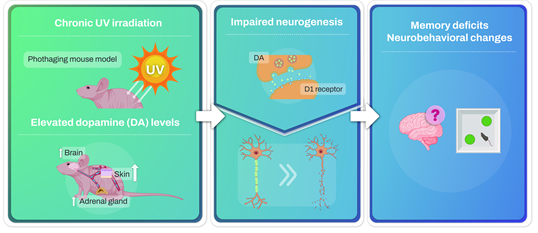 Conceptual Diagram Demonstrating Memory Deficiency and Neurobehavioral Changes Caused by Ultraviolet Rays
[Photo by Korea Health Industry Development Institute]
The Korea Health Industry Development Institute announced on the 27th that a research team led by Dr. Yoon Kyung-no, Professor Jung Jin-ho, and Professor Lee Dong-hoon from the Department of Dermatology at Seoul National University Hospital, along with a research team from Seoul National University College of Medicine including Master’s student Kim Sun-yong and Professor Lee Yong-seok, successfully demonstrated that UV rays reaching the skin negatively affect brain function.
The skin functions not only as a protective barrier but also as a neuroendocrine organ that independently produces and regulates hormones and neurotransmitters, earning it the nickname "the third brain." In particular, the skin generates various neurotransmitters in response to UV exposure, and these changes in neurotransmitters play a role in regulating signals transmitted to the brain and nerves.
The research team aimed to elucidate the interaction between UV exposure on the skin and brain function, especially scientifically proving the effect of UV on memory. After exposing mouse skin to UV rays 18 times over 6 weeks, they measured memory formation, neurogenesis, and synaptic plasticity in the brain. Synaptic plasticity refers to the sustained changes in the efficiency or pattern of transmission at neural synapses. The results showed that long-term UV exposure neurophysiologically impaired neurogenesis and synaptic plasticity and altered gene expression affecting dopamine neuron differentiation, proving that UV exposure on the skin induces memory decline.
In fact, mice exposed to UV had difficulty recognizing new objects and locations, and when their memory was evaluated in a maze, their spatial and working memory abilities significantly decreased.
In other words, chronic UV exposure on the skin can induce changes in neurobehavior such as hippocampal memory loss and neurogenesis impairment by altering dopamine levels in the central nervous system and peripheral organs including the skin.
Professor Jung Jin-ho of Seoul National University Hospital stated, "This study reveals the fundamental mechanisms by which UV affects neurobehavior, playing an important role in enhancing neurological understanding in the brain field. It is also expected to contribute to the development of pharmacological strategies targeting dopamine receptors to mitigate the negative neurological effects caused by UV exposure."
Supported by the Ministry of Health and Welfare and the Korea Health Industry Development Institute under the Dermatological Science Applied Materials and Leading Technology Development Project, this study was published in the world-renowned scientific journal, Experimental Molecular Medicine.
© The Asia Business Daily(www.asiae.co.kr). All rights reserved.
![Clutching a Stolen Dior Bag, Saying "I Hate Being Poor but Real"... The Grotesque Con of a "Human Knockoff" [Slate]](https://cwcontent.asiae.co.kr/asiaresize/183/2026021902243444107_1771435474.jpg)















