6th Plenary Meeting of the Minimum Wage Commission
The legal deadline for processing next year's minimum wage has been missed. This is because the business and labor sectors have different intentions regarding surpassing the 10,000 won minimum wage and the differential application by industry, and have failed to narrow their differences. On the 27th, the legal deadline for minimum wage deliberations was exceeded, but no initial proposal for the increase rate was presented, and only a power struggle between labor and management continued.
At the 6th plenary meeting held at the Government Complex Sejong on the same day, the business and labor sectors failed to narrow their differences over the differential application of minimum wages by industry. The business sector demanded differential application by industry, while the labor sector opposed it, urging to stop the claim for differential application considering the legal purpose of guaranteeing the minimum wage level and stabilizing workers' livelihoods.
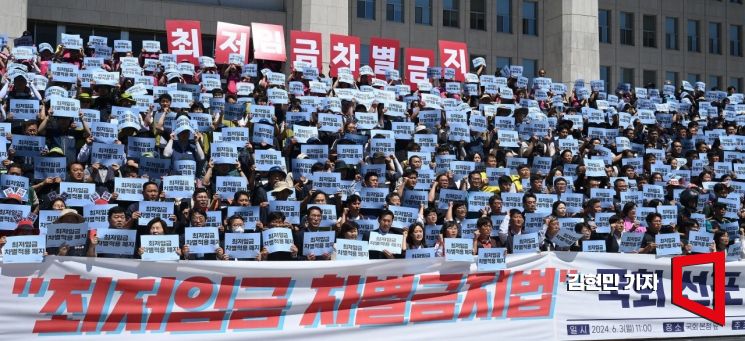 Kim Dong-myeong, Chairman of the Federation of Korean Trade Unions, Yang Kyung-soo, Chairman of the Korean Confederation of Trade Unions, and members of the two major trade unions are holding a "Press Conference for the National Assembly Proclamation of the Minimum Wage Anti-Discrimination Act" on the steps in front of the main building of the National Assembly on the 3rd. Photo by Kim Hyun-min kimhyun81@
Ryu Ki-jung, Executive Director of the Korea Employers Federation (KEF) representing the business sector, pointed out, "The current minimum wage exceeds the appropriate upper limit of 60% of the median wage and stands at 65.8% of the median wage," adding, "In some industries, the minimum wage approaches 90% of the median wage." Executive Director Ryu argued, "In sectors such as lodging and food service, voices claiming that the current minimum wage is difficult to bear are inevitably growing," and insisted, "The practice of uniformly raising the minimum wage without distinguishing industries, ignoring reality, must now change."
Lee Myung-ro, Head of the Workforce Policy Division at the Korea Federation of SMEs, stated regarding the 'recruitment difficulties in applicable industries,' one of the concerns raised by the labor sector about differential minimum wage application, "The occurrence of recruitment difficulties means that the business situation is good, and such companies can solve recruitment difficulties by paying appropriate wages regardless of the minimum wage."
Regarding the criticism that large corporations or excellent SMEs with good business conditions might be subject to differential application and thus receive a lower minimum wage depending on the industry, he said, "Such companies can be excluded from the differential application."
Lee added, "The decline in a company's ability to pay results from low labor productivity of workers and low management productivity of employers, which is a joint responsibility of labor and management, so it is unreasonable for only employers to bear the responsibility," and said, "The government should resolve the livelihood guarantees for workers receiving lower minimum wages due to differential application through social welfare policies such as the earned income tax credit."
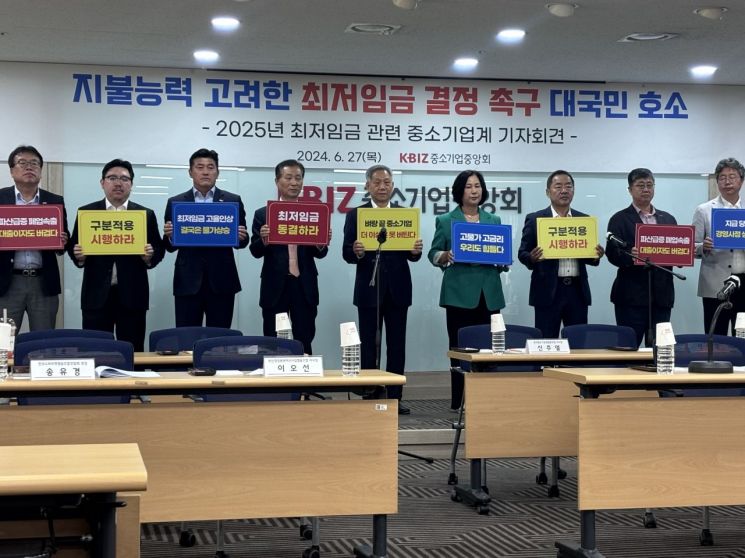
On the other hand, Lee Mi-seon, Vice Chairperson of the Korean Confederation of Trade Unions (KCTU), became tearful while mentioning KCTU members who were dragged away after demanding a meeting with Minister Lee Jeong-sik of the Ministry of Employment and Labor at the Seoul Regional Employment and Labor Office the day before, advocating for the abolition of 'differential application of the minimum wage.'
Vice Chairperson Lee criticized, "Minimum wage workers earning about 2 million won a month cannot survive any longer in this crazy inflation era if their wages go down further," and said, "Differential application of the minimum wage means not guaranteeing the minimum wage level for some types of labor and not ensuring livelihood stability for some workers."
She pointed out, "Differential application of the minimum wage directly violates the purpose and intent of the Minimum Wage Act," and criticized, "The fact that the Minimum Wage Commission is discussing differential application itself should be ashamed."
Vice Chairperson Lee said, "Minimum wage workers receive about 1.85 million won a month after taxes, but the reported living expenses for single, unmarried workers last year were 2.46 million won," and criticized, "In this situation, is it right to cut the wages of workers who support households and family livelihoods with 1.85 million won?"
She emphasized, "The pain of small business owners and self-employed people stems from the fee extortion by large corporations, high loan interest rates, and franchise encroachment on local markets, but the business sector talks as if these things do not exist and tries to cut workers' wages by using small business owners and the self-employed as a front."
Ryu Ki-seop, Secretary General of the Federation of Korean Trade Unions (FKTU), said, "The Minimum Wage Commission has the duty and responsibility to deliberate the minimum wage to improve and stabilize the lives of low-wage workers," and added, "I hope the claims for differential application unrelated to the original purpose of the minimum wage stop, and discussions related to next year's minimum wage level begin."
At the plenary meeting that day, Kwon Soon-won, a professor at Sookmyung Women's University and the public interest committee secretary, delivered opening remarks, stating, "I will focus and dedicate myself to the deliberations to produce the best results without being constrained by time."
Since the legal deadline for the Minimum Wage Commission to complete deliberations on next year's minimum wage was that day, this statement appears to indicate that they will not be rushed by time. Professor Kwon also emphasized, "The minimum wage is discussed within the plenary meeting," and denied matters mentioned outside the Minimum Wage Commission.
Although the legal deliberation deadline was exceeded, neither side presented an initial minimum wage demand proposal that day. Once labor and management submit their minimum wage proposals, plenary meetings will be held two to three times a week to narrow the differences. The deadline for the Minister of Employment and Labor to announce next year's minimum wage is August 5. Considering that administrative procedures such as objections take about 20 days, an agreement must be reached by mid-next month.
© The Asia Business Daily(www.asiae.co.kr). All rights reserved.
![Clutching a Stolen Dior Bag, Saying "I Hate Being Poor but Real"... The Grotesque Con of a "Human Knockoff" [Slate]](https://cwcontent.asiae.co.kr/asiaresize/183/2026021902243444107_1771435474.jpg)
















