Foreign Workers Account for 10% of Industrial Accident Deaths
Widespread Lack of Safety Training on Site
Illegal Dispatch and Poor Safety Management Persist
"Administrative Authorities Need to Strengthen Supervision"
A, a 36-year-old foreign worker from Bangladesh, was injured three years ago at a factory handling agricultural machinery. It was a serious accident where his leg was torn by a cylinder, so he had to file for an industrial accident claim. However, A never received any safety training at this factory. Since settling in Korea, he has worked at a total of five factories, but only one of them provided safety training. Even then, the training was conducted in Korean, so A had to work without understanding most of it.
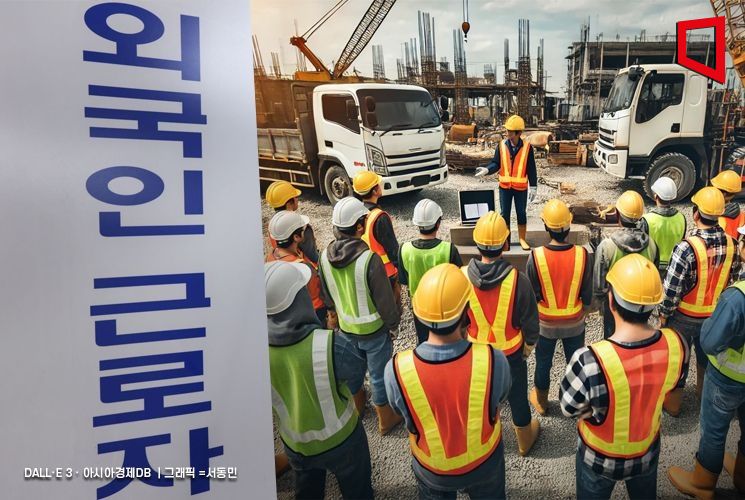
As it was revealed that the majority of the victims of the fire at the Hwaseong Arisel factory were foreign workers, the so-called 'migration of risk,' where dangerous jobs are assigned to them, has come under scrutiny. There are calls for administrative authorities to thoroughly supervise companies to ensure safety training is conducted and to prevent illegal dispatching.
The risks faced by foreign workers are also reflected in statistics. According to the Ministry of Employment and Labor's "Status of Death Accidents Approved for Survivor Benefits," 85 foreign workers died from industrial accidents last year, accounting for 10.5% of the total (812). Although the total number of deaths decreased compared to 2022 (874), the number of foreign worker deaths remained at 85, increasing their accident proportion by 0.8 percentage points from 9.7%.
Insufficient safety training is identified as a major factor putting foreign workers at risk. According to the Industrial Safety and Health Act, workplaces must provide at least one hour of safety and health education to daily workers or fixed-term workers with contracts of one week or less. However, foreign workers complain that these regulations are not properly enforced in actual workplaces.
Udaya Rai, chairman of the Migrant Workers' Union, stated, "In small-scale workplaces, safety training is often not properly conducted. Even workplaces that comply with regulations only provide formal training. In actual work sites, safety rules are ignored, and foreign workers are pressured to work quickly without regard for safety," he lamented.
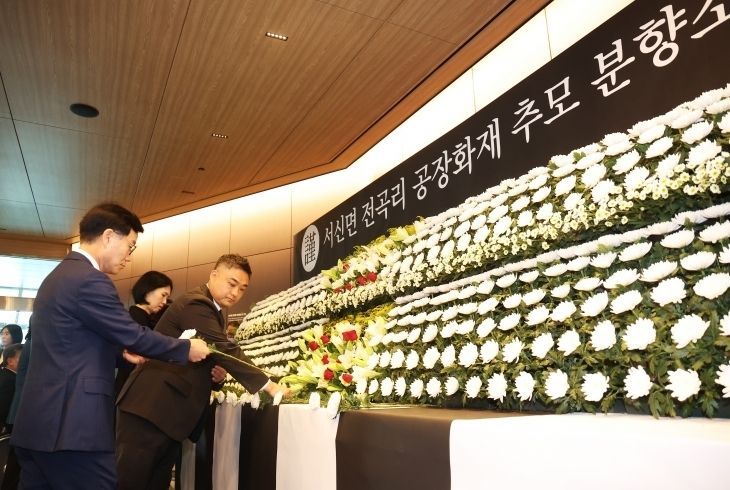 On the 26th, mourners are paying tribute to the victims at the memorial incense altar set up at Seosin-myeon lithium battery factory fire in Hwaseong City Hall, Gyeonggi Province. [Image source=Yonhap News]
Illegal dispatching of foreign workers is also a problem. In industrial sites, foreign workers are frequently deployed to workplaces where dispatching workers is prohibited by law. The Arisel factory, where the large fire occurred, was a workplace where dispatching was banned because it involved 'direct production processes in manufacturing,' yet it is suspected of illegally dispatching foreign workers.
Illegal dispatching leads to lax safety management for these workers. Kim Dalseong, director of the Pocheon Migrant Workers Center, pointed out, "There are over 400,000 undocumented foreign workers in our country. Most of them are employed in workplaces where dispatching is not allowed. It is difficult to provide proper safety training to those who come and go as daily workers," he said.
Experts emphasize that administrative authorities must strictly supervise to ensure safety regulations are followed in workplaces. Lee Byunghun, emeritus professor of sociology at Chung-Ang University, said, "Our society has already established various legal systems to protect workers, such as safety training regulations. However, the problem lies in employers not following these regulations and the inadequate administrative system to correct this. Proper management and supervision by administrative authorities are necessary," he stated.
© The Asia Business Daily(www.asiae.co.kr). All rights reserved.
![Clutching a Stolen Dior Bag, Saying "I Hate Being Poor but Real"... The Grotesque Con of a "Human Knockoff" [Slate]](https://cwcontent.asiae.co.kr/asiaresize/183/2026021902243444107_1771435474.jpg)
















