Completion of Icheon Liquefied Hydrogen Charging Station
Capable of Charging 120 Buses per Day
SK E&S is building a liquefied hydrogen refueling station in Icheon, Gyeonggi Province, and will start supplying liquefied hydrogen for SK Hynix's hydrogen commuter bus charging.
SK E&S subsidiary SK Plug Hybus (Hybus) held a completion ceremony for the 'Icheon Daeheung Liquefied Hydrogen Refueling Station' on the 27th in Daewol-myeon, Icheon-si, Gyeonggi Province. The ceremony was attended by key officials including Kim Kyung-hee, Mayor of Icheon; Kim Ha-sik, Chairman of Icheon City Council; Jung Sun-hwa, Director of Air Environment Policy at the Ministry of Environment; Jung Han-gyu, Head of Advanced Mobility Industry Division of Gyeonggi Province; So Yoo-seop, Vice President of SK E&S; Lee Bang-sil, Vice President of SK Hynix; Heo Deok-haeng, Head of Planning and Coordination at KD Transport Group; and Cho Yong-woong, Executive Director of Wizdom.
Hybus is a joint venture established in January 2022 by SK E&S and the US company Plug Power to promote hydrogen business in Asia.
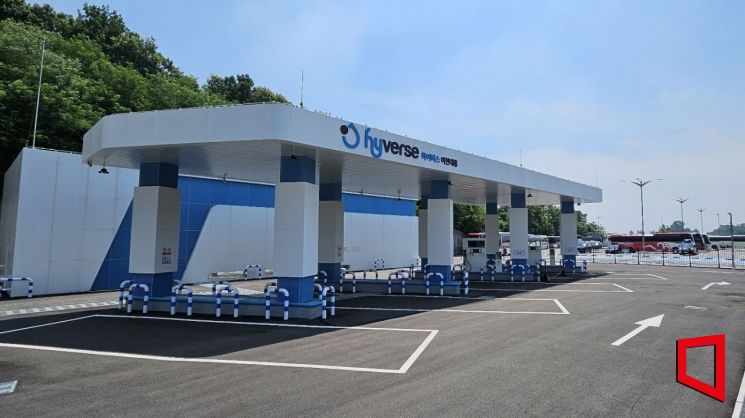
The Icheon Daeheung Liquefied Hydrogen Refueling Station is the first liquefied hydrogen refueling station in Gyeonggi Province, with Hybus responsible for its construction and operation. After being selected in 2022 for the Ministry of Environment's hydrogen refueling station installation support project, construction began in August 2023, and the facility was successfully commissioned earlier this year.
Equipped with a 4-ton liquefied hydrogen storage tank, cryogenic pumps, and two refueling dispensers, the facility has a capacity of approximately 120 kg/h. This capacity allows refueling of six buses per hour, or about 120 hydrogen buses per day. Located within the SK Hynix Icheon campus parking lot, it will provide a stable supply of hydrogen fuel for SK Hynix's commuter buses used by its employees.
Liquefied hydrogen is supplied from SK E&S's Incheon liquefied hydrogen plant. The Incheon plant, completed in May, is the world's largest single-plant facility capable of producing 30,000 tons of liquefied hydrogen annually.
This refueling station is the first case of implementing the 'ESG Leading Companies Hydrogen Commuter Bus Transition Agreement' signed in May last year by the Ministry of Environment, major companies, local governments, and transportation companies. At that time, the agreement parties, including ESG (Environmental, Social, and Governance) leading companies such as SK Hynix, agreed to cooperate in introducing hydrogen commuter buses and convert more than 2,000 existing internal combustion engine commuter buses to hydrogen buses by 2026.
Accordingly, it is expected that the introduction of hydrogen commuter buses will accelerate in the future. Recently, major companies have been required to reduce all direct and indirect greenhouse gas emissions, including 'Scope 3' (other indirect emissions) such as employee commuting and business trips, in line with the strengthening of ESG disclosure standards. They are actively considering the introduction of hydrogen buses to convert work vehicles, including commuter buses, to zero-emission vehicles.
Hydrogen buses do not emit pollutants during operation and have air purification functions, contributing to improved air quality. Additionally, they have the advantage of a long driving range per charge, making them suitable for long-distance operation.
Lee Bang-sil, Vice President of SK Hynix, said, "SK Hynix is actively practicing carbon reduction and ESG management. In particular, the transition from diesel commuter buses to hydrogen commuter buses, which started this year, is significant as a carbon reduction activity in which employees directly participate and practice."
So Yoo-seop, Vice President of SK E&S, stated, "Liquefied hydrogen refueling stations have the advantage of being suitable for large commercial vehicles, so they will spread in earnest with the expansion of hydrogen buses and others. We will proceed steadily with liquefied hydrogen production and refueling businesses to contribute to the creation of a stable hydrogen supply ecosystem."
© The Asia Business Daily(www.asiae.co.kr). All rights reserved.
![Clutching a Stolen Dior Bag, Saying "I Hate Being Poor but Real"... The Grotesque Con of a "Human Knockoff" [Slate]](https://cwcontent.asiae.co.kr/asiaresize/183/2026021902243444107_1771435474.jpg)















