On the 27th, Public Appeal Press Conference at the Korea Federation of SMEs
"Raise the Minimum Wage Together and Move Only to Easy Jobs"
The small and medium-sized enterprise (SME) sector has united in calling for differentiated application of the minimum wage for industries with weak payment capacity.
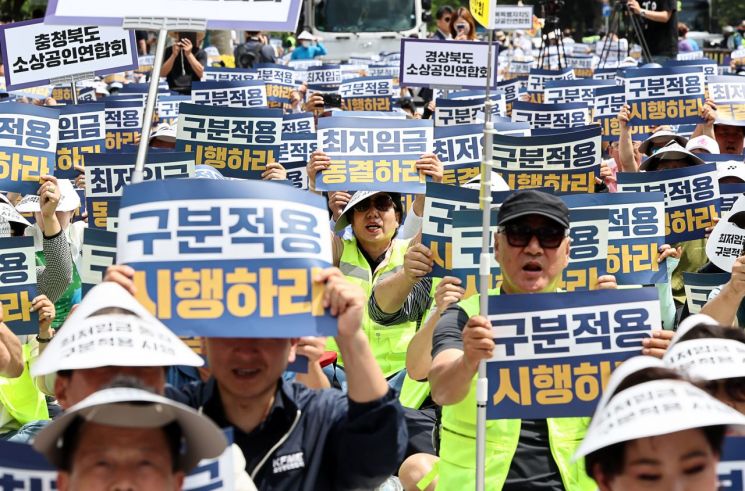 On the afternoon of the 25th, participants held up related hand placards at a rally urging the improvement of the minimum wage system, hosted by the Small Business Federation near the National Assembly Station.
 [Photo by Yonhap News]
On the 27th, the Korea Federation of SMEs held a press conference titled “A Public Appeal Urging the 2025 Minimum Wage Decision Considering Payment Capacity” at the Korea Federation of SMEs in Yeouido, Seoul. The statutory review period for next year’s minimum wage ends on this day.
At the press conference, Lee Jae-kwang, chairman of the Labor and Workforce Committee of the Korea Federation of SMEs, along with representatives from 10 industries, stated in their appeal, “In the first quarter of this year, sales and operating profits of small business owners decreased by 7.7% and 23.2%, respectively, and when an employee earns 1 million won, small business owners earn only 720,000 won.” They explained, “Given these business conditions, a significant number of small enterprises and small business owners with reduced payment capacity are unable to pay even the statutory minimum wage.”
They continued, “More seriously, the proportion of workers who do not receive the minimum wage varies by industry by up to 41.2 percentage points, which means that the system is not functioning in industries with weak payment capacity, making it difficult to protect workers.” They emphasized, “It is necessary to balance the income protection of wage workers with the payment capacity of small enterprises and small business owners.”
Lee Myung-ro, head of the Workforce Policy Division at the Korea Federation of SMEs, said, “There is debate over top-down versus bottom-up methods for differentiated application, but since our minimum wage level is higher than that of the G7 countries, the OECD average, and countries that apply differentiated minimum wages, it is difficult to apply the same method as other countries.” He added, “If there is a shortfall in living expenses, the government’s role, such as expanding the Earned Income Tax Credit (EITC), is also necessary.” The ‘top-down’ approach refers to setting industry-specific minimum wages lower than the basic minimum wage, while the ‘bottom-up’ approach allows certain industries to have minimum wages higher than the basic minimum wage.
At the press conference, Lee Sung-moon, director of the Korea Education IT Service Industry Cooperative, said, “Each industry has its own profitability, but ignoring this and raising the minimum wage uniformly causes workers to seek only easy jobs, making it really difficult to find people for positions that require even a little skill.”
Kim Ki-hong, director of the Korea Internet PC Cafe Cooperative, said, “Industries that find it difficult to afford the minimum wage plus weekly holiday pay tend to hire split part-time workers. Neither employees nor employers want this situation, but the reality leaves no choice, which is very unfortunate.”
According to the “Survey on Difficulties and Opinions Related to the Minimum Wage for SMEs” released by the Korea Federation of SMEs on the 3rd, 61.6% of SMEs responded that next year’s minimum wage should be lowered or frozen. Regarding responses to a minimum wage increase beyond a bearable level, 42.2% of SMEs said they have “no countermeasures,” and 35.0% said they would “reduce new hires.”
© The Asia Business Daily(www.asiae.co.kr). All rights reserved.
![Clutching a Stolen Dior Bag, Saying "I Hate Being Poor but Real"... The Grotesque Con of a "Human Knockoff" [Slate]](https://cwcontent.asiae.co.kr/asiaresize/183/2026021902243444107_1771435474.jpg)















