"Youth Population Halved in 30 Years... Aging Is a Matter of Speed"
44 Experts Participate... First Government-Level Population Response Council
"A period of upheaval," "the need for coexistence between youth and the elderly," "aging is a matter of speed, not level."
Experts gathered to address the population crisis with a total fertility rate of 0.7 and the extinction of local areas. On the afternoon of the 26th, the "Ministry of Land, Infrastructure and Transport Population Response Council" (hereinafter referred to as the Council) was launched at the President Hotel in Jung-gu, Seoul. Centered on the Ministry of Land, Infrastructure and Transport, the Council was formed to minimize the negative impacts caused by low birthrates and aging and to proactively respond to future policy demands. This is the first time a population response council has been established at the government ministry level.
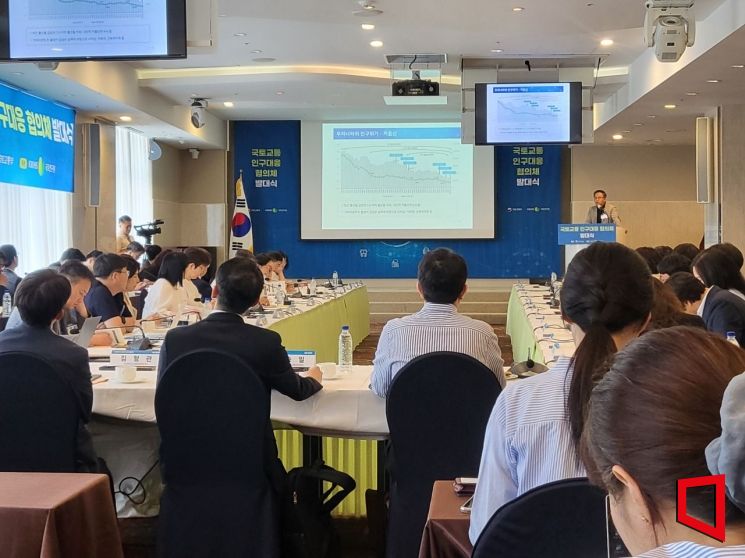 The launch ceremony of the 'Land, Infrastructure and Transport Population Response Council' held on the afternoon of the 26th at the President Hotel in Jung-gu, Seoul. / Photo by Noh Kyung-jo
Park Sang-woo, Minister of Land, Infrastructure and Transport, said in his welcoming remarks, "We regret having missed the golden time to solve the low birthrate and aging problems. However, we must do what we can now and create systems for the long term." This is based on the judgment that population decline and worsening population structure imbalance could rapidly affect key areas of land, infrastructure, and transport such as regional living patterns, housing types, transportation demand, and industrial competitiveness.
The Council includes 44 experts from institutions such as the Korea Research Institute for Human Settlements, Korea Transport Institute, Korea Institute for Industrial Economics and Trade, Seoul Institute, local research institutes, Korea Land and Housing Corporation (LH) Land and Housing Research Institute, and Korea Expressway Corporation. The "2030 Advisory Group" also participates to reflect the opinions of future generations. Through the operation of the Council, the Ministry of Land, Infrastructure and Transport plans to meticulously predict changes caused by population structure shifts across all land, infrastructure, and transport sectors and to identify policy tasks and key initiatives to respond accordingly.
Lee Sang-rim, senior researcher at Seoul National University Population Policy Research Center, who gave the keynote presentation, said, "The youth population will be about half of what it is now in 30 years. A vicious cycle of regional impoverishment and the end of supply-driven housing markets are expected. We need to consider ways to proactively reduce potential future conflicts."
According to Statistics Korea and others, South Korea ranks 29th among 37 OECD member countries in terms of elderly population ratio. Although it may not seem problematic now, it is projected to reach the highest level of aging in the world within 30 years. The youth population, which was 10.61 million in 2022, is expected to drop to about 4.84 million by 2052, and due to population decline, the basic administrative district system consisting of 228 cities, counties, and districts will inevitably be reorganized. This means that the speed of aging is more problematic than the level.
Cha Mi-sook, senior research fellow at the Korea Research Institute for Human Settlements, in her presentation titled "Directions for National Land Spatial Policy to Respond to Local Extinction," said, "Local extinction will deepen the perforation phenomenon across national land spaces such as vacant houses and closed schools, and reduce accessibility to living infrastructure such as medical services and public transportation." She also expressed concerns that socioeconomically vulnerable groups may concentrate in population-declining areas.
She added, "It is necessary to consider how the Ministry of Land, Infrastructure and Transport will approach national land spatial planning, paying attention to the speed of population structure changes. Combining low birthrate policies with regional balanced development policies will be necessary to achieve results."
The Council operates divided into four subcommittees (Land and Urban, Housing and Land, Industry and Jobs, Transportation and Network). The overall direction is coordinated by a general committee composed of subcommittee heads, and research support is provided by the Korea Research Institute for Human Settlements.
Minister Park Sang-woo said, "As low birthrate and aging rapidly progress, changes in national land space, housing supply, and infrastructure investment require a lot of time and cost for policy responses and have significant ripple effects, so policies must be considered deeply from a long-term perspective. I hope Council members will generously propose creative policies with high feasibility. We will also maintain close communication and cooperation with the Low Birthrate and Aging Society Committee."
© The Asia Business Daily(www.asiae.co.kr). All rights reserved.
![Clutching a Stolen Dior Bag, Saying "I Hate Being Poor but Real"... The Grotesque Con of a "Human Knockoff" [Slate]](https://cwcontent.asiae.co.kr/asiaresize/183/2026021902243444107_1771435474.jpg)















