Bank of Korea Explains Government's Postponement of Level 2 Stress DSR Regulation
Minor Adjustments in Government Policy, Household Debt Management Stance Remains Unchanged
Bank of Korea Financial Stability Report Press Briefing
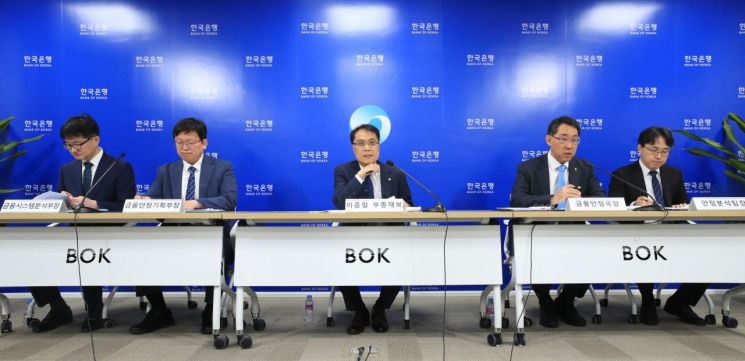 On the morning of the 26th, a briefing session on the Financial Stability Report was held at the Bank of Korea in Jung-gu, Seoul. From the left in the photo: Lee Jong-han, Head of Financial System Analysis Department; Seo Pyung-seok, Head of Financial Stability Planning Department; Lee Jong-ryeol, Deputy Governor; Jang Jeong-su, Director of Financial Stability Bureau; Kim Jeong-ho, Head of Stability Analysis Team. (Photo by Bank of Korea)
The Bank of Korea stated that the government’s two-month delay in implementing the second phase of the stress Debt Service Ratio (DSR) regulation does not indicate a change in the government’s household debt management stance.
At a press conference held on the morning of the 26th at the Bank of Korea in Jung-gu, Seoul, Lee Jong-ryeol, Deputy Governor of the Bank of Korea, said regarding the government’s postponement of the stress DSR regulation implementation, “This measure does not mean that the government’s household debt management stance has changed,” adding, “It is understood as a slight fine-tuning of the government’s policy.”
Deputy Governor Lee emphasized, “We share the view that the household debt growth rate should be managed stably within the range of Gross Domestic Product (GDP) growth.”
The Financial Services Commission announced the “Second Half Stress DSR Operation Direction” the previous day, postponing the implementation date of the second phase stress DSR from July 1 to September 1.
The stress DSR is a system that reduces borrowers’ loan limits by applying a certain level of additional interest rate when calculating the DSR, to prepare for the possibility of increased principal and interest repayment burdens due to rising interest rates during the loan period, especially for borrowers using variable-rate loans.
As the system to reduce household loan limits was postponed just one week before its implementation, questions arose in the market about whether the government’s household debt management stance had changed. Concerns were particularly voiced given the recent rise in Seoul housing prices and the increase in household loans.
In response, the Financial Services Commission explained that the decision was made to facilitate a smooth landing of real estate project financing (PF) and to consider the difficult situations of low-income earners and self-employed individuals.
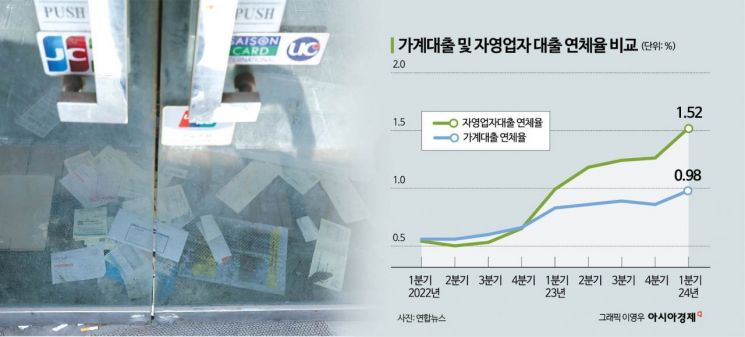
According to the Bank of Korea, household credit at the end of the first quarter of this year was 1,882.8 trillion won, an increase of 1.6% year-on-year, mainly driven by bank mortgage loans. The household loan delinquency rate at the end of the first quarter was also 0.98% (0.37% for banks and 2.17% for non-banks), showing an upward trend since the second half of 2022.
The Bank of Korea also explained that concerns about an increase in household debt growth due to the postponement of the stress DSR are not a situation to be overly worried about. Jang Jeong-su, Director of the Financial Stability Department at the Bank of Korea, said, “Although there is an expectation of rising real estate prices, the perception that prices are still high limits buying sentiment,” adding, “We are discussing various macroprudential policy measures with the government.”
Regarding concerns about accelerated housing price increases and household loan growth, Director Jang emphasized, “If necessary, there are measures such as expanding the scope of DSR application,” and added, “We can include policies that currently exempt DSR application, such as jeonse deposit loans, interim payment loans, and policy finance, under regulation, or adjust the DSR ratio; various measures can be used.”
The Bank of Korea also pointed out that Korea’s household debt ratio remains at a high level and needs to be managed. Due to a recent revision of the base year, Korea’s household debt-to-GDP ratio has fallen below 100%.
Director Jang stated, “Even though the household debt ratio dropped to 91% due to the GDP base year revision, it is still the fourth highest in the world,” and added, “It needs to continue to stabilize downward.” Regarding the risk of accelerating household debt, he said, “We need to observe for some more time whether this is a fundamental upward shift,” emphasizing, “We will monitor closely and take appropriate measures if necessary.”
Meanwhile, according to the Financial Stability Report released by the Bank of Korea on the same day, Korea’s macro leverage?the total debt ratio of corporations, households, and government relative to nominal GDP?was estimated at 251.3% as of the end of the fourth quarter last year. Korea’s macro leverage was lower than the average of advanced countries (11 countries in BIS statistics) at 264.3%, but the private sector (207.4% at the end of last year) significantly exceeded the advanced countries’ average of 160.6%.
While major countries have pursued deleveraging (debt reduction) since the COVID-19 pandemic, Korea’s household and corporate debt levels have continued to rise, according to the analysis.
© The Asia Business Daily(www.asiae.co.kr). All rights reserved.
![Clutching a Stolen Dior Bag, Saying "I Hate Being Poor but Real"... The Grotesque Con of a "Human Knockoff" [Slate]](https://cwcontent.asiae.co.kr/asiaresize/183/2026021902243444107_1771435474.jpg)
















