"Emergency Medical System Operating More Stably Than Expected"
Park Min-su, the 2nd Vice Minister of Health and Welfare, revealed that he discussed the medical community's backlash against the government's announcement to increase medical school quotas with President Yoon Seok-yeol.
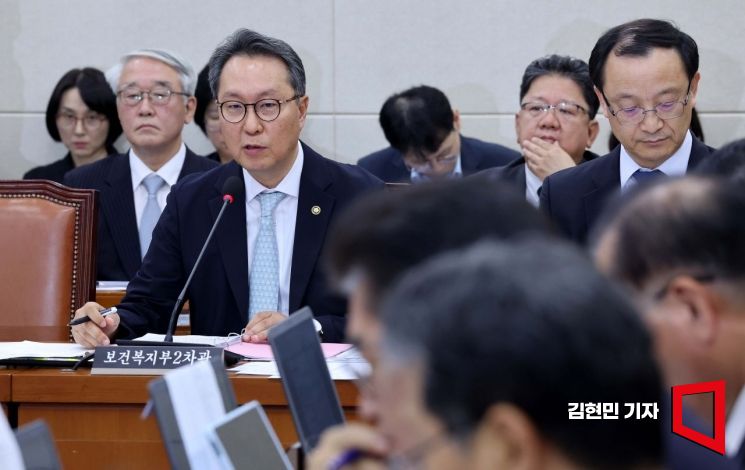 Park Min-su, the 2nd Vice Minister of Health and Welfare, is responding to lawmakers' questions at the Health and Welfare Committee's hearing on the emergency situation in the medical sector held at the National Assembly on the 26th. Photo by Kim Hyun-min kimhyun81@
On the 26th, during a hearing on the emergency situation in the medical community held by the National Assembly's Health and Welfare Committee, Park responded to a question from Kim Nam-hee, a member of the Democratic Party of Korea, asking whether he had reported to President Yoon about the possibility of doctors' strikes and work stoppages before announcing the increase in medical school quotas. Park said, "Since we had multiple discussions regarding medical reform, including the increase in medical school quotas, we naturally also discussed the medical community's backlash."
Regarding what measures President Yoon instructed to minimize patient harm caused by collective actions of medical organizations, Park said, "Rather than giving direct instructions, we reported on emergency medical care measures currently underway that aim to minimize gaps in care for critically ill and emergency patients even if residents withdraw."
Rep. Kim asked Park, "At the 6th Central-Local Cooperation Meeting in February, President Yoon said that if citizens cannot receive proper treatment in a timely manner when they are sick, the state is failing to fulfill its constitutional duty. Do you think the current medical situation patients are experiencing reflects a state fulfilling its constitutional duty to provide timely treatment when citizens are ill?" Park replied, "That is precisely the background for pushing forward medical reform. Our medical system's capacity to provide timely and appropriate care has been lacking, so these measures are to supplement that. The fundamental motivation behind medical reform is to ensure no patient is left untreated when ill."
Furthermore, Park stated, "There has been strong opposition from the medical community regarding increasing the number of doctors, and there have been multiple instances of collective actions. This was anticipated this time as well, and emergency medical care measures were implemented accordingly, but it is a fact that some harm still occurred. However, when residents collectively resigned and left the field, it was generally believed within the medical community that sustaining this for more than three or four weeks would be difficult, yet it has been operating for nearly four months. Looking at inpatient care, surgeries, and consultations at general hospital level and above, although the volume is somewhat reduced compared to usual, operations have been very stable."
Park added, "However, when looking at specific patient cases, there are instances of harm, but upon investigation, there are differences between patient claims and medical staff explanations. It is difficult to regard all of these as outright refusal of care." He continued, "For clear cases, criminal complaints and other measures have been taken. Going forward, the government will make every effort to engage in dialogue with the medical community to minimize patient harm and to resolve this situation as quickly as possible."
© The Asia Business Daily(www.asiae.co.kr). All rights reserved.
![Clutching a Stolen Dior Bag, Saying "I Hate Being Poor but Real"... The Grotesque Con of a "Human Knockoff" [Slate]](https://cwcontent.asiae.co.kr/asiaresize/183/2026021902243444107_1771435474.jpg)















