Neurofit, a specialized company in brain disease imaging artificial intelligence (AI) solutions, announced on the 26th that it presented research results on brain electrical stimulation simulation related to Alzheimer's disease through a poster presentation at the Organization for Human Brain Mapping (OHBM 2024). OHBM is an academic conference that serves as a platform for scholarly exchange among brain science researchers worldwide and a battleground for cutting-edge brain science technologies. Since its first meeting in Paris, France, in 1995, it has been held every June in major cities around the world. This year, it took place from the 23rd to the 27th of this month at COEX in Gangnam-gu, Seoul.
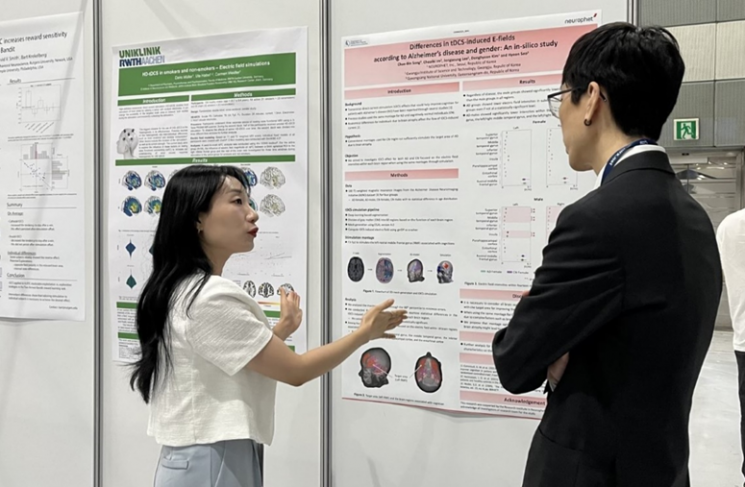 A Neurofit researcher is presenting a poster at OHBM 2024 held at COEX in Gangnam-gu, Seoul.
 [Photo by Neurofit]
The research results presented this time are related to Neurofit Tesplan Plus, a brain electrical stimulation video therapy planning software, and Neurofit Aqua, a brain neurodegeneration magnetic resonance imaging (MRI) analysis software, both showcased through booth exhibitions. Neurofit Tesplan Plus is a research product with added stroke area analysis support functions to the existing Neurofit Teslab and is currently about to be launched.
As the Alzheimer's disease treatment market grows recently, many studies have reported that transcranial direct current stimulation (tDCS) can help improve cognitive function in Alzheimer's patients. However, previous studies have used the same brain electrical stimulation methods for both Alzheimer's patients and cognitively normal individuals. In such cases, there is a possibility that the target brain areas are not sufficiently stimulated, reducing effectiveness.
In this regard, Neurofit conducted a poster presentation at OHBM titled “Simulation Study on Differences in Electric Fields Induced by Transcranial Direct Current Stimulation According to Alzheimer's Disease and Gender.” Through this, they investigated whether there are differences in the induced electric fields when applying the same brain stimulation methods to Alzheimer's patients and cognitively normal individuals. In this process, Neurofit Teslab and Neurofit Aqua were used to create three-dimensional brain models, and simulation experiments were conducted applying the same tDCS stimulation methods to each treatment group.
The results confirmed that the electric field strength in different brain regions of Alzheimer's patients differs from that of normal individuals. Previous studies have shown that neurophysiological changes induced by tDCS are significantly correlated with simulation-based electric field strength, so the difference in electric field strength between normal individuals and Alzheimer's patients may lead to differences in clinical effects. This suggests the need for customized tDCS stimulation methods that consider the anatomical structural differences of Alzheimer's patients. Furthermore, customized tDCS stimulation methods for Alzheimer's patients are expected to enhance the effects of tDCS and help improve cognitive function.
Bin Jungil, CEO of Neurofit, stated, “OHBM is a prestigious international conference where leading brain experts gather, and we showcased Neurofit’s upgraded brain electrical stimulation simulation products and research.” He added, “Especially as the Alzheimer's disease treatment market is expanding, there was great enthusiasm from researchers regarding brain stimulation technology for Alzheimer's treatment, leading to in-depth discussions on related research and development.”
© The Asia Business Daily(www.asiae.co.kr). All rights reserved.
![Clutching a Stolen Dior Bag, Saying "I Hate Being Poor but Real"... The Grotesque Con of a "Human Knockoff" [Slate]](https://cwcontent.asiae.co.kr/asiaresize/183/2026021902243444107_1771435474.jpg)















