Lee Juseok, Vice President of Intel Korea, Presentation
Introducing Competitive Original API to Replace CUDA
"In the central processing unit (CPU) business, we have long-standing know-how from working as a partner with Microsoft (MS) for many years, ensuring software runs smoothly through hardware application programming interfaces (APIs). Gaudi is no different. We are preparing a system that supports overall API stability, including software."
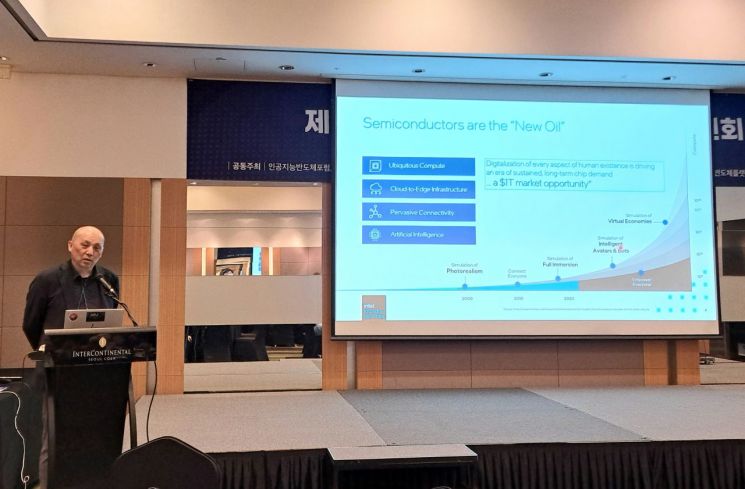
Lee Ju-seok, Vice President of Intel Korea, said this on the 26th at the '6th Artificial Intelligence Semiconductor Forum Breakfast Lecture' held at the InterContinental Seoul COEX. Just as the U.S. company Nvidia increased its dominance in the AI market by launching the AI accelerator along with the supporting software platform 'CUDA,' Intel also expressed confidence in building a software ecosystem to enhance the utilization of its AI accelerator 'Gaudi.'
During the lecture, Vice President Lee introduced the recently developed 'One API' as a response to CUDA. He said, "While CUDA is dedicated to graphics processing units (GPUs), One API is a high-performance computing language, that is, a programming language," adding, "It is software designed to run on various hardware." He continued, "We are creating a One API developer community," and "We plan to hold the first meeting next week and are considering collaborating with the Artificial Intelligence Semiconductor Forum if possible."
One API is characterized by its applicability not only to GPUs but also to CPUs, neural processing units (NPUs), and other hardware. Vice President Lee explained, "Intel's goal has been to open all software so that many people can use it together, and we have invested in technology accordingly," adding, "It is not difficult to convert CUDA to One API." He also emphasized, "The advantage of using One API is its speed."
Intel has recently been focusing on building a software ecosystem to increase the utilization of Gaudi. To this end, it has been conducting a joint research project with Naver in Korea since April. The project involves various studies applying Gaudi's latest generation product, Gaudi2, aiming to reduce dependence on Nvidia AI accelerators while enhancing Gaudi's competitiveness.
Intel is also striving to meet AI demand in its foundry (semiconductor contract manufacturing) business. Vice President Lee noted the trend of AI shifting from large language models (LLMs) to small language models (sLLMs). He said, "Specialized models are evolving to be used on edge devices, such as my smartphone and PC," adding, "When this moves to embedded systems, the AI semiconductor market will grow explosively."
Amid this trend, Vice President Lee said, "(Intel) is investing to respond to AI semiconductor demand." He also predicted, "A market for small quantities of diverse products will definitely emerge," adding, "A semiconductor market could be created that enables lightweight models based on specialized data to be serviced." He explained that this is "a situation Intel is considering how to respond to."
© The Asia Business Daily(www.asiae.co.kr). All rights reserved.
![Clutching a Stolen Dior Bag, Saying "I Hate Being Poor but Real"... The Grotesque Con of a "Human Knockoff" [Slate]](https://cwcontent.asiae.co.kr/asiaresize/183/2026021902243444107_1771435474.jpg)















