Meeting of Korean and Japanese Deputy Prime Ministers of Economy After One Year
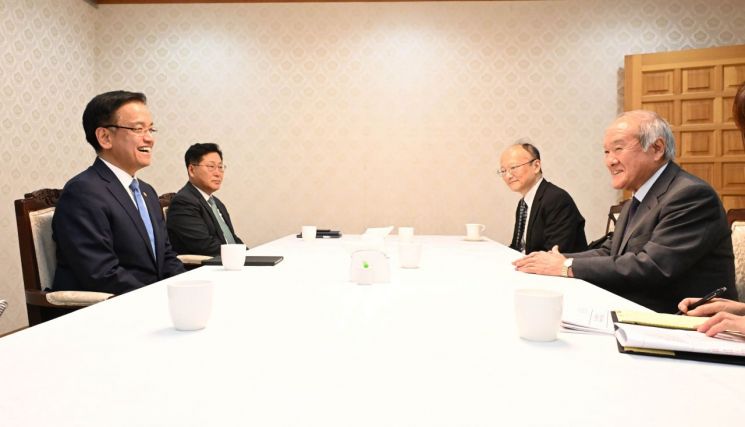 Deputy Prime Minister and Minister of Economy and Finance Choi Sang-mok is having a preliminary meeting with Japanese Minister of Finance Suzuki Shunichi at the '9th Korea-Japan Finance Ministers' Meeting' held at the Government Seoul Office in Jongno-gu, Seoul, on the afternoon of the 25th.
Deputy Prime Minister and Minister of Economy and Finance Choi Sang-mok and Japanese Minister of Finance Suzuki Shunichi reaffirmed their commitment to continue appropriate measures while sharing serious concerns about excessive currency depreciation. They recognized the low birthrate issue as a primary common structural challenge and expressed their intention to share policy efforts to address it.
On the same day, Deputy Prime Minister Choi met Minister Suzuki at the Seoul Government Complex to hold the "9th Korea-Japan Finance Ministers' Meeting" and discussed economic issues between the two countries. The Korea-Japan Finance Ministers' Meeting had been suspended for about seven years since the last meeting between Deputy Prime Minister and Minister of Economy and Finance Yoo Il-ho and Japanese Minister of Finance Aso Taro in 2016, but it has been held for two consecutive years this year and last year.
After the talks, the two deputy prime ministers issued a joint press statement emphasizing, "We will respond to policies with vigilance and agility to maintain economic growth and financial stability."
They first assessed that the global economy is in a moderate recovery phase but agreed that uncertainties in the global economy remain due to ongoing geopolitical conflicts, the possibility of growth slowdown in major trading partners, and increased volatility in foreign exchange markets. The ministers especially shared serious concerns about the depreciation of their currencies and agreed to continue taking appropriate measures.
They also shared recognition of the need to promote investment between the two countries and welcomed Korea's efforts to improve accessibility for foreign investment in government bonds, inclusion in the World Government Bond Index (WGBI), and structural improvements in the foreign exchange market such as opening the market to foreign financial institutions and extending market hours.
Furthermore, they recognized the low birthrate issue as a primary common structural challenge and shared policy efforts to resolve it.
In this regard, Deputy Prime Minister Choi explained the policy direction focused on addressing the direct causes of low birthrate through support in three major areas: work-family balance, childcare, and housing. He also explained that structural reforms aimed at fundamentally solving the low birthrate issue, such as improving the quality of public education and promoting balanced regional development, will continue.
Minister Suzuki introduced Japan's policy package called the "Children's Future Strategy," which strengthens support for child-rearing generations through labor market and labor environment reforms and secures the sustainability of the overall social security system.
The two ministers stated that Korea's "Value-Up" policy to enhance the value of the Korean stock market and Japan's "Asset Management Nation" plan to shift household financial assets to financial investment products will contribute to sustainable economic growth.
The Korea-Japan Finance Ministers' Meeting has been held annually since 2006 but was suspended for seven years due to diplomatic conflicts such as the Dokdo/Takeshima and historical issues. This is the first time in eight years that the meeting is held in Korea since 2016. The next meeting is scheduled to be held in Japan next year.
© The Asia Business Daily(www.asiae.co.kr). All rights reserved.
![Clutching a Stolen Dior Bag, Saying "I Hate Being Poor but Real"... The Grotesque Con of a "Human Knockoff" [Slate]](https://cwcontent.asiae.co.kr/asiaresize/183/2026021902243444107_1771435474.jpg)
















