[2nd Anniversary of Inauguration]... Confidence in "Now It Works" is the Greatest Achievement
Opening "Better Living Opportunities" Such as Complex Shopping Malls and Integrated Care
Evaluated as "Ready to Become a Leading City of Korea"
Gwangju Mayor Kang Gi-jung stated, "The greatest achievement of the past two years of the 8th local government administration is that citizens and public officials have seen the hopeful change that 'now it can be done,'" adding, "We have completed preparations for a new era of Gwangju, a city of opportunities for jobs, enjoyment, and better living, aiming to become a leading city in South Korea by 2030."
At the '2nd Anniversary Press Conference of the 8th Local Government Administration' on the 25th, Mayor Kang emphasized, "Thanks to the efforts of 1.43 million Gwangju citizens and over 5,000 public officials working together, we have achieved many accomplishments over the past two years. In the next two years, we will lead visible and tangible changes in daily life, the growth of the Gwangju-Jeonnam megacity, and a prosperous local economy as one of South Korea's three major economic hubs."
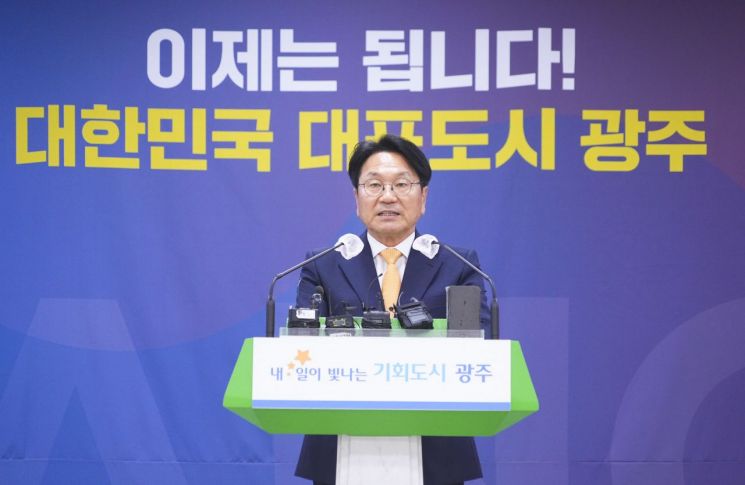
Mayor Kang identified the greatest achievements as completing preparations for a new era of Gwangju by opening 'opportunities for jobs' through future industries, startups, and demonstrations; 'opportunities for enjoyment' through a set of three complex shopping malls; and 'opportunities for better living' through a poster city and integrated care reflecting Gwangju's unique identity.
He explained, "The top priority for Gwangju was to create quality jobs. We believed the answer lies in industry," adding, "We focused on leading new future industries in Gwangju and creating reasons for companies to come to Gwangju."
As a result, the industrial infrastructure was expanded. Essential hardware in the form of 'industrial complexes' and software in the form of 'high value-added industries' were equipped to enable companies to invest in Gwangju and enhance their competitiveness.
After 14 years, the '1 million pyeong Future Car National Industrial Complex' and 'Medical Specialized Complex' were newly established. The Jingok Industrial Complex, Bitgreen Industrial Complex, and Future Car Industrial Complex were upgraded with a '2.2 million pyeong specialized materials, parts, and equipment complex' and the 40-year-old Songam Industrial Complex was transformed into a high value-added industrial base called the 'Future Car Content Industrial Complex.'
The National AI Data Center, which began service in November last year, is providing 846 projects free of charge to companies.
To supplement jobs beyond industry, startups and demonstrations have created reasons for companies to come to Gwangju. The city's demonstration spaces expanded from 36 locations last year to 80 this year, and the 500 billion KRW innovation fund has currently raised 403.4 billion KRW.
Additionally, to prevent the notion that "companies don't come because there is no talent," Gwangju is solidly building its own talent development ladder in collaboration with Samsung, Google, NHN, and others.
Following the AI Academy that has produced 916 talents, this year the GCC (Gwangju Realistic Content Cube) Academy for cultural industry talent development opened, and the Gwangju AI Gifted High School is scheduled to begin construction next year with a goal to open in 2027.
Opportunities for enjoyment and leisure have also been opened. The Hyundai Department Store Gwangju, Shinsegae Gwangju Art & Culture, and Grand Starfield are scheduled to open in 2027, 2028, and 2030 respectively.
The set of three complex shopping malls is expected to provide three opportunities: 'investment, jobs, and coexistence.' Companies will invest over 4 trillion KRW, creating 27,000 direct jobs and 100,000 direct and indirect jobs. To ensure growth alongside local commercial districts, a 'Coexistence Development Council' will be promoted in cooperation with the local community.
Gwangju City is actively promoting the 'Da-Ja-Bo (public transportation, bicycles, pedestrians) city' initiative to realize a '2045 Carbon Neutral City,' five years ahead of the national target.
Mayor Kang stated, "Overcoming climate disasters such as heatwaves, floods, and droughts, the path to a 2045 carbon-neutral city is through a Da-Ja-Bo city," and announced, "The 'G-Pass,' a public transportation discount system tailored to life stages offering free rides for children and half-price fares for youth, will be fully implemented starting next year."
He added, "In line with the redevelopment of the former Jeonbang and Ilsin Textile sites, we aim to reduce the burden on future generations, improve pedestrian accessibility, and expand the transportation system centered around the Gwangcheon area by connecting a 'future transportation system,' transitioning to a Da-Ja-Bo city by 2027."
The global challenges of low birth rates and aging populations are being addressed not through cash support but through meticulous care and work-family balance.
The 'Gwangju-style Integrated Care,' which realizes care democracy, has become the standard for care in South Korea. The '24-hour public late-night children's hospital,' first implemented nationwide in Gwangju, has become an alternative to pediatric open runs. Policies such as the 10 a.m. start time for elementary school parents and simple breakfast services for industrial complex workers have spread nationwide as policies for all working people.
Mayor Kang asserted, "There is no future for South Korea unless the capital-centric system is broken," and called for "bold deregulation, delegation of authority, and revolutionary tax and fiscal support to create local jobs."
He also emphasized, "The recent abolition of the comprehensive real estate tax by the government is accelerating the fiscal crisis of local governments," and stressed, "Fiscal decentralization and energy decentralization must be implemented as practical local autonomy to resolve the local fiscal crisis."
He added, "Next year, marking 30 years of local autonomy, we will cooperate more with the National Assembly and communicate more to realize fiscal decentralization."
In particular, to enhance local competitiveness, he proposed the establishment of the 'Gwangju-Jeonnam Metropolitan Megacity' to enable Gwangju and Jeonnam to join forces and grow as one of South Korea's three major economic axes. The idea is to develop South Korea through the three-axis megacity of Seoul, Gwangju, and Busan.
The metropolitan megacity plan includes ▲the rapid establishment of a civilian-military integrated airport as a gateway airport transporting people and logistics in the southwest region ▲the construction of a metropolitan transportation network connecting Gwangju and Jeonnam, including expressways between Gwangju-Wando, Gwangju-Yeongam, Gwangju-Goheung, electrification of the Gyeongjeon Line, the Gwangju-Naju metropolitan railroad, and the Gwangju-Daegu Moonlight Railroad ▲and the creation of RE100 industrial complexes and specialized distributed energy zones combining data and energy.
© The Asia Business Daily(www.asiae.co.kr). All rights reserved.
![Clutching a Stolen Dior Bag, Saying "I Hate Being Poor but Real"... The Grotesque Con of a "Human Knockoff" [Slate]](https://cwcontent.asiae.co.kr/asiaresize/183/2026021902243444107_1771435474.jpg)















