Simultaneous Increase in Interest and Non-Interest Income
Assets Reach 291.6 Trillion KRW... Up 3.5%
Last year, domestic banks in South Korea recorded nearly 2 trillion won in net income from their overseas branches. This was the result of simultaneous increases in interest income and non-interest income due to rising interest rates and the sale of non-performing loans.
According to the "2023 Domestic Banks' Overseas Branch Management Status and Localization Index Evaluation Results" announced by the Financial Supervisory Service on the 26th, the net income of domestic banks' overseas branches last year was $1.33 billion (approximately 1.85 trillion won), a 34.3% ($340 million) increase compared to the previous year ($991 million). This accounts for 8.1% of the net income earned by domestic banks last year (21.2 trillion won). In 2022, this proportion was 6.8%, rising by 1.3 percentage points in one year.
The increase in overseas branch performance was due to a $186 million rise in interest income from higher interest rates and a $295 million increase in non-interest income from non-recurring factors such as the sale of non-performing loans. The loss from the sale of non-performing loans at Bank Bukopin in Indonesia, acquired by KB Kookmin Bank in 2018, turned from a $100 million deficit in 2022 to a $50 million surplus last year. The return on assets (ROA) of domestic banks' overseas branches last year was 0.63%, up 0.14 percentage points from 0.49% the previous year.
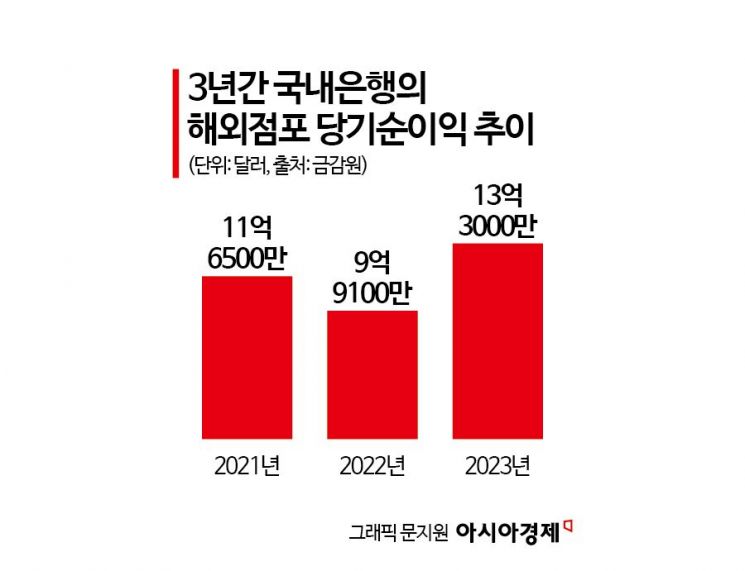
Looking at the performance of overseas branches by country, Vietnam generated the highest income at $330 million. In contrast, Indonesia was the only country to record a loss among overseas branches, with a deficit of $103 million. However, the deficit narrowed by nearly 80%, from $570 million to $103 million. The country with the highest year-on-year performance increase was China, with a remarkable 1329.9% ($1.35 billion) growth. Meanwhile, the United States saw the largest decline, decreasing by 97% ($1.56 billion).
Last year, the asset size of overseas branches was $210.19 billion (291.6 trillion won), a 3.5% ($7.05 billion) increase compared to the end of the previous year ($203.14 billion). This accounts for 7.4% of the total assets of domestic banks (bank accounts) amounting to 3672 trillion won. This proportion rose by 0.2 percentage points compared to 7.2% in 2022. By asset type, foreign exchange purchases (15.5%), securities (13.5%), and loans (5.5%) increased, while cash and deposits (-4.1%) and head office branch accounts (-2.5%) decreased. By country, the largest asset sizes were in the United States ($34.35 billion), China ($29.94 billion), and Hong Kong ($25.85 billion), in that order.
Asset quality deteriorated. The ratio of non-performing loans (NPLs) at domestic banks' overseas branches last year was 1.74%, up 0.23 percentage points from 1.51% the previous year. Cambodia (2.81%) and the United States (1.33%) saw increases, while Indonesia (-1.22%), Japan (-0.43%), and Singapore (-0.23%) experienced decreases.
The number of overseas branches of domestic banks last year was 202 (in 41 countries), down 5 from 207 at the end of the previous year. Two new branches were opened last year, and seven branches were closed. By branch type, there were 88 branches, the most, followed by 60 local corporations and 54 offices.
By country, the largest number of overseas branches was in Vietnam (20), followed by the United States and China (16 each), Myanmar (14), and Hong Kong (11). By region, Asian branches accounted for 137, or 67.8% of all overseas branches. This was followed by the Americas with 29 branches (14.4%), Europe with 27 branches (13.4%), and others with 9 branches (4.5%).
The comprehensive evaluation grade of the localization index for domestic banks' overseas branches last year was 2+, the same as the previous year. This index was introduced in October 2008 to encourage localized management. It evaluates the localization level of overseas branches and the internationalization level of the head office separately, then calculates a comprehensive grade. The "overseas branch localization level" rose by one grade to 10 compared to the previous year. The "head office internationalization level" remained at 20, unchanged from the previous year. By country, the overseas branch localization level was highest at 1+ for branches in Cambodia, followed by Indonesia (10) and Japan (1-).
© The Asia Business Daily(www.asiae.co.kr). All rights reserved.
![Clutching a Stolen Dior Bag, Saying "I Hate Being Poor but Real"... The Grotesque Con of a "Human Knockoff" [Slate]](https://cwcontent.asiae.co.kr/asiaresize/183/2026021902243444107_1771435474.jpg)















